




National Cheng Kung University (NCKU) tracks campus food waste through a systematic approach.
Waste Collection Standards
The University’s Implementation Guidelines for General Waste and Resource Recycling clearly stipulate collection and transport methods for both raw and cooked food waste, serving as a uniform operational standard across campus.
Transparency and Historical Data
For measurement and transparency, the Office of General Affairs maintains a Historical Food Waste Volumes page that discloses long-term changes in recovered quantities, alongside a Historical Waste Volumes page reporting the annual tonnage of general waste sent to the Chengxi Incineration Plant—together forming verifiable trend data.
Workflow and Coordination
The detailed workflow involves sealed compactor trucks conducting circuit collections; sorted recyclables are handled by contracted recyclers, with sales proceeds remitted to the university treasury; collection schedules are coordinated with the city’s pickup times to ensure efficiency.
Reporting and Carbon Reduction Integration
In addition, the Office’s Energy Conservation and Carbon Reduction Survey includes food-waste recycling as a standing reporting item, requiring units to submit data and strengthening the compilation of campus food-waste statistics.
Waste Collection Standards
The University’s Implementation Guidelines for General Waste and Resource Recycling clearly stipulate collection and transport methods for both raw and cooked food waste, serving as a uniform operational standard across campus.
Transparency and Historical Data
For measurement and transparency, the Office of General Affairs maintains a Historical Food Waste Volumes page that discloses long-term changes in recovered quantities, alongside a Historical Waste Volumes page reporting the annual tonnage of general waste sent to the Chengxi Incineration Plant—together forming verifiable trend data.
Workflow and Coordination
The detailed workflow involves sealed compactor trucks conducting circuit collections; sorted recyclables are handled by contracted recyclers, with sales proceeds remitted to the university treasury; collection schedules are coordinated with the city’s pickup times to ensure efficiency.
Reporting and Carbon Reduction Integration
In addition, the Office’s Energy Conservation and Carbon Reduction Survey includes food-waste recycling as a standing reporting item, requiring units to submit data and strengthening the compilation of campus food-waste statistics.
- NCKU Garbage Disposal and Resources Recycling
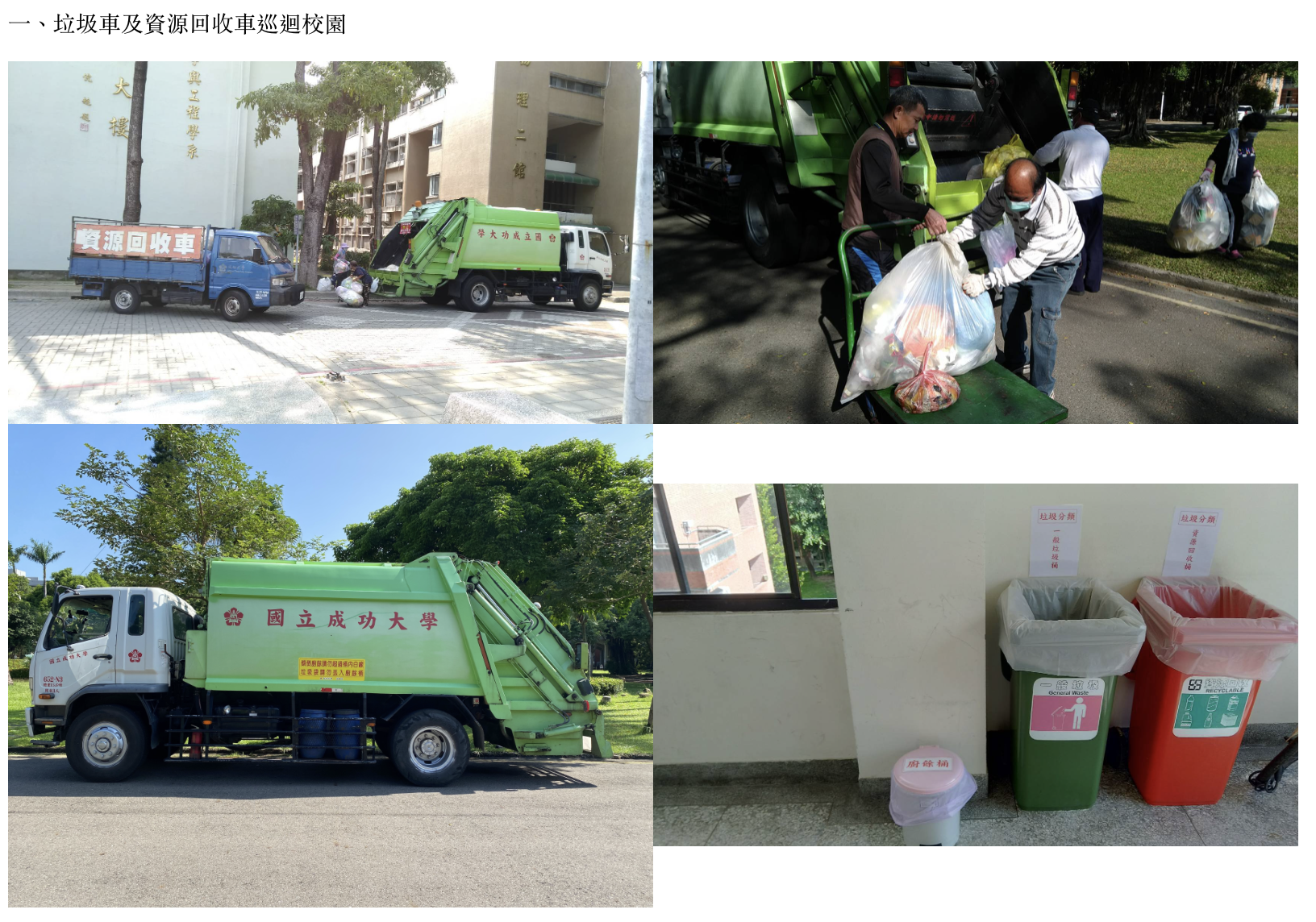
NCKU has dedicated garbage trucks and recycling vehicles on campus to ensure that waste (including food waste) and recyclables are properly sorted and processed. The university implements scheduled collection and on-site sorting to enforce waste reduction and resource recycling policies, thereby avoiding waste from mixed disposal.
- Food Waste Tracking at the University:
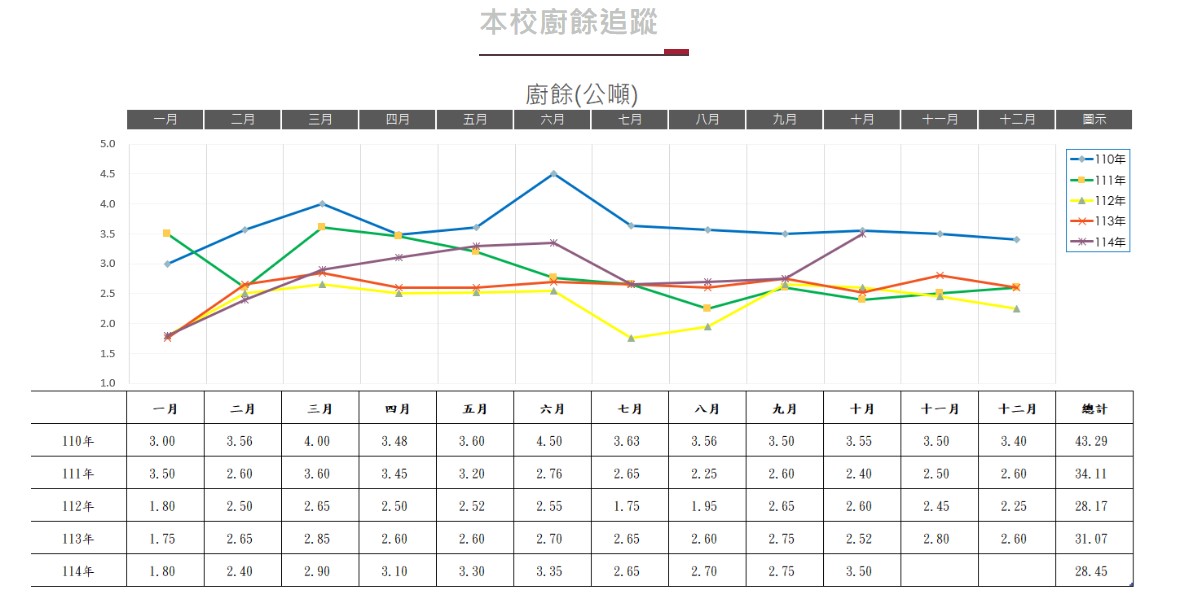 From 2021 to 2025, NCKU has continuously tracked the amount of campus food waste, showing a yearly decline. In 2021 the total was about 43.29 tons, decreasing to 34.11 tons in 2022, 28.17 tons in 2023, 31.07 tons in 2024, and as of now in 2025 it’s only 22.20 tons. This demonstrates that control and reduction measures have become effective. The overall trend shows that the university values resource recycling and sustainability, and is gradually reducing food-service waste.
- NCKU’s Amount of Waste Disposal Over the Years:
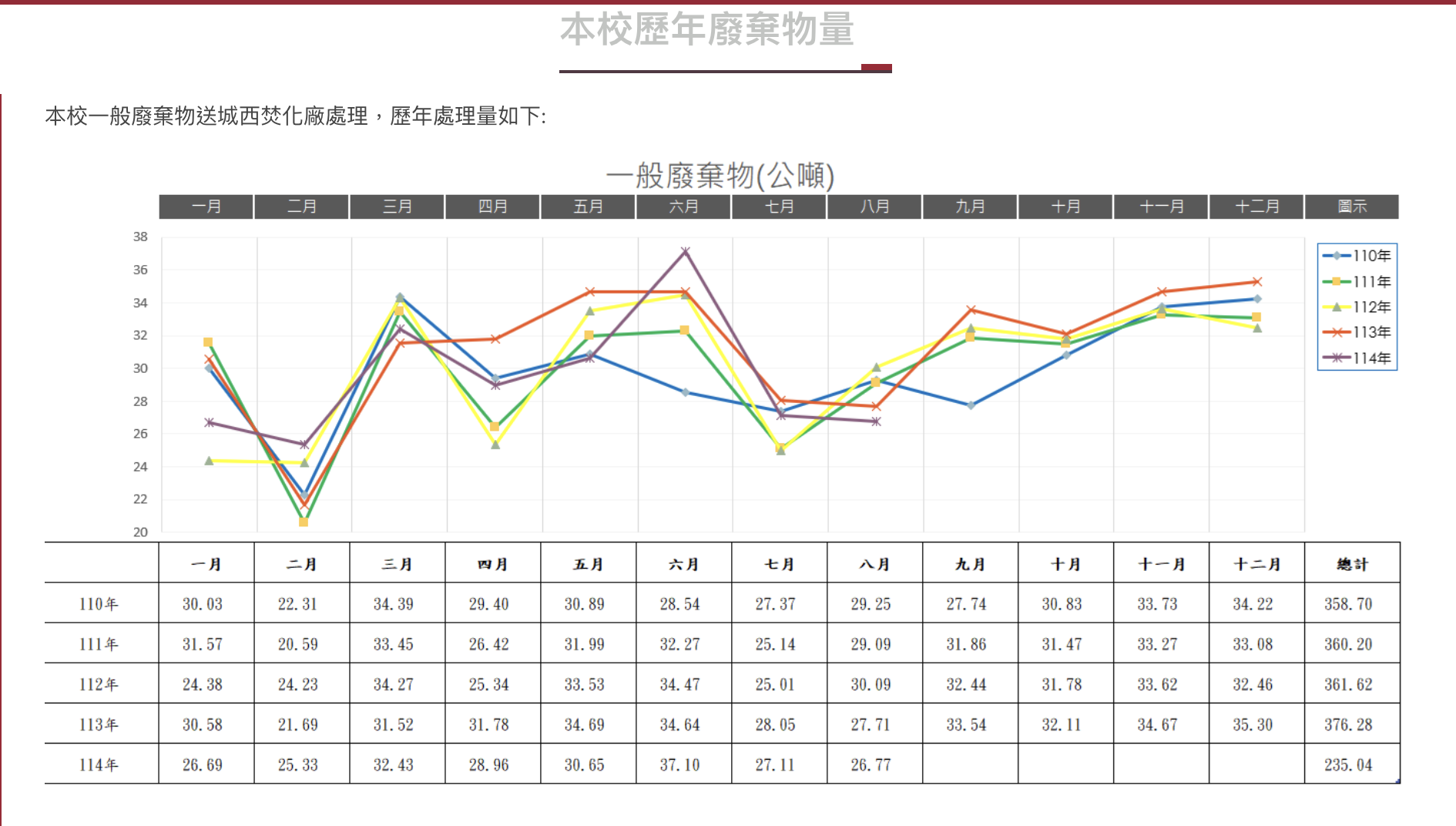
NCKU publishes its monthly general waste disposal amounts from 2021 to 2025 (handled by Chengxi Incineration Plant). The yearly totals hover around 358–376 tons, while the figure for 2025 is currently 235.04 tons. The monthly data show clear fluctuations—higher in March and June, dropping in July due to reduced summer activities. Most importantly, by combining this data with tracked food waste volumes, one can calculate what proportion of the university’s general waste is made up by food waste.
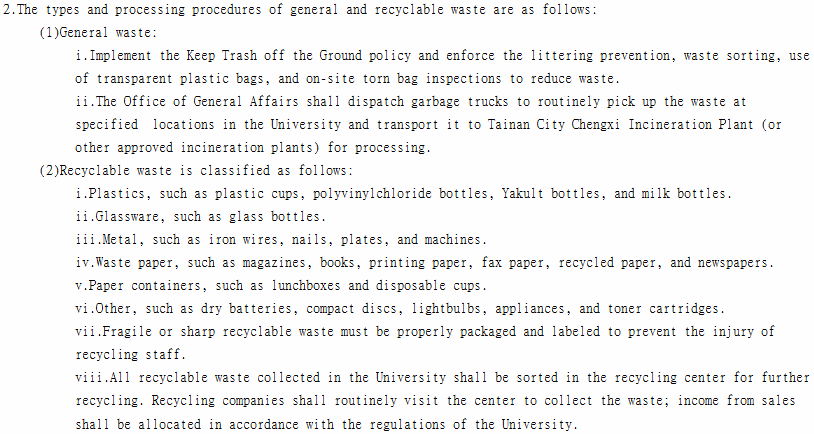
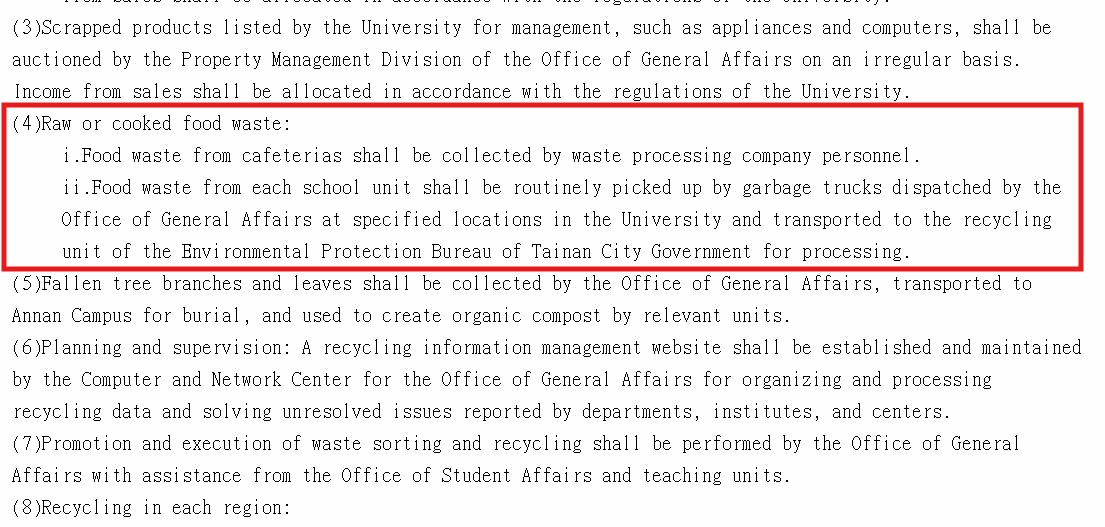
NCKU has clear handling rules for raw and cooked food waste ( Article 4 of the “Guidelines for the Implementation of General Waste and Recyclable Waste Recycling.” ) : food waste from restaurants is collected and transported to campus by staff from the operating contractor; food waste generated by other units is collected on a regular schedule by the General Affairs Office, taken to designated points on campus, and handed over to recycling units of the Tainan Environmental Protection Bureau. This system ensures that food waste is managed and tracked systematically across the whole university, enabling accurate measurement and subsequent resource reuse; it shows the university’s commitment to effective food waste management.
- General Waste Disposal in NCKU :
NCKU has clear handling rules for raw and cooked food waste ( Article 4 of the “Guidelines for the Implementation of General Waste and Recyclable Waste Recycling.” ) : food waste from restaurants is collected and transported to campus by staff from the operating contractor; food waste generated by other units is collected on a regular schedule by the General Affairs Office, taken to designated points on campus, and handed over to recycling units of the Tainan Environmental Protection Bureau. This system ensures that food waste is managed and tracked systematically across the whole university, enabling accurate measurement and subsequent resource reuse; it shows the university’s commitment to effective food waste management.
- Energy Conservation and Carbon Reduction Survey (Including Food Waste Recycling):

NCKU, as part of its energy-saving and carbon reduction survey, includes dedicated sections for “Garbage Recycling” and “Food Waste Recycling.” Both require entries of quantity (with units) and the start and end dates for each statistical period, which facilitates reporting and tracking. This system shows that the university has established a standardized data registration platform that not only covers general waste but also specifically measures food waste. By building up these data records, the university can fully understand how much food waste is produced, enhance the precision of monitoring, and strengthen its sustainability governance.