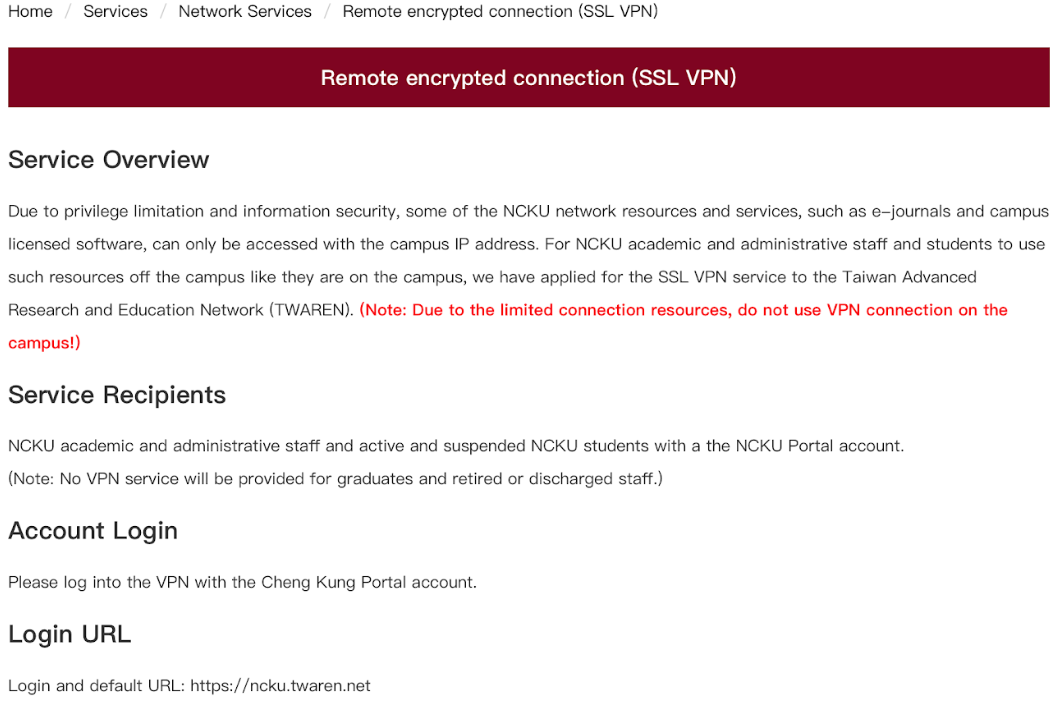




National Cheng Kung University (NCKU) institutionalizes telecommuting and flexible working policies, integrating administrative digitization with robust cybersecurity to systematically reduce daily commuting demands and transport-related emissions. The Personnel Office officially enacted the "NCKU Guidelines for Remote Working," establishing an institutional statutory foundation that authorizes remote work across departments while treating telecommuting personnel as on-duty staff subject to standard hours, daily task monitoring, and data confidentiality standards. To operationalize decentralized working, NCKU operates an administrative "Online Attendance System" that accommodates flexible working hours and digital timekeeping from off-campus locations, eliminating the need for physical on-site sign-ins. This is reinforced by the "SSL VPN Remote Encrypted Connection Service," which enables secure remote access to internal administrative systems and databases. Furthermore, through the "N3learning" digital platform, NCKU transitions employee training into virtual formats. Together, these formal policies and digital infrastructures actively cultivate a telecommuting ecosystem that curtails employee travel and fosters sustainable campus operations.
 NCKU has established guidelines for working from home to balance operational flexibility, administrative efficiency, and information security. Staff working remotely are treated as working on campus, adhering to standard working hours and using remote desktop connections or the campus VPN for online clock-in and clock-out. To ensure prompt communication and track progress, employees must maintain open communication channels, set daily work objectives with supervisors, and submit daily work logs for approval. In terms of cybersecurity, the guidelines require data encryption for transmissions, regular system and software updates, and strictly prohibit handling confidential official documents—establishing a secure and resilient remote working environment through structured management protocols.
https://pers.ncku.edu.tw/var/file/29/1029/img/4051/457270490.pdf
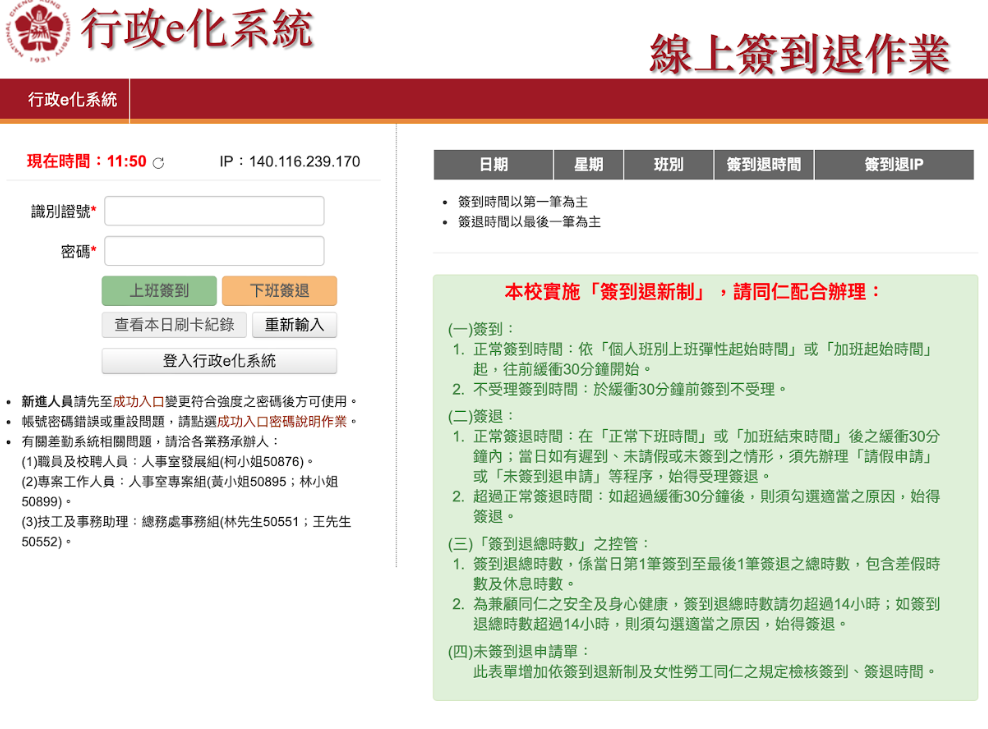 NCKU operates an administrative "Online Attendance System" to provide a flexible and location-independent attendance management framework for faculty and administrative staff. The platform supports flexible working hour policies, enabling personnel to log clock-in and clock-out timestamps securely online without reliance on paper timesheets or centralized physical card readers. By streamlining time tracking across diverse locations, the system provides vital administrative infrastructure that facilitates remote work, flexible hours, and reduced commuting demands.
https://eadm.ncku.edu.tw/welldoc/ncku/iftwd/signIn.php
- Campus Announcement Practices Explicitly Listing “Remote Work” as an Acceptable Work Location Option
NCKU has established guidelines for working from home to balance operational flexibility, administrative efficiency, and information security. Staff working remotely are treated as working on campus, adhering to standard working hours and using remote desktop connections or the campus VPN for online clock-in and clock-out. To ensure prompt communication and track progress, employees must maintain open communication channels, set daily work objectives with supervisors, and submit daily work logs for approval. In terms of cybersecurity, the guidelines require data encryption for transmissions, regular system and software updates, and strictly prohibit handling confidential official documents—establishing a secure and resilient remote working environment through structured management protocols.https://pers.ncku.edu.tw/var/file/29/1029/img/4051/457270490.pdf
- NCKU Administrative e-System: Online Attendance System for Flexible and Remote Working
NCKU operates an administrative "Online Attendance System" to provide a flexible and location-independent attendance management framework for faculty and administrative staff. The platform supports flexible working hour policies, enabling personnel to log clock-in and clock-out timestamps securely online without reliance on paper timesheets or centralized physical card readers. By streamlining time tracking across diverse locations, the system provides vital administrative infrastructure that facilitates remote work, flexible hours, and reduced commuting demands.https://eadm.ncku.edu.tw/welldoc/ncku/iftwd/signIn.php