



From 2016 to 2025, the proportion of female students at NCKU increased steadily from 35.9% to 37.6%. Among undergraduate students, the proportion of female students rose from 36.6% to 39.2%. The five academic departments with the highest numbers of female students pursuing bachelor’s degrees were, in order, the Department of Foreign Languages and Literature, Department of Medicine, Department of Law, Department of Architecture, and Department of Psychology. These departments span a diverse range of disciplines, demonstrating women’s broad participation in higher education across different professional fields and highlighting diverse opportunities for learning and development.
- NCKU Statistics on Male and Female Student Enrollment Rates
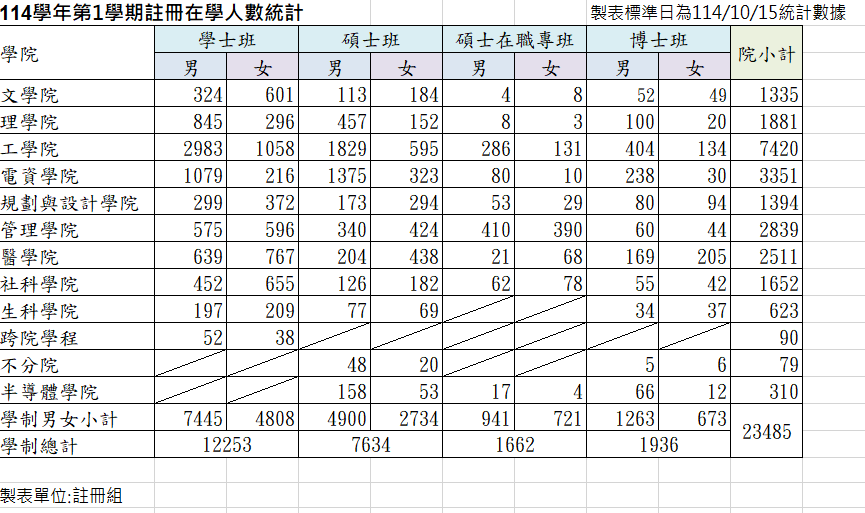 NCKU has established a gender-based student enrollment monitoring mechanism, regularly collecting and analyzing the enrollment of male and female students to track changes in women’s participation in higher education. These long-term gender-disaggregated statistics provide a quantitative basis for monitoring women’s educational participation and assessing access to education.
https://reg-acad.ncku.edu.tw/p/412-1041-18707.php?Lang=zh-tw
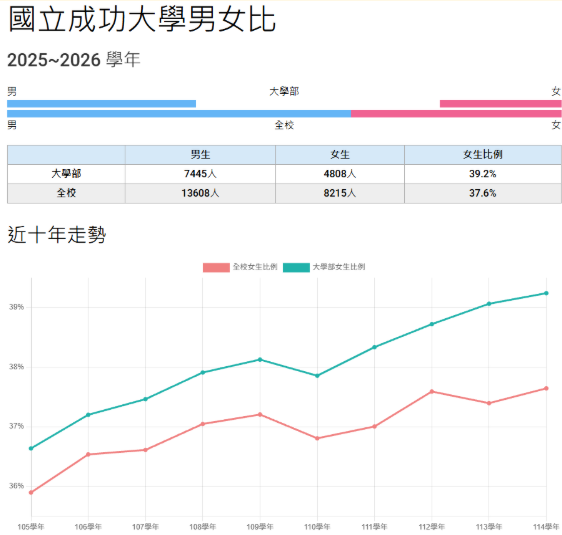 From 2016 to 2025, NCKU continued to increase women’s participation in higher education. The proportion of female students university-wide increased from 35.9% to 37.6%, while the proportion of female undergraduate students rose from 36.6% to 39.2%. Among bachelor’s degree programs, the five departments with the largest numbers of female students were, in order, the Department of Foreign Languages and Literature, Department of Medicine, Department of Law, Department of Architecture, and Department of Psychology. These fields span the humanities, medicine, law, design, and social sciences, demonstrating women’s broad participation in higher education across diverse professional fields and reflecting diverse opportunities for learning and development. NCKU continues to foster a campus environment that supports women’s participation in higher education and diverse professional development.