



SDG17
NCKU and the NCSIST Sign a Memorandum of Understanding to Jointly Advance Defense Technology R&D and Talent Cultivation
To promote academic research exchange and the innovative development of cutting-edge defense technologies, National Cheng Kung University (NCKU) and the National Chung-Shan Institute of Science and Technology (NCSIST) signed a Memorandum of Understanding (MOU) on December 12. Through collaboration in research and education, both parties aim to deepen cooperation in defense-related technologies and talent cultivation. The scope of cooperation covers several key defense technology domains, including artificial intelligence, cybersecurity, aeronautical and aerospace engineering, systems and marine electromechanics, and industrial engineering and management.
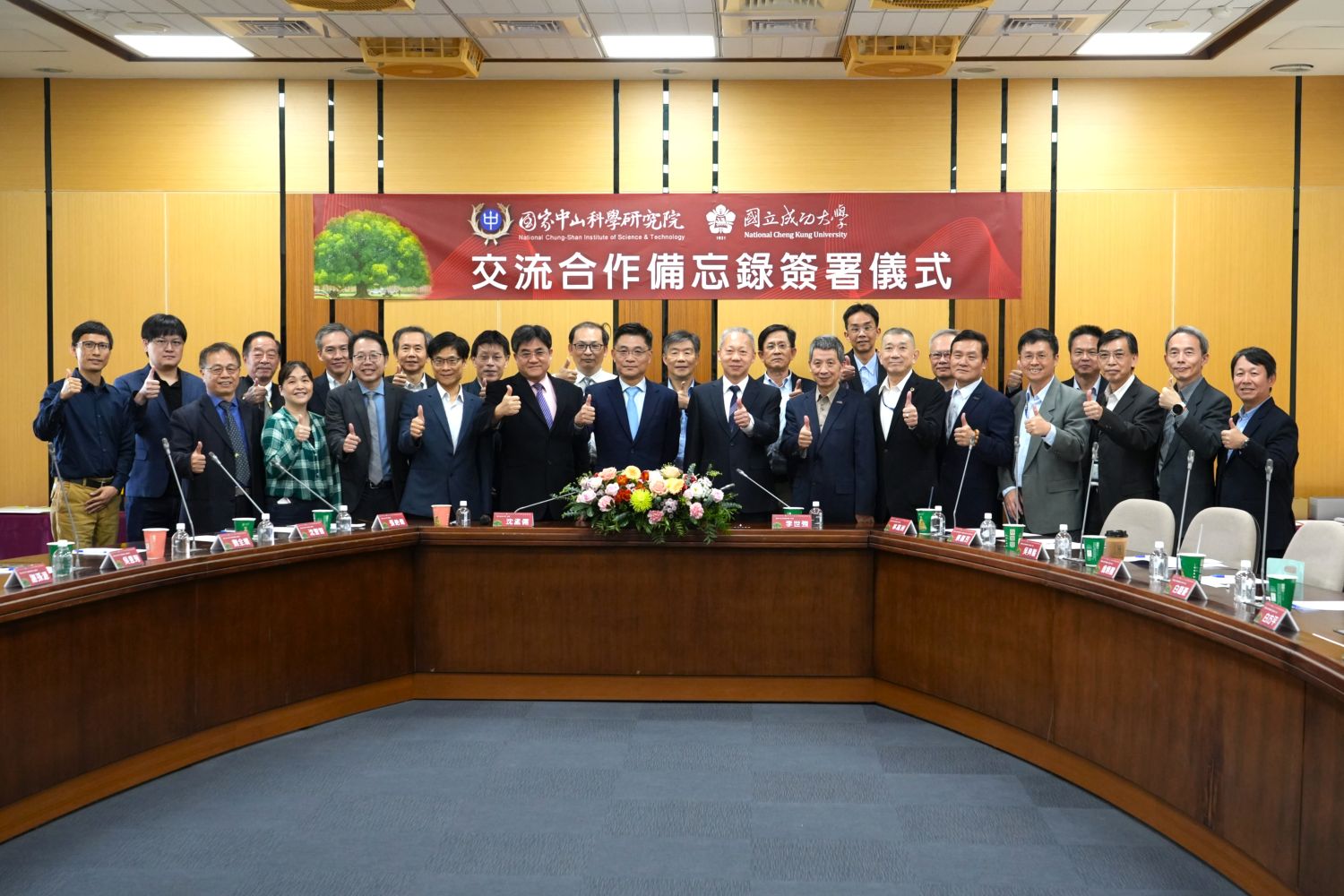
The signing ceremony was held at 1:00 p.m. in the conference room on the fourth floor of Yun-Ping Administration Building, Kuang-Fu Campus. The MOU was signed by NCKU President Meng-Ru Shen (沈孟儒) and NCSIST President Shih-Chiang Lee (李世強) on behalf of their respective institutions. Attending the ceremony were NCKU Vice President Shih-Wei Chang (張始偉), Dean of Academic Affairs Sheng-Chih Shen (沈聖智), Dean of Research & Development Department Chuan-Pu Liu (劉全璞), Vice President for International Affairs Sun-Yuan Hsieh (謝孫源), faculty representatives from relevant colleges, as well as NCSIST Vice President Kao-Chou Lin (林高洲), Deputy Executive Director of the Strategy Council Chia-Fang Tsai (蔡嘉芳), Director Dian-Fu Wu (吳典黻) of the Missile Systems Institute, Director Ping-Kuo Weng (翁炳國) of the Materials and Electro-Optics Research Division, and Director Kai-Hao Pai (白鎧豪) of the Electronics Systems Research Division, among others. Nearly 30 representatives were present to witness the signing.
In his remarks, President Shen warmly welcomed President Lee and the NCSIST delegation. He briefly introduced NCKU as it approaches its 95th anniversary and recalled the founding vision of its first president, which emphasized social engagement and the cultivation of students with calm judgment, open minds, and practical skills. Over the past 94 years, NCKU has made significant contributions to society and the nation, playing a key role across many fields. NCKU and NCSIST have long maintained close interactions and have already launched collaborative projects in areas such as AI algorithms, high-power batteries, and underwater technologies. NCKU has consistently emphasized that academic research should serve society, drive innovation, and enhance public safety, thereby generating tangible national benefits. President Shen noted that collaboration with NCSIST is not only vital to national interests but also beneficial to student development by providing broader learning pathways and career directions. He expressed hope that both sides would continue to build upon existing foundations and further deepen cooperation.
President Lee stated that his son is also an alumnus of NCKU, giving him a strong familiarity with the university, and expressed his pleasure at establishing this partnership. He noted that collaboration between NCSIST and NCKU has already begun, with concrete outcomes targeted within two years. He expressed confidence that the initial joint project with NCKU could potentially influence and reshape Taiwan’s overall operational strategies, particularly in the strategic context of the Taiwan Strait, and could represent an important opportunity for asymmetric approaches to addressing challenges posed by China. President Lee emphasized that this project marks only the beginning and that future efforts will proceed step by step. Beyond strengthening national security, the collaboration aims to forge closer links between defense practice and academic research, ensuring that research outcomes directly address national needs. He expressed optimism that the partnership would yield substantial results.
Under the MOU, both parties will integrate talent, facilities, technologies, and academic resources on the principles of equality and mutual benefit. Cooperation will encompass scientific research, talent cultivation, research project implementation, and the promotion of industry–academia collaboration. Exchanges will also include teaching, internships, and joint research, as well as the co-organization or rotation of achievement presentations and academic conferences to facilitate the sharing of technological capabilities and knowledge.
The MOU is established with an initial term of five years. Upon expiration, it may be extended in writing by mutual agreement. If collaborative projects are still ongoing at the end of the term, they will continue in accordance with the original contractual conditions to ensure uninterrupted cooperation.
Through this MOU, NCKU and NCSIST aim to lay a solid foundation for long-term collaboration, jointly advancing the autonomous development of national defense technologies, enhancing the overall momentum of industry–academia–research integration, and cultivating more interdisciplinary technological talent, thereby contributing to the nation’s scientific advancement and security.
The signing ceremony was held at 1:00 p.m. in the conference room on the fourth floor of Yun-Ping Administration Building, Kuang-Fu Campus. The MOU was signed by NCKU President Meng-Ru Shen (沈孟儒) and NCSIST President Shih-Chiang Lee (李世強) on behalf of their respective institutions. Attending the ceremony were NCKU Vice President Shih-Wei Chang (張始偉), Dean of Academic Affairs Sheng-Chih Shen (沈聖智), Dean of Research & Development Department Chuan-Pu Liu (劉全璞), Vice President for International Affairs Sun-Yuan Hsieh (謝孫源), faculty representatives from relevant colleges, as well as NCSIST Vice President Kao-Chou Lin (林高洲), Deputy Executive Director of the Strategy Council Chia-Fang Tsai (蔡嘉芳), Director Dian-Fu Wu (吳典黻) of the Missile Systems Institute, Director Ping-Kuo Weng (翁炳國) of the Materials and Electro-Optics Research Division, and Director Kai-Hao Pai (白鎧豪) of the Electronics Systems Research Division, among others. Nearly 30 representatives were present to witness the signing.
In his remarks, President Shen warmly welcomed President Lee and the NCSIST delegation. He briefly introduced NCKU as it approaches its 95th anniversary and recalled the founding vision of its first president, which emphasized social engagement and the cultivation of students with calm judgment, open minds, and practical skills. Over the past 94 years, NCKU has made significant contributions to society and the nation, playing a key role across many fields. NCKU and NCSIST have long maintained close interactions and have already launched collaborative projects in areas such as AI algorithms, high-power batteries, and underwater technologies. NCKU has consistently emphasized that academic research should serve society, drive innovation, and enhance public safety, thereby generating tangible national benefits. President Shen noted that collaboration with NCSIST is not only vital to national interests but also beneficial to student development by providing broader learning pathways and career directions. He expressed hope that both sides would continue to build upon existing foundations and further deepen cooperation.
President Lee stated that his son is also an alumnus of NCKU, giving him a strong familiarity with the university, and expressed his pleasure at establishing this partnership. He noted that collaboration between NCSIST and NCKU has already begun, with concrete outcomes targeted within two years. He expressed confidence that the initial joint project with NCKU could potentially influence and reshape Taiwan’s overall operational strategies, particularly in the strategic context of the Taiwan Strait, and could represent an important opportunity for asymmetric approaches to addressing challenges posed by China. President Lee emphasized that this project marks only the beginning and that future efforts will proceed step by step. Beyond strengthening national security, the collaboration aims to forge closer links between defense practice and academic research, ensuring that research outcomes directly address national needs. He expressed optimism that the partnership would yield substantial results.
Under the MOU, both parties will integrate talent, facilities, technologies, and academic resources on the principles of equality and mutual benefit. Cooperation will encompass scientific research, talent cultivation, research project implementation, and the promotion of industry–academia collaboration. Exchanges will also include teaching, internships, and joint research, as well as the co-organization or rotation of achievement presentations and academic conferences to facilitate the sharing of technological capabilities and knowledge.
The MOU is established with an initial term of five years. Upon expiration, it may be extended in writing by mutual agreement. If collaborative projects are still ongoing at the end of the term, they will continue in accordance with the original contractual conditions to ensure uninterrupted cooperation.
Through this MOU, NCKU and NCSIST aim to lay a solid foundation for long-term collaboration, jointly advancing the autonomous development of national defense technologies, enhancing the overall momentum of industry–academia–research integration, and cultivating more interdisciplinary technological talent, thereby contributing to the nation’s scientific advancement and security.
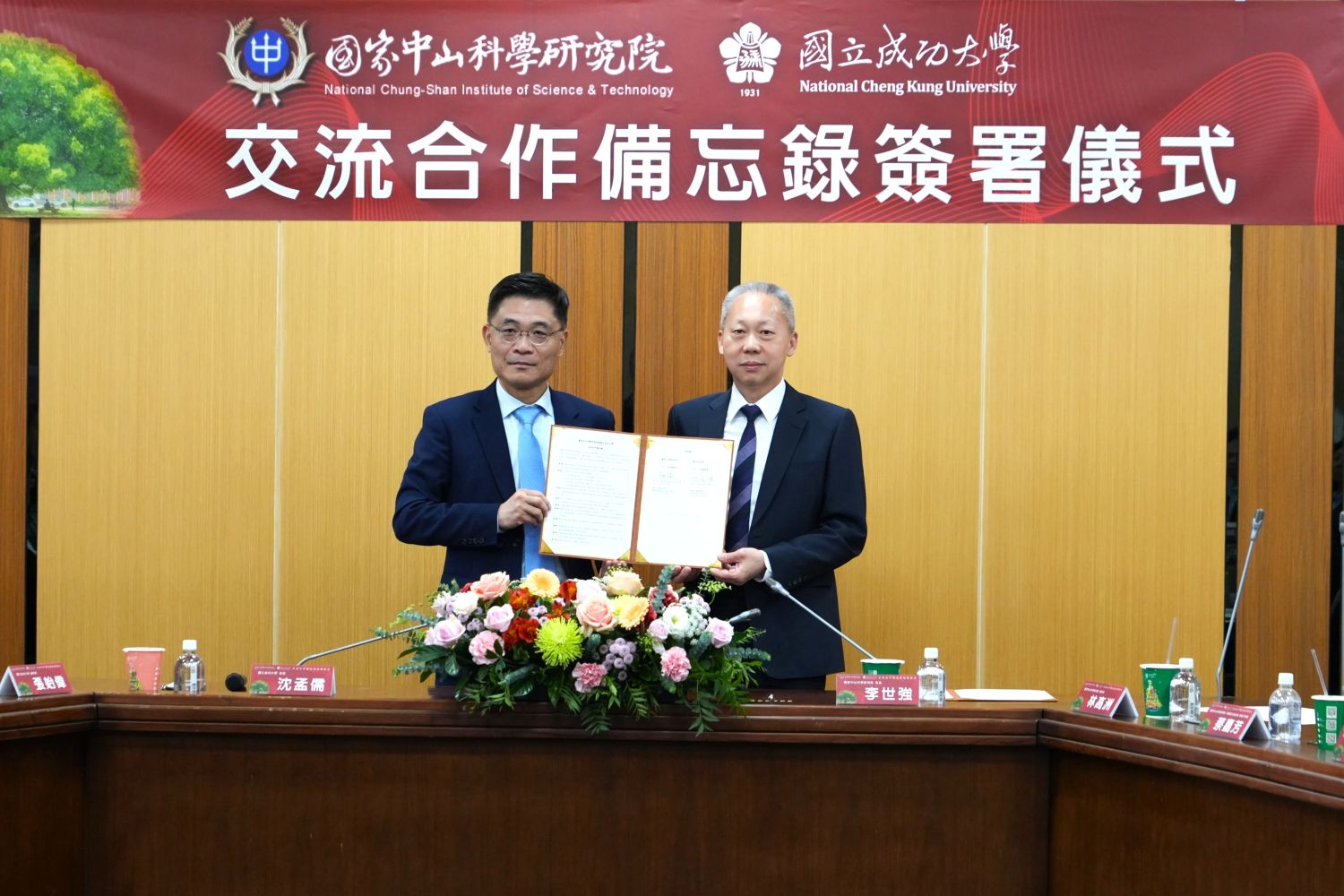
President Meng-Ru Shen (left) and President Shih-Chiang Lee of NCSIST (right) sign the agreement on behalf of their respective institutions.
Group Photo of the Distinguished Guests in Attendance
SDG17NCKU “Leadership and Action” Course Partners with Three High Schools to Showcase Self-Directed Learning Achievements
View more
SDG17Haitian Ambassador Roudy Stanley Penn Visits NCKU to Empower Students and Deepen Academic Collaboration
View more