



SDG11
Stakeholders Gather at NCKU to Rethink Landslide-Dammed Lake Risk Management: From Monitoring and Early Warning to Recovery


The breach of the Mataian landslide-dammed lake during Typhoon Ragasa in late September 2025 has drawn significant public attention. In response, the Disaster Prevention Education Center of National Cheng Kung University (NCKU) hosted a symposium titled “From Monitoring to Governance: Rethinking Research and Disaster Risk Management Systems for the Mataian Landslide-Dammed Lake” on December 17. The event was co-organized by the Disaster Research Center of NCKU, the Department of Hydraulic and Ocean Engineering, and the Taiwan Water Industry Association, with support from the College of Engineering, the College of Planning and Design, and the College of Social Sciences.
The symposium brought together experts from diverse fields—including engineering, geology, hydrology, meteorology, urban and rural planning, psychology, and social sciences—to jointly examine the current status and future directions of landslide-dammed lake risk governance in Taiwan. Participants emphasized the importance of translating scientific research into policy and action, as well as the central role of local participation and disaster prevention education.
The event opened with welcoming remarks by Vice President Chun-Chang Lee (李俊璋), Dean Chien-Teng Chan (詹錢登) of the College of Engineering, Dean Hsueh-Sheng Chang (張學聖) of the College of Planning and Design, and Dean Chun-Li Tsai (蔡群立) of the College of Social Sciences, all of whom highlighted the highly interdisciplinary significance of the symposium’s theme. This was followed by an introductory address by Professor Hsiao-Wen Wang (王筱雯) of the Department of Hydraulic and Ocean Engineering, who also serves as Director of the Disaster Research Center and the Disaster Prevention Education Center.
Professor Wang pointed out the engineering and scientific challenges currently faced in landslide-dammed lake governance. She emphasized that disaster governance is no longer merely an engineering or scientific issue, but a core challenge of territorial governance, institutional design, and social resilience. Drawing on historical experience, she noted that landslide-dammed lakes often form rapidly, have short life cycles, and are characterized by high uncertainty. The key to governance lies not in achieving precise predictions, but in reducing information gaps and gaining time for decision-making and emergency response.
Technical and scientific discussions during the symposium covered topics such as monitoring technologies, sediment analysis, geological and geomorphological changes, signal sensing, dam-break modeling, and downstream risk assessment. Participants widely agreed that technological applications must be integrated with institutional frameworks and social participation in order to support phased and adaptive disaster response decisions under conditions of high uncertainty. Representatives from academia, government agencies, and engineering practice also shared cross-event experiences and highlighted institutional and regulatory challenges. They further noted that under extreme climate conditions, existing regulations and divisions of authority still leave room for improvement.
The symposium also incorporated perspectives from local communities. Chin-Huang Chen (陳錦煌), founding chairperson of the Xingang Cultural & Educational Foundation, drew on experiences from post-disaster reconstruction following the 921 Earthquake, arguing that prevention and mitigation should begin with post-disaster recovery. He emphasized that the traditional wisdom embedded in community life must be sustained and meaningfully implemented under extreme climate conditions.
A local resident representative from Guangfu, Hualien, Lisin Haluwey (理新.哈魯蔚), shared insights from Indigenous cultural traditions and personal disaster experiences. He reflected on gaps in information dissemination and risk communication, emphasizing that disaster prevention and reconstruction should focus more on people’s perceptions, safety judgments, and long-term life choices. He also called for scientific findings and institutional designs to be understandable, trustworthy, and participatory at the local level.
This symposium gathered diverse experts from government, academia, and engineering practice, including senior technical and managerial professionals from organizations such as Sinotech Engineering Consultants, the Forestry and Nature Conservation Agency of the Ministry of Agriculture, the Rural Development and Soil and Water Conservation Agency of the Ministry of Agriculture, the Water Resources Agency of the Ministry of Economic Affairs, and the National Science and Technology Center for Disaster Reduction. Scholars from fields such as soil and water conservation, civil engineering, hydraulics, geography, architecture, and urban and rural planning engaged in cross-disciplinary dialogue on monitoring, early warning, and decision support for landslide-dammed lakes. They emphasized the importance of inter-ministerial collaboration and data sharing to ensure that information can be translated into timely decisions. Without integration into institutional design and local community understanding and action, the effectiveness of governance will remain limited.
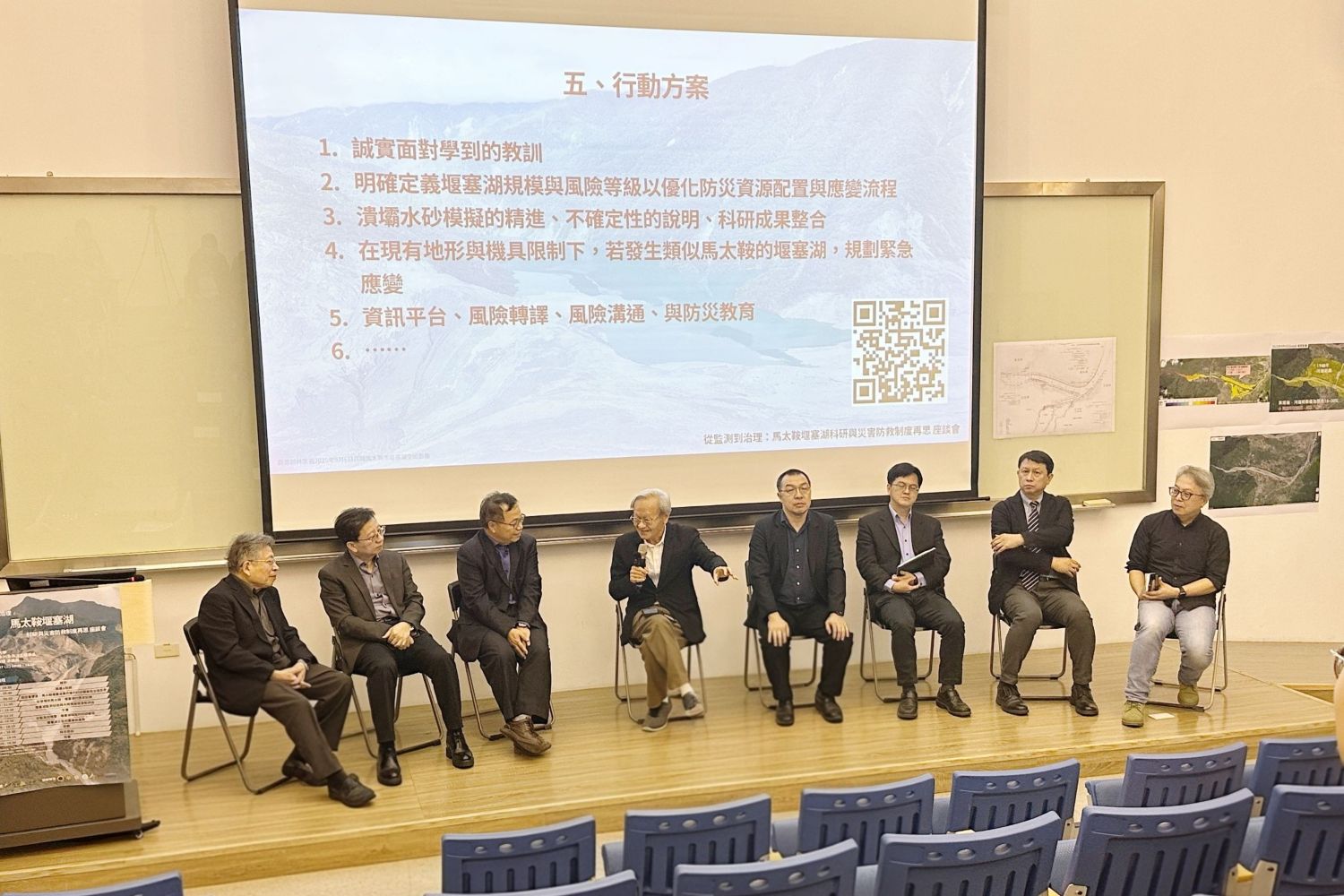
In closing, Professor Wang synthesized the day’s discussions and proposed six key institutional reflections. Based on the framework of “knowns and unknowns,” she outlined a set of actionable, systems-based policy recommendations spanning from “monitoring → scientific research → institutions → social governance → capacity building.” These included the need for post-disaster governance to follow medium- and long-term pathways, driven by integrated watershed management and long-term land-use strategies, with careful assessment of potential risk transfers to avoid creating new hazards through isolated engineering interventions.
She further emphasized that local knowledge and Indigenous experiences should be formally incorporated into risk governance frameworks through institutionalized participation and feedback mechanisms. This would reduce the long-term burden of uncertainty borne by communities and enhance the practical effectiveness of early warning systems and emergency responses.
The symposium brought together experts from diverse fields—including engineering, geology, hydrology, meteorology, urban and rural planning, psychology, and social sciences—to jointly examine the current status and future directions of landslide-dammed lake risk governance in Taiwan. Participants emphasized the importance of translating scientific research into policy and action, as well as the central role of local participation and disaster prevention education.
The event opened with welcoming remarks by Vice President Chun-Chang Lee (李俊璋), Dean Chien-Teng Chan (詹錢登) of the College of Engineering, Dean Hsueh-Sheng Chang (張學聖) of the College of Planning and Design, and Dean Chun-Li Tsai (蔡群立) of the College of Social Sciences, all of whom highlighted the highly interdisciplinary significance of the symposium’s theme. This was followed by an introductory address by Professor Hsiao-Wen Wang (王筱雯) of the Department of Hydraulic and Ocean Engineering, who also serves as Director of the Disaster Research Center and the Disaster Prevention Education Center.
Professor Wang pointed out the engineering and scientific challenges currently faced in landslide-dammed lake governance. She emphasized that disaster governance is no longer merely an engineering or scientific issue, but a core challenge of territorial governance, institutional design, and social resilience. Drawing on historical experience, she noted that landslide-dammed lakes often form rapidly, have short life cycles, and are characterized by high uncertainty. The key to governance lies not in achieving precise predictions, but in reducing information gaps and gaining time for decision-making and emergency response.
Technical and scientific discussions during the symposium covered topics such as monitoring technologies, sediment analysis, geological and geomorphological changes, signal sensing, dam-break modeling, and downstream risk assessment. Participants widely agreed that technological applications must be integrated with institutional frameworks and social participation in order to support phased and adaptive disaster response decisions under conditions of high uncertainty. Representatives from academia, government agencies, and engineering practice also shared cross-event experiences and highlighted institutional and regulatory challenges. They further noted that under extreme climate conditions, existing regulations and divisions of authority still leave room for improvement.
The symposium also incorporated perspectives from local communities. Chin-Huang Chen (陳錦煌), founding chairperson of the Xingang Cultural & Educational Foundation, drew on experiences from post-disaster reconstruction following the 921 Earthquake, arguing that prevention and mitigation should begin with post-disaster recovery. He emphasized that the traditional wisdom embedded in community life must be sustained and meaningfully implemented under extreme climate conditions.
A local resident representative from Guangfu, Hualien, Lisin Haluwey (理新.哈魯蔚), shared insights from Indigenous cultural traditions and personal disaster experiences. He reflected on gaps in information dissemination and risk communication, emphasizing that disaster prevention and reconstruction should focus more on people’s perceptions, safety judgments, and long-term life choices. He also called for scientific findings and institutional designs to be understandable, trustworthy, and participatory at the local level.
This symposium gathered diverse experts from government, academia, and engineering practice, including senior technical and managerial professionals from organizations such as Sinotech Engineering Consultants, the Forestry and Nature Conservation Agency of the Ministry of Agriculture, the Rural Development and Soil and Water Conservation Agency of the Ministry of Agriculture, the Water Resources Agency of the Ministry of Economic Affairs, and the National Science and Technology Center for Disaster Reduction. Scholars from fields such as soil and water conservation, civil engineering, hydraulics, geography, architecture, and urban and rural planning engaged in cross-disciplinary dialogue on monitoring, early warning, and decision support for landslide-dammed lakes. They emphasized the importance of inter-ministerial collaboration and data sharing to ensure that information can be translated into timely decisions. Without integration into institutional design and local community understanding and action, the effectiveness of governance will remain limited.
In closing, Professor Wang synthesized the day’s discussions and proposed six key institutional reflections. Based on the framework of “knowns and unknowns,” she outlined a set of actionable, systems-based policy recommendations spanning from “monitoring → scientific research → institutions → social governance → capacity building.” These included the need for post-disaster governance to follow medium- and long-term pathways, driven by integrated watershed management and long-term land-use strategies, with careful assessment of potential risk transfers to avoid creating new hazards through isolated engineering interventions.
She further emphasized that local knowledge and Indigenous experiences should be formally incorporated into risk governance frameworks through institutionalized participation and feedback mechanisms. This would reduce the long-term burden of uncertainty borne by communities and enhance the practical effectiveness of early warning systems and emergency responses.
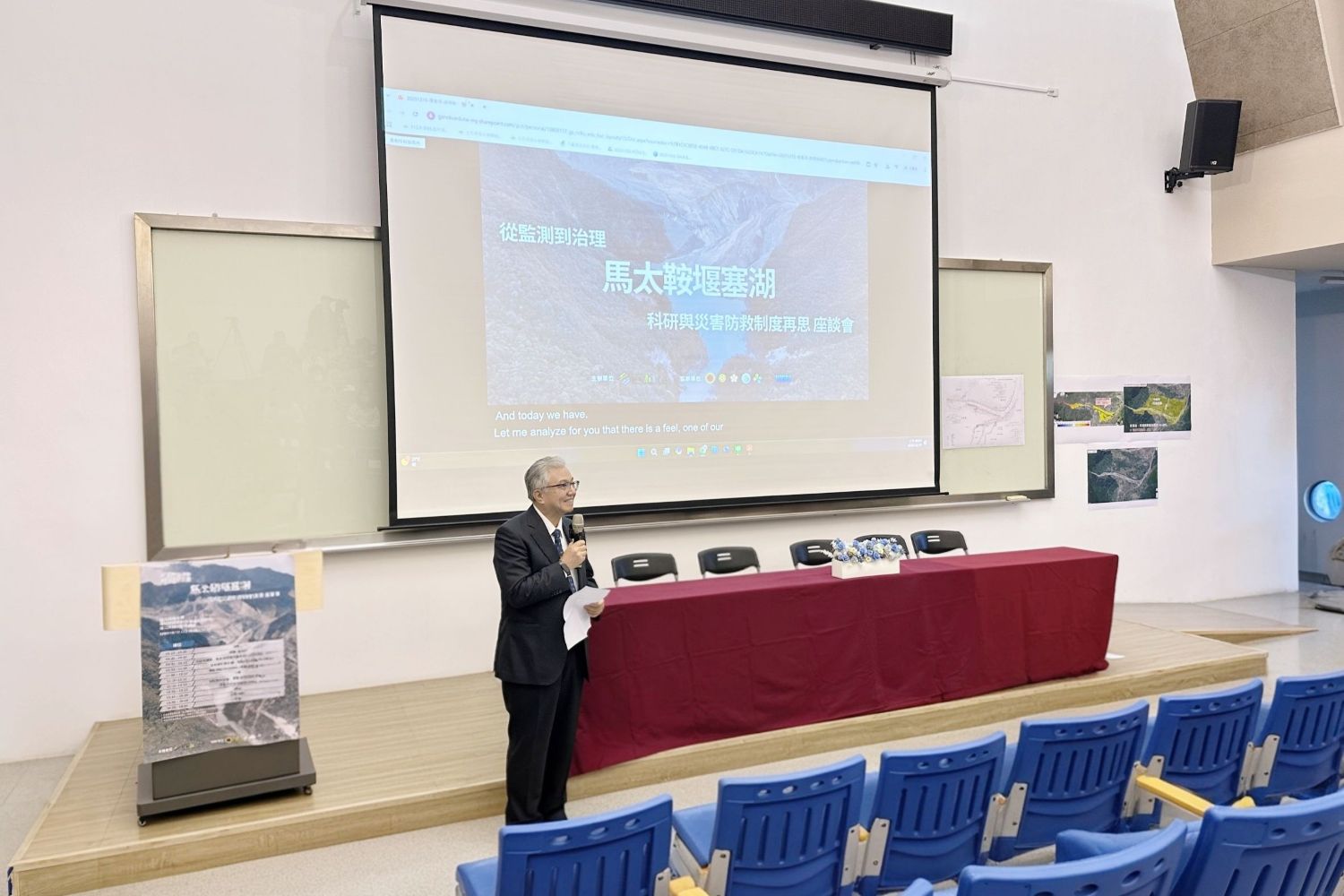
In his remarks, Vice President Chun-Chang Lee highlighted the highly interdisciplinary significance of the symposium’s theme.
Government, Industry, Academia, Research Institutions, and Communities Convene at NCKU to Redefine Pathways for Landslide-Dammed Lake Risk Management—from Monitoring and Early Warning to Reconstruction

Director Hsiao-Wen Wang synthesized the day-long discussions and proposed six key institutional reflections.
SDG11NCKU and the Tainan Art Museum Co-host a Symposium on Painter Pei-Yao Zeng and Sign a Memorandum for Collaboration
View more
SDG11NCKU and Pingtung County Government collaborate on the "Great Earth Project" to support dementia-friendly communities
View more![[USR Feature Report] The Power that Drives Learning: Badlands 3.0 Aims to Become a Resilience Cultivation Practice Base](/userfiles/images/20250620083304584.jpg)