




SDG9
NCKU Architecture and HIWIN Collaborate to Create the Most Artistic Entrance Installation at COMPUTEX 2026



The 2026 COMPUTEX TAIPEI was held from June 2 to 5 under the annual theme “AI Together.” For the first time, the exhibition expanded across Taipei Nangang Exhibition Center, Taipei World Trade Center, and Taipei Music Center, bringing together approximately 1,500 leading technology companies from 33 countries. The event focused on physical AI, AI PCs, high-performance computing, and the newly established AI Robotics Zone.
For this year’s COMPUTEX, the Department of Architecture at National Cheng Kung University (NCKU) collaborated with HIWIN Technologies to present the theme “Let Art and Culture Give Taiwan’s Technology Invisible Wings.” Through a robotic arm dance performance, the project transformed the exhibition into a fusion of technology and art. Displayed at the entrance of Taipei World Trade Center Hall 1, the installation became one of the most eye-catching artistic highlights of the entire exhibition.
Professor Yang-Ting Shen, director of NCKU Architecture’s SyncLab, has collaborated with HIWIN Technologies for years in the fields of human–machine collaboration and technological art. One of their most representative projects was Trace, a human–robot collaborative dance featured in the 2024 technological art exhibition “Diffusion Coupling: The Diffusion, Parallelism, and Integration of Technology and Art,” jointly organized by the Kaohsiung Museum of Fine Arts and the National Science and Technology Council. The project later received the 2025 Future Technology Award from the National Science and Technology Council.
The Robotic Arm Dance presented at COMPUTEX 2026 marks the first international debut of the collaboration between NCKU and HIWIN. During the creative process, Anarchy Dance Theatre, Duck Art Studio, and the Taiwan Creative Content Agency (TAICCA) also served as important co-creation partners.
The Robotic Arm Dance project was supervised by Professor Yang-Ting Shen of NCKU Architecture, developed by NCKU Architecture PhD candidate Mi-Chi Wang, and choreographed by Ya-Chu Tsao, a master’s student in NCKU’s Graduate Program of Techno Art. Based on the concept of “a dialogue between the body and technology,” the work uses HIWIN’s robotic arm as a medium for dance performance. By treating the human body as a form of programming language, the team taught the robotic arm to perform movements, ultimately creating an artwork that integrates technology and artistic expression.
A key feature of the project is NCKU’s innovative approach of “using the body as code” in technological art creation. Team members Mi-Chi Wang and Chi-Yu Chung developed the human–machine interaction interface TwinPose, which uses computer vision to capture the creator’s body movements in real time and translate them into six-axis robotic arm motions. This allows performing artists to choreograph robotic movements through intuitive body movements without requiring programming or engineering expertise.
Wang explained, “TwinPose greatly lowers the barrier for performing artists who wish to use robotic arms as a creative medium, allowing more artists to incorporate this technology into their own artistic language.”
Professor Shen, the project supervisor, described this approach as a demonstration of the “No Code” concept. Instead of relying on complex programming processes, the system simplifies high-threshold coding procedures into intuitive human behaviors, allowing conversations, gestures, and body movements to be translated into commands that control and interact with machines. The No Code concept can be applied not only in artistic creation but also in practical fields, such as healthcare robots for long-term care and human–machine collaboration on construction sites. Through these applications, machines can develop more human-centered interactions and achieve harmonious collaboration between humans and technology.
Exhibition Information
Exhibition Title|HIWIN Technologies @ COMPUTEX 2026 — Technology × Art Cross-disciplinary Co-Creation
Exhibition Dates|June 2 (Tuesday) – June 5 (Friday), 2026
Venue|Taipei World Trade Center Hall 1
Supervisor|Yang-Ting Shen (Professor, Department of Architecture, NCKU; Director of SyncLab)
Creators|Mi-Chi Wang (PhD Candidate, Department of Architecture, NCKU); Ya-Chu Tsao (Master’s Student, Graduate Program of Techno Art, NCKU)
System Development|Mi-Chi Wang (Lead Designer and Developer); Chi-Yu Chung (Engineering Development)
Organizers|NCKU SyncLab; HIWIN Technologies Corporation
Co-creation Partners|Anarchy Dance Theatre; Dac Creative; Taiwan Creative Content Agency (TAICCA)
Exhibition Website|(URL)
For this year’s COMPUTEX, the Department of Architecture at National Cheng Kung University (NCKU) collaborated with HIWIN Technologies to present the theme “Let Art and Culture Give Taiwan’s Technology Invisible Wings.” Through a robotic arm dance performance, the project transformed the exhibition into a fusion of technology and art. Displayed at the entrance of Taipei World Trade Center Hall 1, the installation became one of the most eye-catching artistic highlights of the entire exhibition.
Professor Yang-Ting Shen, director of NCKU Architecture’s SyncLab, has collaborated with HIWIN Technologies for years in the fields of human–machine collaboration and technological art. One of their most representative projects was Trace, a human–robot collaborative dance featured in the 2024 technological art exhibition “Diffusion Coupling: The Diffusion, Parallelism, and Integration of Technology and Art,” jointly organized by the Kaohsiung Museum of Fine Arts and the National Science and Technology Council. The project later received the 2025 Future Technology Award from the National Science and Technology Council.
The Robotic Arm Dance presented at COMPUTEX 2026 marks the first international debut of the collaboration between NCKU and HIWIN. During the creative process, Anarchy Dance Theatre, Duck Art Studio, and the Taiwan Creative Content Agency (TAICCA) also served as important co-creation partners.
The Robotic Arm Dance project was supervised by Professor Yang-Ting Shen of NCKU Architecture, developed by NCKU Architecture PhD candidate Mi-Chi Wang, and choreographed by Ya-Chu Tsao, a master’s student in NCKU’s Graduate Program of Techno Art. Based on the concept of “a dialogue between the body and technology,” the work uses HIWIN’s robotic arm as a medium for dance performance. By treating the human body as a form of programming language, the team taught the robotic arm to perform movements, ultimately creating an artwork that integrates technology and artistic expression.
A key feature of the project is NCKU’s innovative approach of “using the body as code” in technological art creation. Team members Mi-Chi Wang and Chi-Yu Chung developed the human–machine interaction interface TwinPose, which uses computer vision to capture the creator’s body movements in real time and translate them into six-axis robotic arm motions. This allows performing artists to choreograph robotic movements through intuitive body movements without requiring programming or engineering expertise.
Wang explained, “TwinPose greatly lowers the barrier for performing artists who wish to use robotic arms as a creative medium, allowing more artists to incorporate this technology into their own artistic language.”
Professor Shen, the project supervisor, described this approach as a demonstration of the “No Code” concept. Instead of relying on complex programming processes, the system simplifies high-threshold coding procedures into intuitive human behaviors, allowing conversations, gestures, and body movements to be translated into commands that control and interact with machines. The No Code concept can be applied not only in artistic creation but also in practical fields, such as healthcare robots for long-term care and human–machine collaboration on construction sites. Through these applications, machines can develop more human-centered interactions and achieve harmonious collaboration between humans and technology.
Exhibition Information
Exhibition Title|HIWIN Technologies @ COMPUTEX 2026 — Technology × Art Cross-disciplinary Co-Creation
Exhibition Dates|June 2 (Tuesday) – June 5 (Friday), 2026
Venue|Taipei World Trade Center Hall 1
Supervisor|Yang-Ting Shen (Professor, Department of Architecture, NCKU; Director of SyncLab)
Creators|Mi-Chi Wang (PhD Candidate, Department of Architecture, NCKU); Ya-Chu Tsao (Master’s Student, Graduate Program of Techno Art, NCKU)
System Development|Mi-Chi Wang (Lead Designer and Developer); Chi-Yu Chung (Engineering Development)
Organizers|NCKU SyncLab; HIWIN Technologies Corporation
Co-creation Partners|Anarchy Dance Theatre; Dac Creative; Taiwan Creative Content Agency (TAICCA)
Exhibition Website|(URL)
NCKU Architecture and HIWIN Technologies collaborated to create the themed exhibition area, “Let Art and Culture Give Taiwan’s Technology Invisible Wings.” (Courtesy of HIWIN Technologies)

The creative concept of Robotic Arm Dance emphasizes a dialogue between the human body and technology. (Courtesy of HIWIN Technologies)
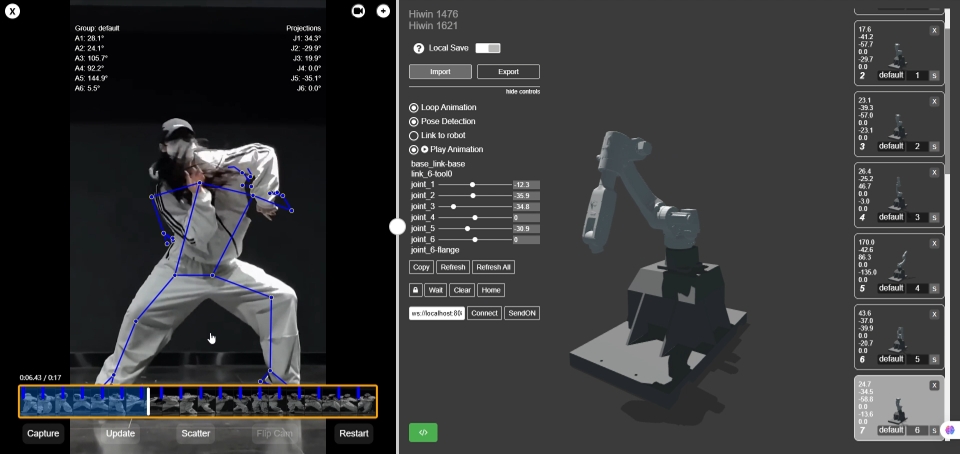
TwinPose interface uses body movements as a form of programming to control the robotic arm. (Provided by Yang-Ting Shen)