



SDG9
NCKU Management Hosts AI Digital Transformation Forum to Advance Smart Governance

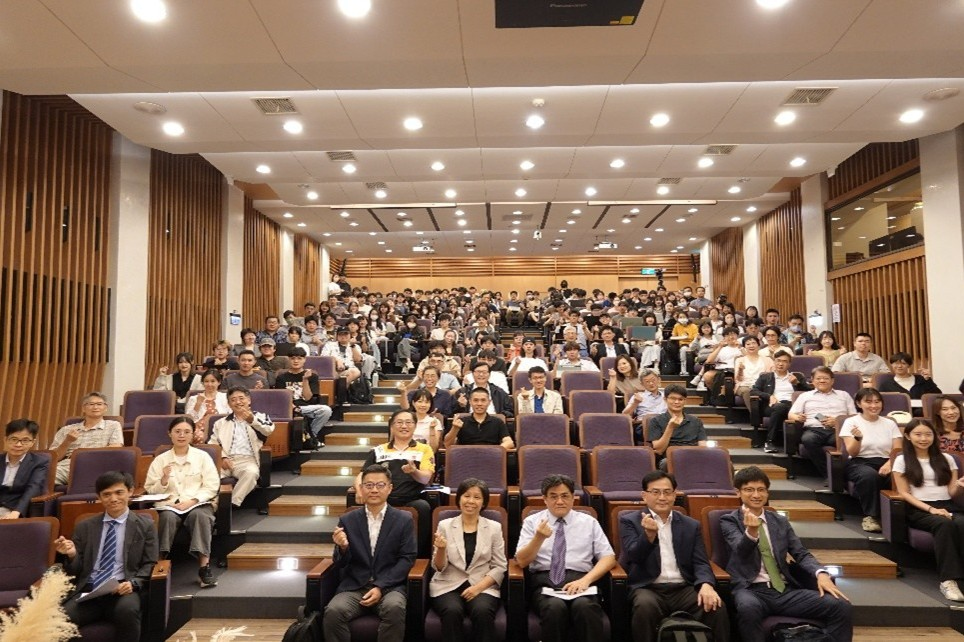
The College of Management at National Cheng Kung University (NCKU) hosted the “Forum on the Challenges and Opportunities of Corporate AI Digital Transformation” on May 15. The event brought together faculty, students, and prominent industry representatives, and invited eight leading experts from government, industry, and academia to discuss AI-driven digital transformation strategies for the next decade, as well as best practices for small and medium-sized enterprises (SMEs) adopting AI technologies.
The forum opened with remarks from NCKU Vice President Shih-wei Chang and Dean Pei-fang Su of the College of Management. Both emphasized that AI has already profoundly reshaped administrative management, research analysis, and everyday applications, becoming an inseparable part of modern life. In response to its rapid evolution, they encouraged an open mindset toward technological innovation while also urging careful reflection on its broader impacts and ethical challenges. This reflects the core theme of the forum: “AI is not merely the adoption of tools, but a continuous learning journey from ‘learners’ to ‘creators.’” Vice President Chang also highlighted that SMEs account for nearly 80% of total employment in Taiwan, underscoring the vital importance of prioritizing their specific digital transformation needs.
Centered on the key themes of “AI Digital Transformation Governance Assessment for Enterprises” and “AI Technology Adoption in Enterprises,” the forum successfully bridged policy, research, and corporate practice. In the face of rapid AI advancement, participants were encouraged not only to use AI tools passively, but to “understand AI, evaluate AI, and grow alongside AI.” To this end, the College invited distinguished guests to explore digital transformation from three major dimensions.
In the “Government Leadership: Forward-Looking Policy and National Strategy” session, senior advisors and officials—including Kuan-ming Li from the Department of Industrial Technology (DoIT), Ministry of Economic Affairs; Bei-ti Hu, Chief Secretary of the Ministry of Digital Affairs (MODA); and Yun-ping Chang from the Small and Medium Enterprise and Startup Administration, Ministry of Economic Affairs—provided invaluable insights into national AI strategies and emerging industrial trends.
The “Institutional Empowerment: Advancing AI Knowledge and Cross-Domain Applications” session featured expertise from Lin Chong-tian of the Metal Industries Research & Development Centre (MIRDC) and Huang-zhen Chang of the Commerce Development Research Institute (CDRI). They discussed how research institutions support enterprises in overcoming operational bottlenecks. Through smart manufacturing enablement and data analytics, these organizations help firms build robust cross-domain capabilities during dual-transition (digital and green) processes.
The “Industry Practice: The Key Transformation from Traditional Manufacturing to AI-Driven Smart Operations” session featured front-line practitioners sharing real-world milestone experiences. Assistant Vice President Yin-ying Chang of Fu Chun Shin Machinery Manufacture shared her company's transformation journey from a traditional manufacturer into a “smart manufacturing integrated solution provider.” Executive Vice President You-gang Lin of Junmay Label described how intelligent manufacturing optimized production workflows and vastly improved design precision. Chi-cheng Ko, Vice President of I-Ching Bedding, stated that AI effectively transforms users into creators, emphasizing that a shift in mindset is the single most crucial factor for traditional industry transformation. By introducing an “AI Mentor” to train frontline staff and digitize the invaluable knowledge of veteran employees into sustainable digital assets, his company achieved significant performance growth, setting a new benchmark for AI-driven smart manufacturing in traditional sectors.
In response to the rapid advancement of artificial intelligence, the in-depth discussions at this event provided fresh, actionable insights for all participants and strongly echoed Dean Pei-fang Su’s core educational philosophy: “Students must understand the value of learning, and universities must systematically communicate and guide that process.” Looking ahead, the College of Management will continue to aggressively promote AI-driven industry-academia collaboration, positioning artificial intelligence as a core driver of higher education transformation and industrial upgrading, and moving steadfastly toward its goal of becoming a premier “human-centered smart management school.”
The forum opened with remarks from NCKU Vice President Shih-wei Chang and Dean Pei-fang Su of the College of Management. Both emphasized that AI has already profoundly reshaped administrative management, research analysis, and everyday applications, becoming an inseparable part of modern life. In response to its rapid evolution, they encouraged an open mindset toward technological innovation while also urging careful reflection on its broader impacts and ethical challenges. This reflects the core theme of the forum: “AI is not merely the adoption of tools, but a continuous learning journey from ‘learners’ to ‘creators.’” Vice President Chang also highlighted that SMEs account for nearly 80% of total employment in Taiwan, underscoring the vital importance of prioritizing their specific digital transformation needs.
Centered on the key themes of “AI Digital Transformation Governance Assessment for Enterprises” and “AI Technology Adoption in Enterprises,” the forum successfully bridged policy, research, and corporate practice. In the face of rapid AI advancement, participants were encouraged not only to use AI tools passively, but to “understand AI, evaluate AI, and grow alongside AI.” To this end, the College invited distinguished guests to explore digital transformation from three major dimensions.
In the “Government Leadership: Forward-Looking Policy and National Strategy” session, senior advisors and officials—including Kuan-ming Li from the Department of Industrial Technology (DoIT), Ministry of Economic Affairs; Bei-ti Hu, Chief Secretary of the Ministry of Digital Affairs (MODA); and Yun-ping Chang from the Small and Medium Enterprise and Startup Administration, Ministry of Economic Affairs—provided invaluable insights into national AI strategies and emerging industrial trends.
The “Institutional Empowerment: Advancing AI Knowledge and Cross-Domain Applications” session featured expertise from Lin Chong-tian of the Metal Industries Research & Development Centre (MIRDC) and Huang-zhen Chang of the Commerce Development Research Institute (CDRI). They discussed how research institutions support enterprises in overcoming operational bottlenecks. Through smart manufacturing enablement and data analytics, these organizations help firms build robust cross-domain capabilities during dual-transition (digital and green) processes.
The “Industry Practice: The Key Transformation from Traditional Manufacturing to AI-Driven Smart Operations” session featured front-line practitioners sharing real-world milestone experiences. Assistant Vice President Yin-ying Chang of Fu Chun Shin Machinery Manufacture shared her company's transformation journey from a traditional manufacturer into a “smart manufacturing integrated solution provider.” Executive Vice President You-gang Lin of Junmay Label described how intelligent manufacturing optimized production workflows and vastly improved design precision. Chi-cheng Ko, Vice President of I-Ching Bedding, stated that AI effectively transforms users into creators, emphasizing that a shift in mindset is the single most crucial factor for traditional industry transformation. By introducing an “AI Mentor” to train frontline staff and digitize the invaluable knowledge of veteran employees into sustainable digital assets, his company achieved significant performance growth, setting a new benchmark for AI-driven smart manufacturing in traditional sectors.
In response to the rapid advancement of artificial intelligence, the in-depth discussions at this event provided fresh, actionable insights for all participants and strongly echoed Dean Pei-fang Su’s core educational philosophy: “Students must understand the value of learning, and universities must systematically communicate and guide that process.” Looking ahead, the College of Management will continue to aggressively promote AI-driven industry-academia collaboration, positioning artificial intelligence as a core driver of higher education transformation and industrial upgrading, and moving steadfastly toward its goal of becoming a premier “human-centered smart management school.”
NCKU College of Management Hosts Forum on Challenges and Opportunities of Corporate AI Digital Transformation.
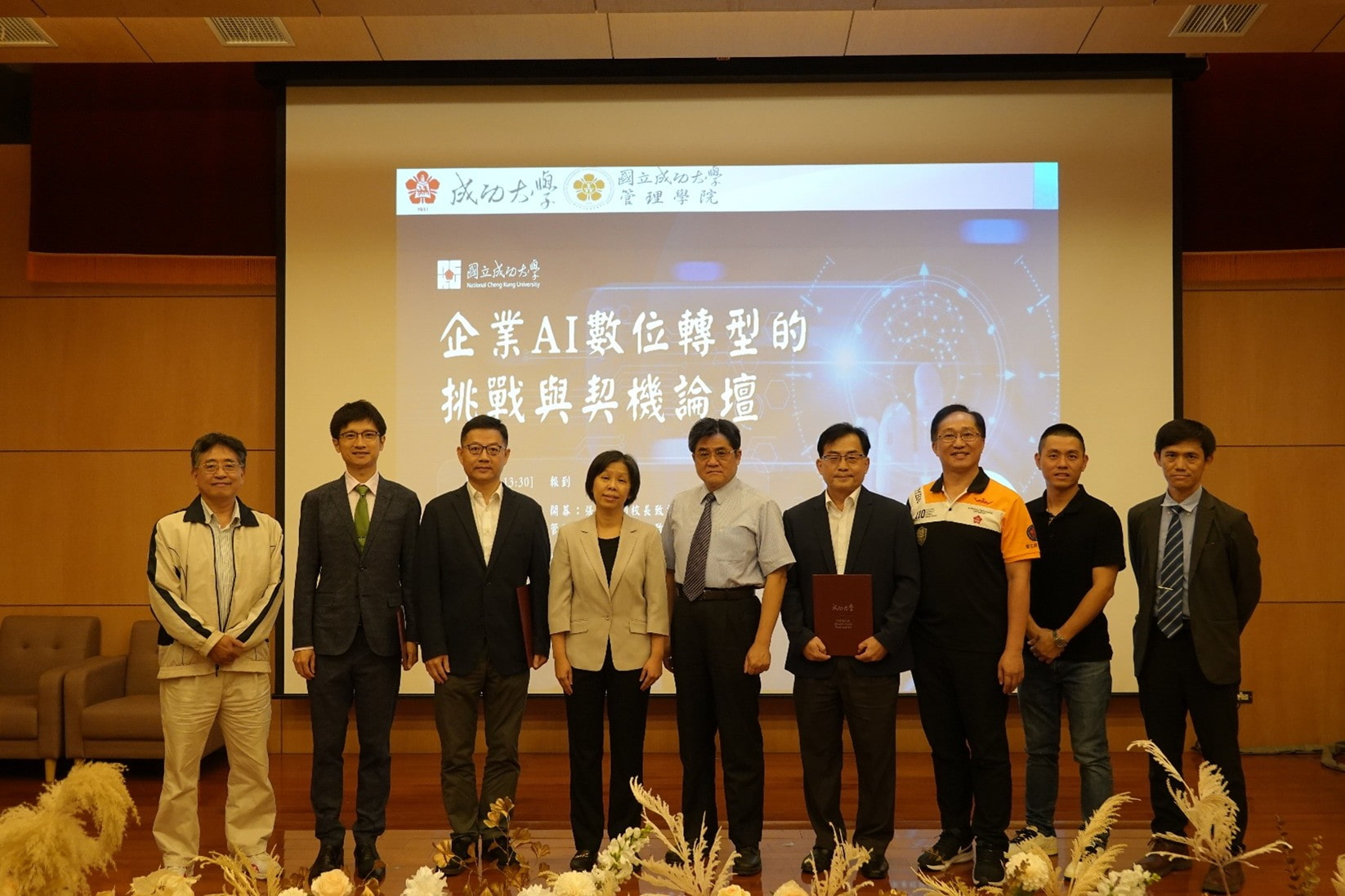
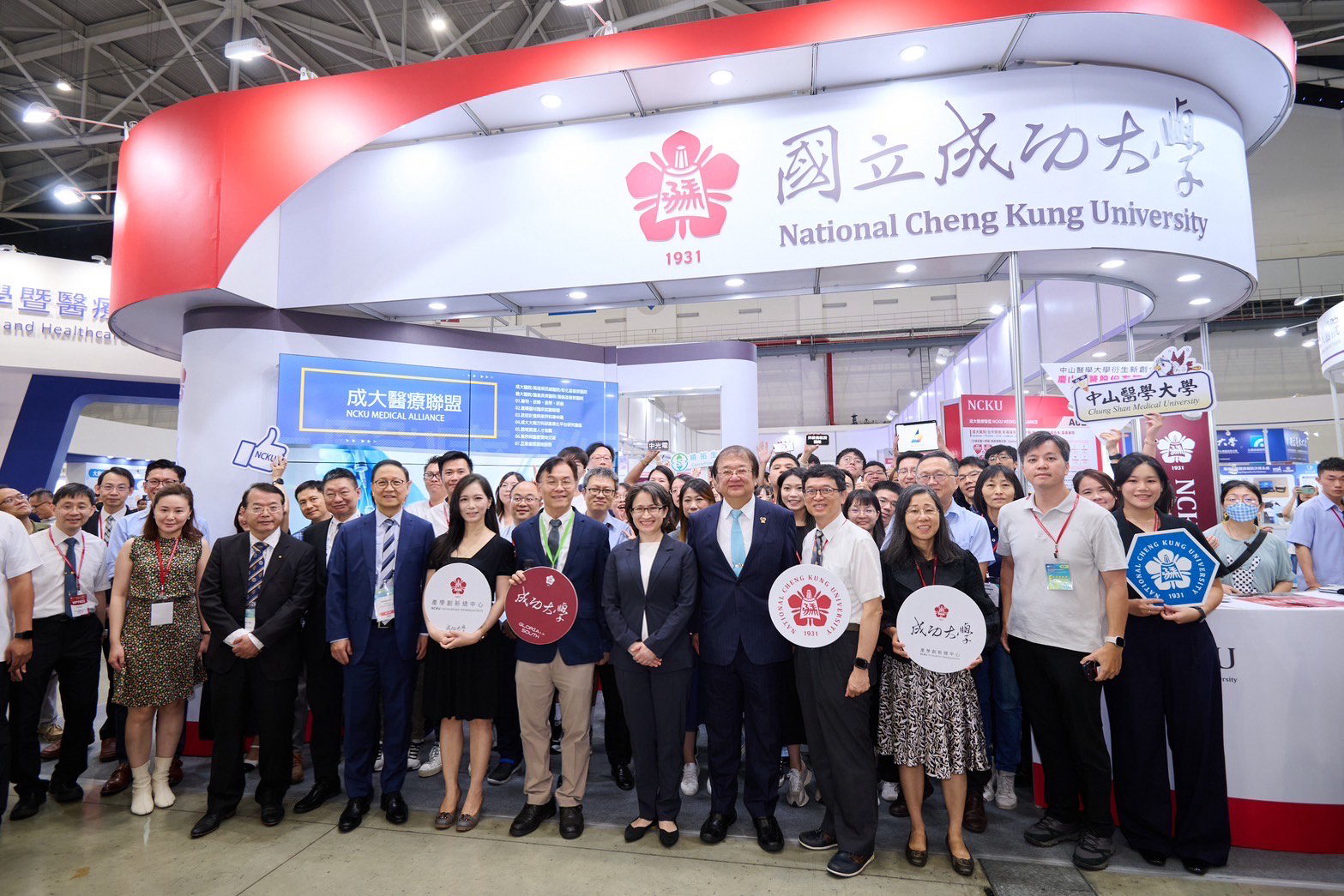
NCKU Vice President Shih-wei Chang (center), College of Management Dean Pei-fang Su (fourth from left), Associate Dean Hui-chia Wang (first from right), and Director Shun-lin Cheng of the Center for Industry-Academia Cooperation (first from left) pose for a group photo with six panelists.
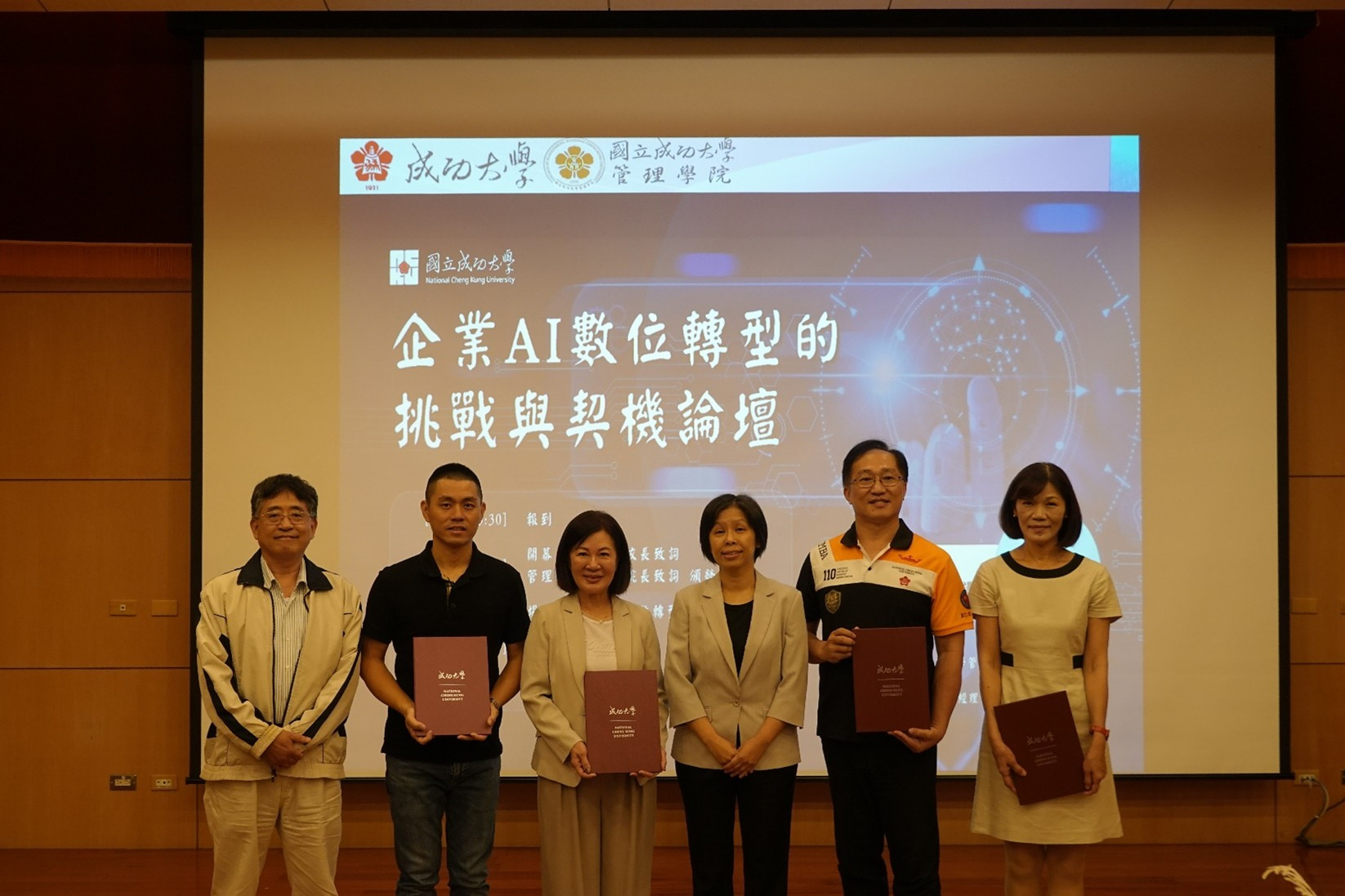
Dean Pei-Fang Su (3rd from right), Director of the Industry-Academia Collaboration Center of the College of Management at NCKU, Shun-Lin Cheng (1st from left), and the four panelists from Session B pose for a group photo.