



SDG11
Finding the Healthiest Route Home: NCKU Team Wins Recognition for Intelligent Air Pollution Navigation System
Navigation systems have long been an indispensable assistant in modern daily life, helping you find the fastest or shortest route to your destination every day. But what if it could find the "healthiest route"? A research team led by Professor Chih-Da Wu from the Department of Geomatics at National Cheng Kung University (NCKU) utilized Geographic Artificial Intelligence (Geo-AI) and route planning algorithms to develop a low-exposure air pollution navigation system. Following real-world testing across 3,000 routes, the team discovered that by following the system's air pollution navigation guidance, the human body can reduce air pollution inhalation by up to one-third, yielding significant long-term health benefits. This research milestone achieved by NCKU has been published in the top international journal Sustainable Cities and Society, titled "Exposure-Aware commuting: Geo-AI–Driven route optimization to reduce NO2 in urban road networks."
Air pollution is invisible and intangible, yet science has proven that long-term exposure causes severe damage to human health, particularly regarding chronic respiratory and cardiovascular diseases. The research team stated that they had previously collaborated with the Ministry of the Environment and the Taipei Rapid Transit Corporation to integrate this system with the metro network. Citizens can look up online which route home from the metro station is healthiest for them. Although it might not be the shortest path, taking a slight detour offers numerous health benefits. This innovation has garnered multiple domestic awards, including placing in the top 20 of last year's Presidential Hackathon and winning the Far Eastern Yushi USR (University Social Responsibility) Model Award this year (2026).
The team pointed out that using this system to further analyze road networks in Kaohsiung City, they calculated the distribution of nitrogen dioxide (NO2 , one of the primary pollutants emitted by motor vehicles). After testing over 3,000 routes, avoiding high-pollution roads reduced average NO2 exposure by approximately 2.04%, with some routes dropping by more than 5%, and the maximum reduction reaching 39.70%. While the reduction per trip may seem small, the cumulative effect of long-term consistency can reduce inhaled pollution by as much as 900,000 ppb-seconds per year.
Professor Chih-Da Wu’s team has long been engaged in air pollution research. Since physical air quality monitoring instruments and stations are limited and can hardly cover every corner, the team leveraged AI combined with dynamic meteorological conditions to estimate the detailed distribution of various pollutants. Achieving an accuracy rate exceeding 90%, this method holds immense potential for broader applications in the AI era.
The team stated that their next step will be collaborating with the Tainan City Government to launch Tainan's "Air Pollution Navigation System." Whether for daily walks, exercise, cycling, or even driving and riding scooters, citizens can use the system to identify routes with the best air quality and take charge of their health. Furthermore, the team has dedicated substantial efforts to monitoring air pollution in residential areas surrounding petrochemical industrial zones. Recently, in collaboration with Texas Tech University and the University of Illinois Urbana-Champaign, they utilized the system to analyze benzene pollution in the Joppa community adjacent to a petrochemical industrial zone in Dallas, Texas.
Professor Chih-Da Wu expressed that the petrochemical production process generates the pollutant benzene, which escapes into the air. Benzene is classified as a Group 1 carcinogen by the World Health Organization (WHO), and long-term or high-concentration exposure significantly increases the risk of developing leukemia. The Joppa community is not only located next to a petrochemical plant but is also flanked by highways and railways, all of which compound air pollution and impact health. This research achievement has also been published in the top international journal Journal of Cleaner Production, titled "Geospatial machine learning for benzene estimation in an environmentally disadvantaged area: Snapshot air quality assessment of Joppa community, Dallas, Texas."
He stated that he anticipates the methodologies developed by the team will serve as an aid for urban air quality management, health risk assessments, and environmental policy-making, carrying profound significance for constructing more precise environmental governance and healthier cities.
The research team comprises Professor Chih-Da Wu, NCKU Department of Geomatics postdoctoral researcher Aji (from Indonesia), doctoral student Jia-Wei Xu, master's student Ji-Ting He, research assistant Jie-Ying Chen; Associate Professor Wei-Shan Chin from the National Taiwan University (NTU) Department of Nursing, Distinguished Professor Yu-Liang Guo from the NTU Department of Medicine (Division of Occupational Medicine), Assistant Professor Pei-Yi Weng from the Department of Environmental Engineering and Science at National Pingtung University of Science and Technology, Professor Zhi-Xing Hong from the Department of Pediatrics and Professor Si-Jia Chen from the Division of Nephrology at Kaohsiung Medical University, and Associate Professor Xiao-Yun Li from the Department of Leisure Industry and Health Promotion at National Taipei University of Nursing and Health Sciences. The entire team is thrilled that their related research has received recognition from major international journals.
Air pollution is invisible and intangible, yet science has proven that long-term exposure causes severe damage to human health, particularly regarding chronic respiratory and cardiovascular diseases. The research team stated that they had previously collaborated with the Ministry of the Environment and the Taipei Rapid Transit Corporation to integrate this system with the metro network. Citizens can look up online which route home from the metro station is healthiest for them. Although it might not be the shortest path, taking a slight detour offers numerous health benefits. This innovation has garnered multiple domestic awards, including placing in the top 20 of last year's Presidential Hackathon and winning the Far Eastern Yushi USR (University Social Responsibility) Model Award this year (2026).
The team pointed out that using this system to further analyze road networks in Kaohsiung City, they calculated the distribution of nitrogen dioxide (NO2 , one of the primary pollutants emitted by motor vehicles). After testing over 3,000 routes, avoiding high-pollution roads reduced average NO2 exposure by approximately 2.04%, with some routes dropping by more than 5%, and the maximum reduction reaching 39.70%. While the reduction per trip may seem small, the cumulative effect of long-term consistency can reduce inhaled pollution by as much as 900,000 ppb-seconds per year.
Professor Chih-Da Wu’s team has long been engaged in air pollution research. Since physical air quality monitoring instruments and stations are limited and can hardly cover every corner, the team leveraged AI combined with dynamic meteorological conditions to estimate the detailed distribution of various pollutants. Achieving an accuracy rate exceeding 90%, this method holds immense potential for broader applications in the AI era.
The team stated that their next step will be collaborating with the Tainan City Government to launch Tainan's "Air Pollution Navigation System." Whether for daily walks, exercise, cycling, or even driving and riding scooters, citizens can use the system to identify routes with the best air quality and take charge of their health. Furthermore, the team has dedicated substantial efforts to monitoring air pollution in residential areas surrounding petrochemical industrial zones. Recently, in collaboration with Texas Tech University and the University of Illinois Urbana-Champaign, they utilized the system to analyze benzene pollution in the Joppa community adjacent to a petrochemical industrial zone in Dallas, Texas.
Professor Chih-Da Wu expressed that the petrochemical production process generates the pollutant benzene, which escapes into the air. Benzene is classified as a Group 1 carcinogen by the World Health Organization (WHO), and long-term or high-concentration exposure significantly increases the risk of developing leukemia. The Joppa community is not only located next to a petrochemical plant but is also flanked by highways and railways, all of which compound air pollution and impact health. This research achievement has also been published in the top international journal Journal of Cleaner Production, titled "Geospatial machine learning for benzene estimation in an environmentally disadvantaged area: Snapshot air quality assessment of Joppa community, Dallas, Texas."
He stated that he anticipates the methodologies developed by the team will serve as an aid for urban air quality management, health risk assessments, and environmental policy-making, carrying profound significance for constructing more precise environmental governance and healthier cities.
The research team comprises Professor Chih-Da Wu, NCKU Department of Geomatics postdoctoral researcher Aji (from Indonesia), doctoral student Jia-Wei Xu, master's student Ji-Ting He, research assistant Jie-Ying Chen; Associate Professor Wei-Shan Chin from the National Taiwan University (NTU) Department of Nursing, Distinguished Professor Yu-Liang Guo from the NTU Department of Medicine (Division of Occupational Medicine), Assistant Professor Pei-Yi Weng from the Department of Environmental Engineering and Science at National Pingtung University of Science and Technology, Professor Zhi-Xing Hong from the Department of Pediatrics and Professor Si-Jia Chen from the Division of Nephrology at Kaohsiung Medical University, and Associate Professor Xiao-Yun Li from the Department of Leisure Industry and Health Promotion at National Taipei University of Nursing and Health Sciences. The entire team is thrilled that their related research has received recognition from major international journals.
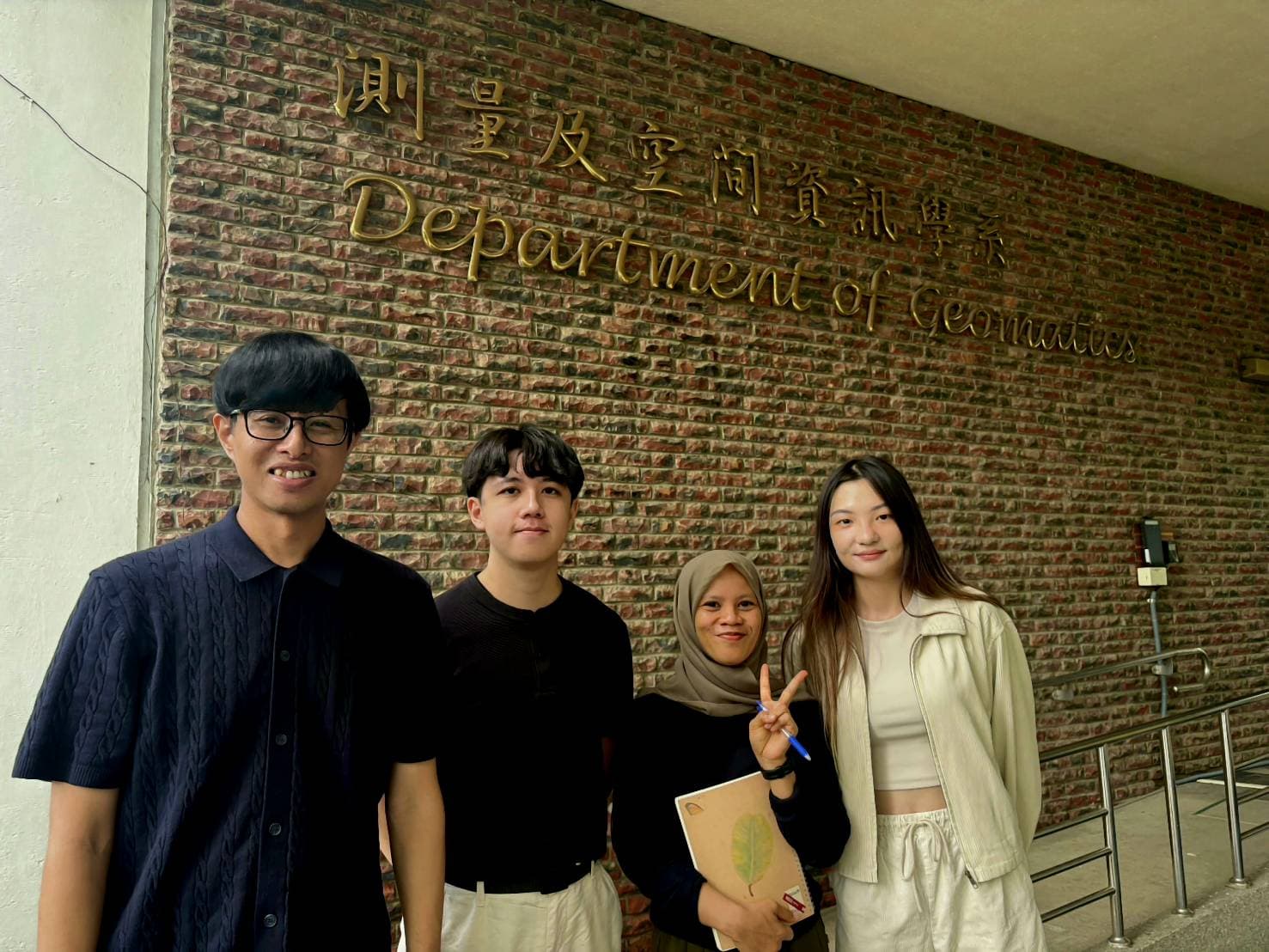
Recognized by a top international journal for their Geo-AI–driven air pollution estimation methodology, members of Professor Chih-Da Wu’s research team from the NCKU Department of Geomatics include (from left) Professor Chih-Da Wu, doctoral student Jia-Wei Xu, Indonesian postdoctoral researcher Aji, and research assistant You-Ru Lin.
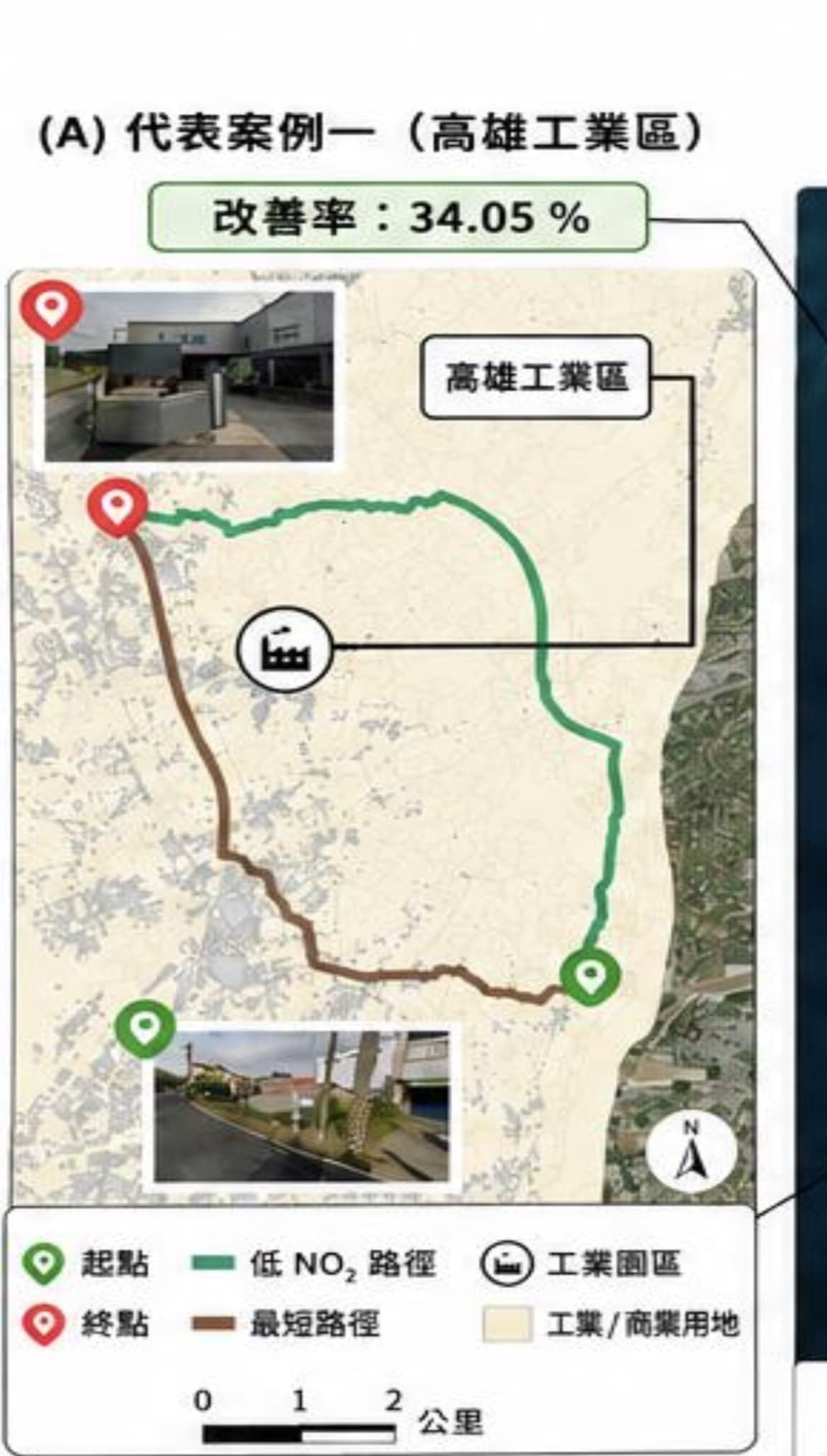
The research team led by Professor Chih-Da Wu from the NCKU Department of Geomatics analyzed the distribution of nitrogen dioxide (NO2) across Kaohsiung's road networks, finding that commuting via the right routes can reduce inhalation by up to one-third.

The research team led by Professor Chih-Da Wu from the NCKU Department of Geomatics collaborated with institutions including Texas Tech University to study benzene pollution around petrochemical industrial zones. Their research milestone has been published in the top international journal Journal of Cleaner Production.
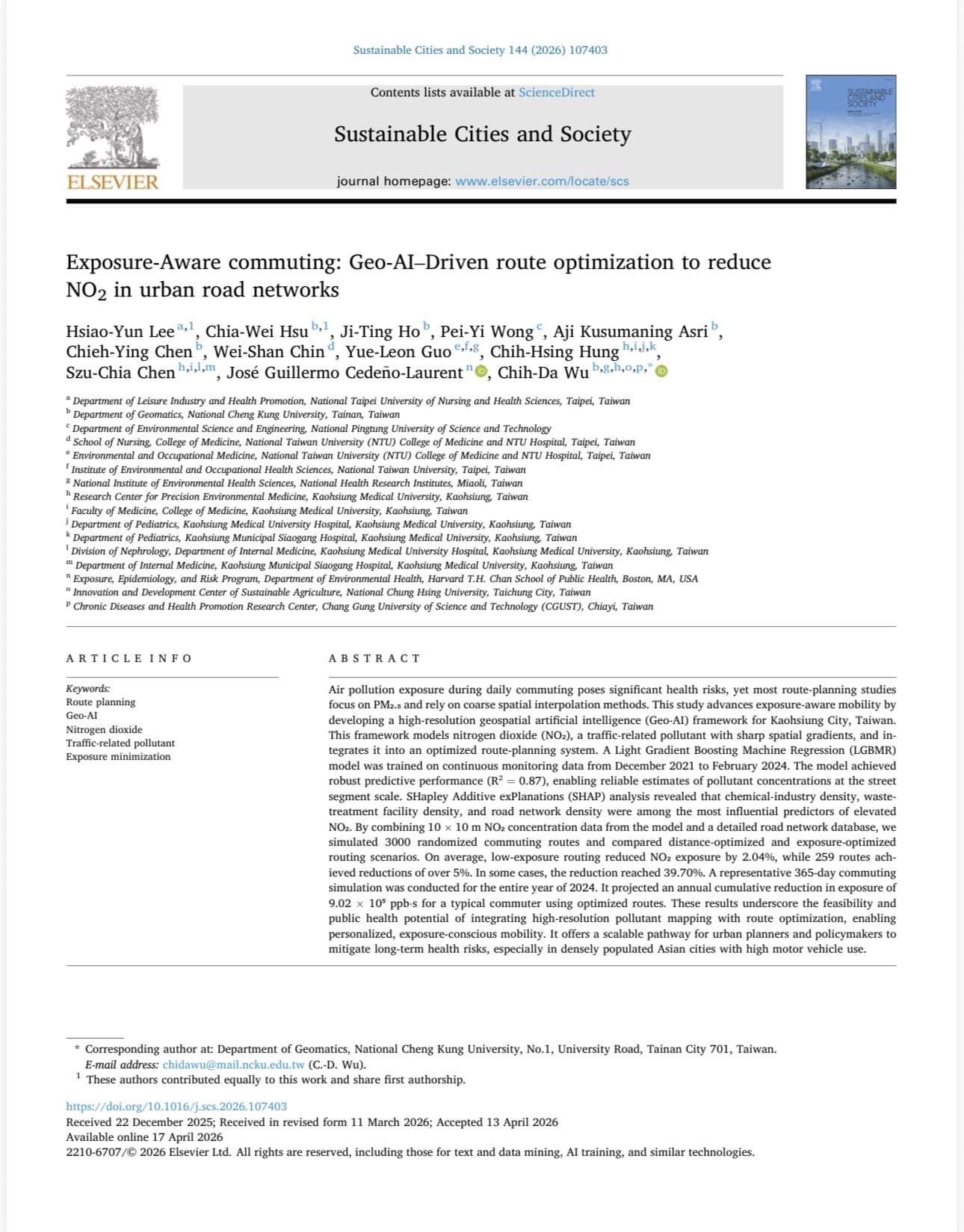
The research team led by Professor Chih-Da Wu from the NCKU Department of Geomatics utilized tools such as Geographic Artificial Intelligence (Geo-AI) to model highly accurate, detailed air pollution distributions. By integrating this with route planning algorithms, they identified paths with the lowest pollution levels—a milestone published in the top international journal Sustainable Cities and Society.

Professor Chih-Da Wu’s research team from the NCKU Department of Geomatics collaborated with the Department of Atmospheric Environment of the Ministry of the Environment and the Taipei Rapid Transit Corporation to construct the air pollution navigation system.