



SDG17
NCKU Song Jiang Troupe Invited to Japan's Sendai Tanabata Festival to Promote Taiwanese Culture

Invited to perform at the Sendai Tanabata Festival in Japan in 2026, the National Cheng Kung University (NCKU) Song Jiang Troupe specially incorporated the "Fukinagashi" (streamer) element into its performance to complement the event's cultural theme. By introducing ribbon dragons and ribbon dance elements, the team seamlessly blended the vigorous strength of Taiwanese martial arts with the light and elegant visuals of the Tanabata Festival. This cross-cultural fusion added vibrant festive spirit and cultural artistic charm, bringing traditional Taiwanese martial arts art into Japanese Tanabata culture while uniting both sides in prayer through cultural exchange.
Executing the National Science and Technology Council (NSTC) Taiwanese Sports Culture Research Project "Vibrant Taiwan," the NCKU Research Center for Humanities and Social Sciences (CHASS) collaborated with faculty and students from the Department of Psychology to assemble the "NCKU Song Jiang Troupe." Bringing together cross-disciplinary scholars and students from sports science, psychology, history, industrial design, and electrical engineering, the team transformed traditional Song Jiang Battle Array performances into cultural exhibits and technological interpretations. In August 2026, the team made its debut performance in Japan, premiering at the "Taiwan Lantern Festival" in Sendai on August 5, followed by three performances at the "Sendai Tanabata Festival" from August 6 to 8. Grounded in academic exchange, the team also presented papers at the "2026 Asian International Congress of Psychology" at Tohoku University on August 9 and 10. The team was received by Sendai Mayor Kazuko Kohori, who conveyed praise from both Sendai citizens and the academic community, commended CHASS Director Zheng-Da Yang and the faculty and students for achieving remarkable results in public diplomacy and academic promotion.
This performance served as a major promotional showcase for the NSTC-supported Taiwanese Sports Culture Research Project, titled "Vibrant Taiwan: From Traditional Martial Arts Skills to Scientifically Validated Sports Cultural Innovation—Development and Application of Multimodal Physical and Mental Health Promotion Programs." Led by Principal Investigator Director Zheng-Da Yang, a delegation of over 20 members—including NCKU Physical Education Office Director Chun-Hao Wang, Institute of Physical Education, Health and Leisure Studies Director Hsueh-Wen Chow, College of Liberal Arts research expert Chih-Chang Chen, National Chiayi University Department of Applied History Professor Chien-Sheng Wu, and students from various departments—traveled to Sendai City. The "Sendai Tanabata Festival" is one of Northeastern Japan's Three Major Festivals. Tainan City, where NCKU is located, shares a cultural bond with Sendai through Tanabata traditions; Tainan celebrates the traditional "Doing the Sixteenth" ritual on Tanabata, while Sendai is renowned for its Tanabata Festival, providing a solid foundation for intercity cultural exchanges.
According to the team, the project's core focus centers on Tainan's local Song Jiang martial arts culture. By combining academic research with local communities and martial arts groups, the initiative highlights NCKU’s cross-disciplinary integration and academic prowess. Breaking away from traditional single-perspective research frameworks, the team deepened academic exploration and application from multiple dimensions, including precision sports science, psychological resilience, cultural heritage preservation, and digital recreation. This demonstrates forward-looking research that bridges Taiwan's unique sports culture with technology, offering empirical scientific evidence for the revitalization and promotion of Taiwan's martial arts culture. Furthermore, prioritizing the integration of humanities and technology, the project systematically verifies findings using interdisciplinary research methods. Grounded in traditional Song Jiang martial arts and reshaped with modern sports concepts, the team developed martial arts routines suited for different generations and demographic groups. This creates a new exercise model infused with Taiwanese cultural flavor while preserving Tainan's local heritage. Combining historical preservation, digital interpretation, sports science, and multifaceted promotional strategies, the project developed evidence-based health promotion solutions that bring a new face to traditional sports culture in response to modern needs.
The performance at the "Sendai Tanabata Festival" not only demonstrated the profound cultural heritage and artistic charm of Taiwan's Song Jiang Troupe, but also showcased how traditional culture can continuously innovate through scientific research, education, and international exchange. Through the fusion of Taiwanese and Japanese festival cultures, the NCKU Song Jiang Troupe and project researchers pushed Tainan's local culture onto the international stage, deepening mutual understanding across cultures. Guided by the mission "Researching the Local, Prospering Locally Together," the team opened new avenues for traditional culture's preservation, heritage pass-down, academic transformation, and global promotion.
Executing the National Science and Technology Council (NSTC) Taiwanese Sports Culture Research Project "Vibrant Taiwan," the NCKU Research Center for Humanities and Social Sciences (CHASS) collaborated with faculty and students from the Department of Psychology to assemble the "NCKU Song Jiang Troupe." Bringing together cross-disciplinary scholars and students from sports science, psychology, history, industrial design, and electrical engineering, the team transformed traditional Song Jiang Battle Array performances into cultural exhibits and technological interpretations. In August 2026, the team made its debut performance in Japan, premiering at the "Taiwan Lantern Festival" in Sendai on August 5, followed by three performances at the "Sendai Tanabata Festival" from August 6 to 8. Grounded in academic exchange, the team also presented papers at the "2026 Asian International Congress of Psychology" at Tohoku University on August 9 and 10. The team was received by Sendai Mayor Kazuko Kohori, who conveyed praise from both Sendai citizens and the academic community, commended CHASS Director Zheng-Da Yang and the faculty and students for achieving remarkable results in public diplomacy and academic promotion.
This performance served as a major promotional showcase for the NSTC-supported Taiwanese Sports Culture Research Project, titled "Vibrant Taiwan: From Traditional Martial Arts Skills to Scientifically Validated Sports Cultural Innovation—Development and Application of Multimodal Physical and Mental Health Promotion Programs." Led by Principal Investigator Director Zheng-Da Yang, a delegation of over 20 members—including NCKU Physical Education Office Director Chun-Hao Wang, Institute of Physical Education, Health and Leisure Studies Director Hsueh-Wen Chow, College of Liberal Arts research expert Chih-Chang Chen, National Chiayi University Department of Applied History Professor Chien-Sheng Wu, and students from various departments—traveled to Sendai City. The "Sendai Tanabata Festival" is one of Northeastern Japan's Three Major Festivals. Tainan City, where NCKU is located, shares a cultural bond with Sendai through Tanabata traditions; Tainan celebrates the traditional "Doing the Sixteenth" ritual on Tanabata, while Sendai is renowned for its Tanabata Festival, providing a solid foundation for intercity cultural exchanges.
According to the team, the project's core focus centers on Tainan's local Song Jiang martial arts culture. By combining academic research with local communities and martial arts groups, the initiative highlights NCKU’s cross-disciplinary integration and academic prowess. Breaking away from traditional single-perspective research frameworks, the team deepened academic exploration and application from multiple dimensions, including precision sports science, psychological resilience, cultural heritage preservation, and digital recreation. This demonstrates forward-looking research that bridges Taiwan's unique sports culture with technology, offering empirical scientific evidence for the revitalization and promotion of Taiwan's martial arts culture. Furthermore, prioritizing the integration of humanities and technology, the project systematically verifies findings using interdisciplinary research methods. Grounded in traditional Song Jiang martial arts and reshaped with modern sports concepts, the team developed martial arts routines suited for different generations and demographic groups. This creates a new exercise model infused with Taiwanese cultural flavor while preserving Tainan's local heritage. Combining historical preservation, digital interpretation, sports science, and multifaceted promotional strategies, the project developed evidence-based health promotion solutions that bring a new face to traditional sports culture in response to modern needs.
The performance at the "Sendai Tanabata Festival" not only demonstrated the profound cultural heritage and artistic charm of Taiwan's Song Jiang Troupe, but also showcased how traditional culture can continuously innovate through scientific research, education, and international exchange. Through the fusion of Taiwanese and Japanese festival cultures, the NCKU Song Jiang Troupe and project researchers pushed Tainan's local culture onto the international stage, deepening mutual understanding across cultures. Guided by the mission "Researching the Local, Prospering Locally Together," the team opened new avenues for traditional culture's preservation, heritage pass-down, academic transformation, and global promotion.
Making its overseas debut in 2026, the NCKU Cross-Disciplinary Song Jiang Troupe was invited to perform at the "Taiwan Lantern Festival" and the "Sendai Tanabata Festival" in Sendai, Japan, in August.
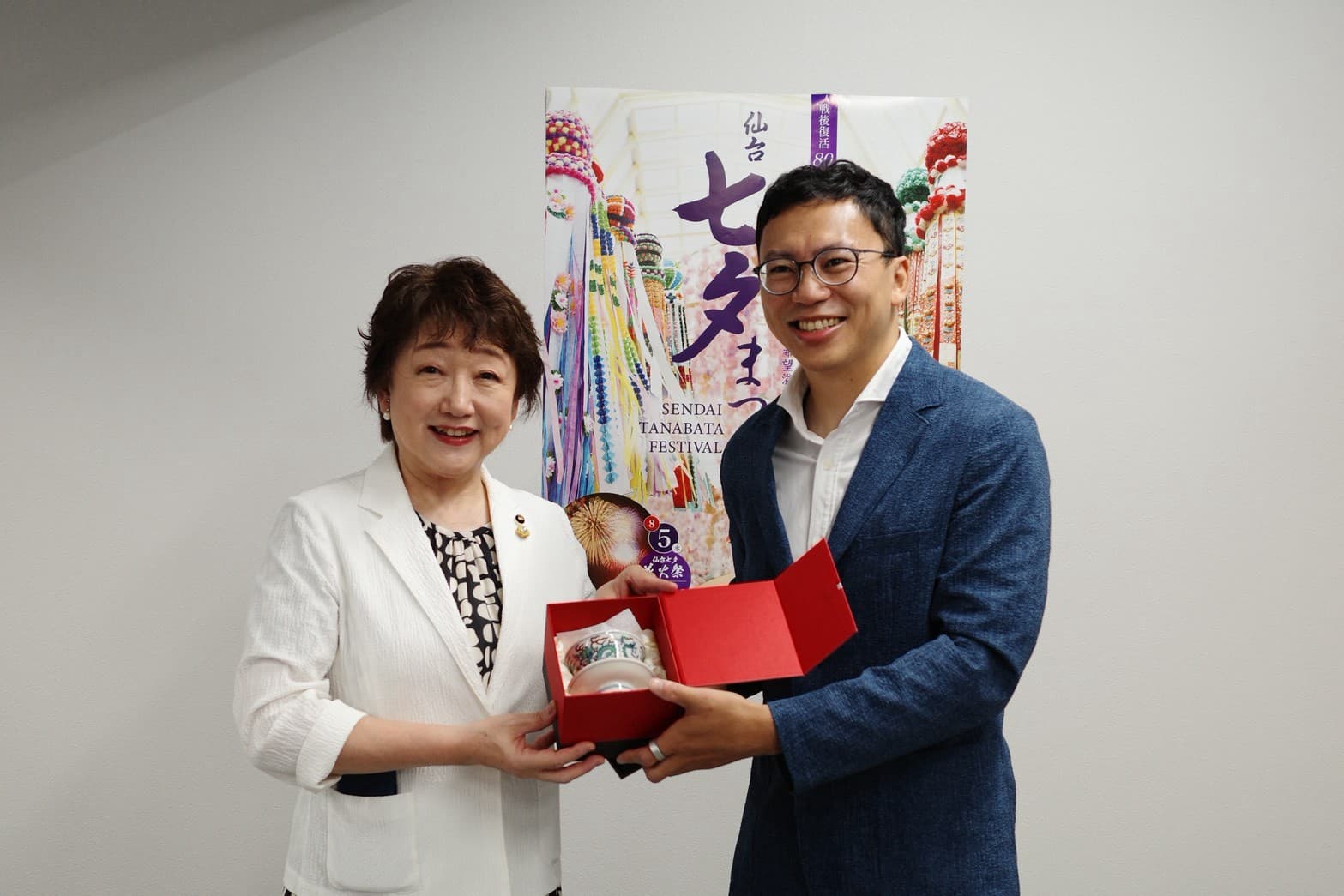
The NCKU delegation was received by Sendai Mayor Kazuko Kohori (left), who conveyed praise and encouragement from Sendai citizens and academia. On the right: Director Zheng-Da Yang of the NCKU Research Center for Humanities and Social Sciences (CHASS).
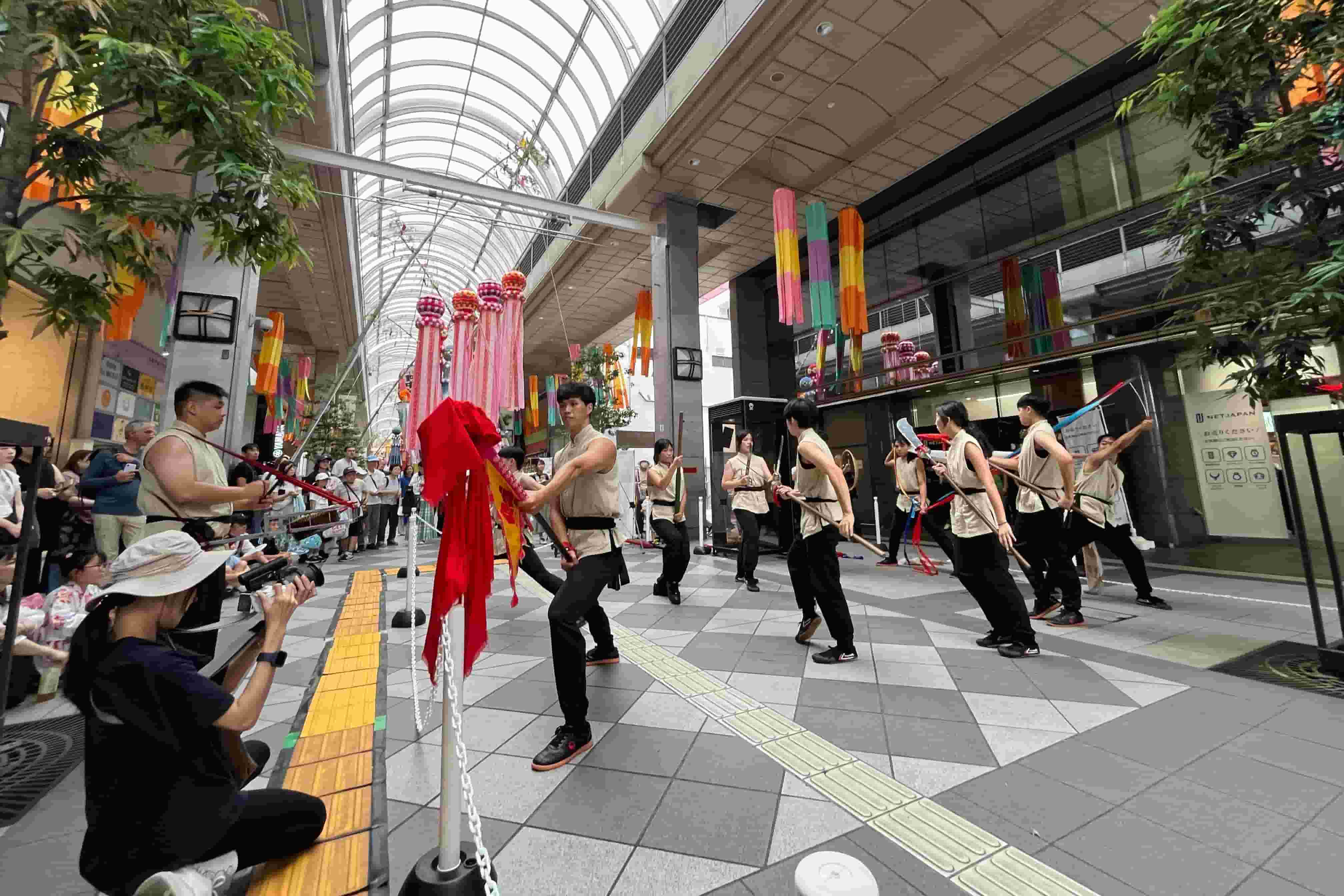
NCKU Song Jiang Troupe performs at the Sendai Tanabata Festival in Japan.