



SDG13
NCKU Invites Kyoto University to Discuss Emerging Trends in International Disaster Management and Sustainable Technologies
To strengthen academic exchange and collaboration with Kyoto University in Japan, National Cheng Kung University (NCKU) President Meng-Ru Shen (沈孟儒), in conjunction with the university’s 94th anniversary celebrations, organized the “2025 NCKU–Kyoto University Research Exchange Day” under the theme of sustainability and disaster prevention. Hosted by Dean Chien-Teng Chan of the College of Engineering, the event took place from November 30 to December 2, 2025. Activities included a forum and field surveys, providing a platform for in-depth discussions on disaster prevention, hydraulic engineering, multiphase terrain simulation, and sustainable environmental governance, among other research topics.
At the forum opening on December 1, Vice President Yong-Chun Lee (李永春), representing President Shen, delivered a speech emphasizing that both NCKU and Kyoto University are renowned for their rich histories and innovative spirits and have long maintained collaborative exchanges in teaching and research. He noted that this forum, centered on sustainability and disaster prevention, reflects the shared responsibility and commitment of both universities in addressing global challenges, fostering collaboration, and enhancing resilience in disaster management and sustainable engineering.
Vice President for International Affairs Sun-Yuan Hsieh (謝孫源) highlighted that the foundation of NCKU – Kyoto University collaboration is solid, supported by multiple university- and college-level agreements promoting student exchange and academic research. He expressed hope that the Research Exchange Day would initiate a new phase and model of bilateral cooperation, which could later expand to other forward-looking research areas, further strengthening international partnerships and joint talent development.
The forum featured two keynote lectures and 13 expert research presentations covering topics such as heavy rainfall and flood evacuation system simulations, landslide behavior analysis, geotechnical material improvement, geological records and engineering applications, AI-enabled geographic information, genotoxicity assessment, sustainable water environment monitoring, and coastal disaster mitigation and ecological technologies. Scholars exchanged expertise across scales—from surface to molecular, from experiments to simulations, and from engineering to policy—creating a rich, multidisciplinary dialogue.
In the keynote sessions, Professor Emeritus Cheng-Lun Hsieh (謝正倫) of NCKU’s Department of Hydraulic and Ocean Engineering reviewed the development of Taiwan’s debris flow and large-scale landslide early-warning systems, while Professor Tomoharu Hori (堀智晴), Director of Kyoto University’s Disaster Prevention Research Institute, presented research on the informational value and behavioral simulations of flood evacuation systems. Both talks received enthusiastic responses. Dean Chien-Teng Chan (詹錢登) presented commemorative plaques in recognition of the long-term contributions of Taiwanese and Japanese scholars in disaster prevention research.
The forum concluded with a panel discussion chaired by Professor Hsiao-Wen Wang (王筱雯), Director of NCKU’s Disaster Prevention Research Center. She proposed broad future collaboration topics, including community-based disaster risk reduction, post-disaster recovery, hydrology and sediment disaster studies, coastal resilience, river management, and interdisciplinary disaster science. These discussions aim to establish sustainable models of collaboration, ensuring the momentum generated by the Research Exchange Day continues between NCKU and Kyoto University.
On December 2, a field survey led by Deputy Director Wen-Chi Lai (賴文基) of the Disaster Prevention Research Center took faculty, students, and Kyoto University scholars to the Jiasian and Baolai areas of Kaohsiung. Participants observed geological structures, landslide topography, and disaster traces on-site, gaining a first-hand understanding of disaster causes and geotechnical applications.
The “NCKU – Kyoto University Research Exchange Day: Sustainability & Disaster Prevention” successfully facilitated in-depth interaction among more than 20 scholars, demonstrating NCKU’s commitment to advancing international research collaboration. Both universities plan to continue expanding cross-national research initiatives, using this exchange as a foundation for building a closer and long-term international research partnership.
At the forum opening on December 1, Vice President Yong-Chun Lee (李永春), representing President Shen, delivered a speech emphasizing that both NCKU and Kyoto University are renowned for their rich histories and innovative spirits and have long maintained collaborative exchanges in teaching and research. He noted that this forum, centered on sustainability and disaster prevention, reflects the shared responsibility and commitment of both universities in addressing global challenges, fostering collaboration, and enhancing resilience in disaster management and sustainable engineering.
Vice President for International Affairs Sun-Yuan Hsieh (謝孫源) highlighted that the foundation of NCKU – Kyoto University collaboration is solid, supported by multiple university- and college-level agreements promoting student exchange and academic research. He expressed hope that the Research Exchange Day would initiate a new phase and model of bilateral cooperation, which could later expand to other forward-looking research areas, further strengthening international partnerships and joint talent development.
The forum featured two keynote lectures and 13 expert research presentations covering topics such as heavy rainfall and flood evacuation system simulations, landslide behavior analysis, geotechnical material improvement, geological records and engineering applications, AI-enabled geographic information, genotoxicity assessment, sustainable water environment monitoring, and coastal disaster mitigation and ecological technologies. Scholars exchanged expertise across scales—from surface to molecular, from experiments to simulations, and from engineering to policy—creating a rich, multidisciplinary dialogue.
In the keynote sessions, Professor Emeritus Cheng-Lun Hsieh (謝正倫) of NCKU’s Department of Hydraulic and Ocean Engineering reviewed the development of Taiwan’s debris flow and large-scale landslide early-warning systems, while Professor Tomoharu Hori (堀智晴), Director of Kyoto University’s Disaster Prevention Research Institute, presented research on the informational value and behavioral simulations of flood evacuation systems. Both talks received enthusiastic responses. Dean Chien-Teng Chan (詹錢登) presented commemorative plaques in recognition of the long-term contributions of Taiwanese and Japanese scholars in disaster prevention research.
The forum concluded with a panel discussion chaired by Professor Hsiao-Wen Wang (王筱雯), Director of NCKU’s Disaster Prevention Research Center. She proposed broad future collaboration topics, including community-based disaster risk reduction, post-disaster recovery, hydrology and sediment disaster studies, coastal resilience, river management, and interdisciplinary disaster science. These discussions aim to establish sustainable models of collaboration, ensuring the momentum generated by the Research Exchange Day continues between NCKU and Kyoto University.
On December 2, a field survey led by Deputy Director Wen-Chi Lai (賴文基) of the Disaster Prevention Research Center took faculty, students, and Kyoto University scholars to the Jiasian and Baolai areas of Kaohsiung. Participants observed geological structures, landslide topography, and disaster traces on-site, gaining a first-hand understanding of disaster causes and geotechnical applications.
The “NCKU – Kyoto University Research Exchange Day: Sustainability & Disaster Prevention” successfully facilitated in-depth interaction among more than 20 scholars, demonstrating NCKU’s commitment to advancing international research collaboration. Both universities plan to continue expanding cross-national research initiatives, using this exchange as a foundation for building a closer and long-term international research partnership.
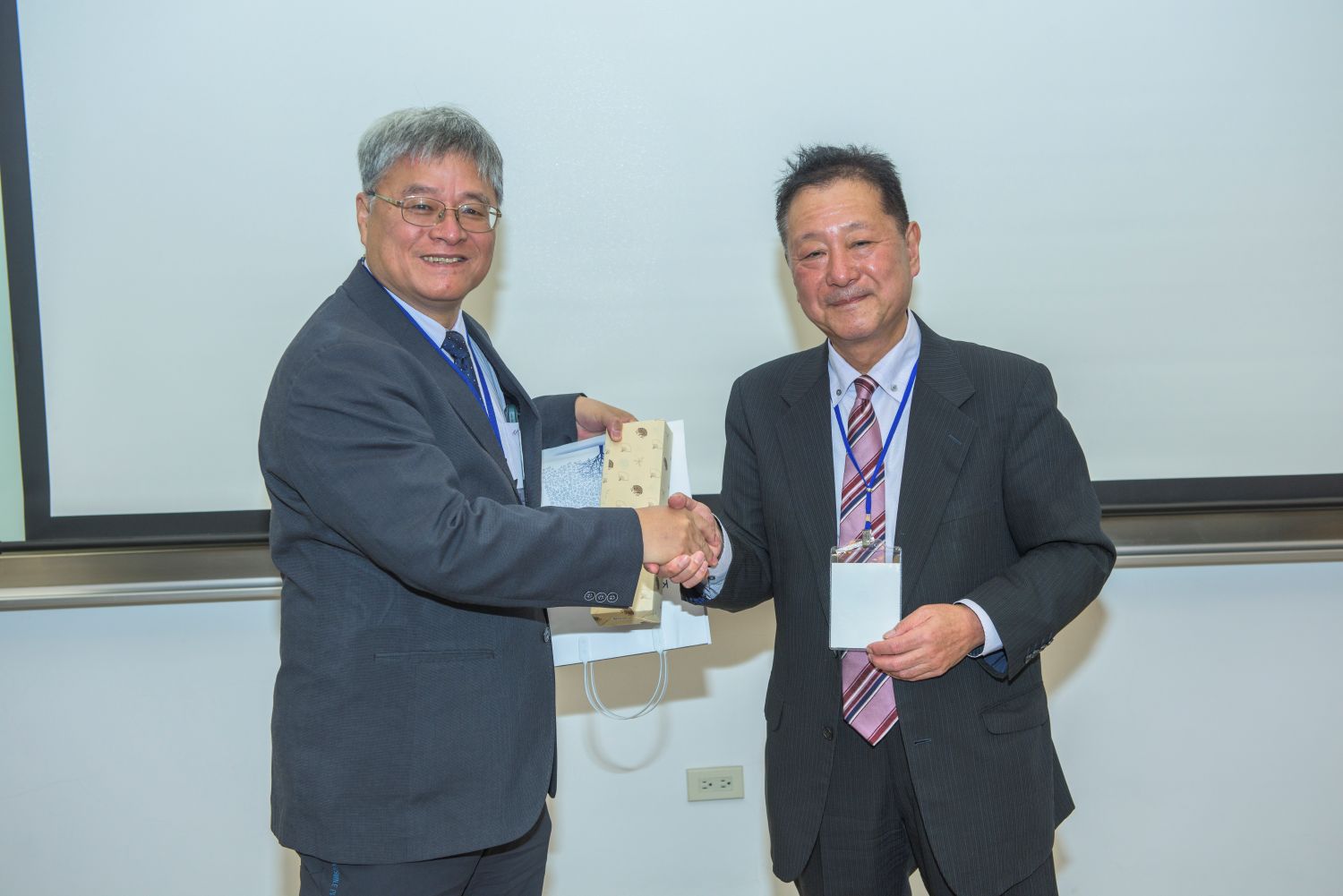
Professor Tomoharu Hori (right), Director of Kyoto University’s Disaster Prevention Research Institute, presents a commemorative gift to Vice President Yong-Chun Lee.
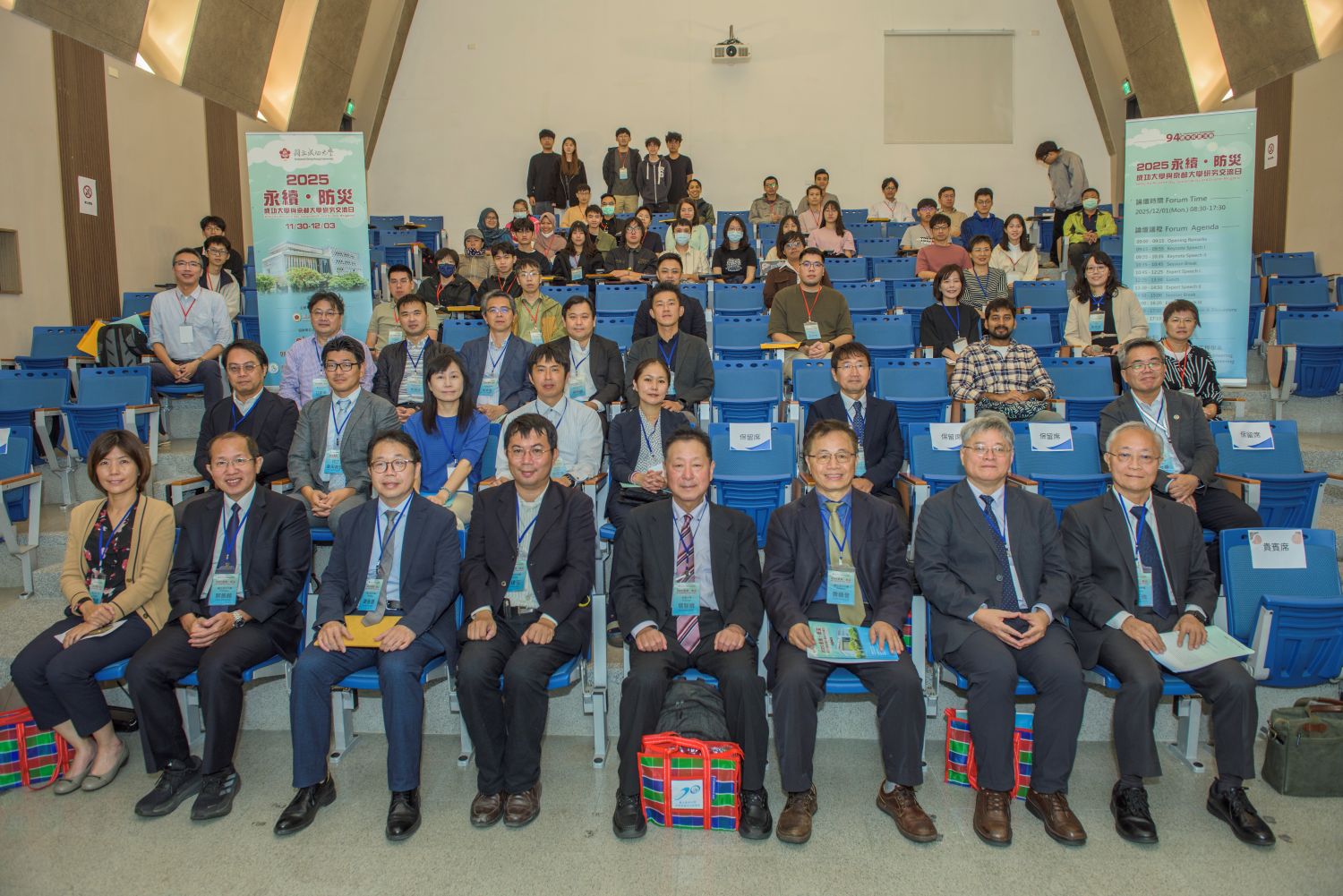
Group photo of the forum participants.
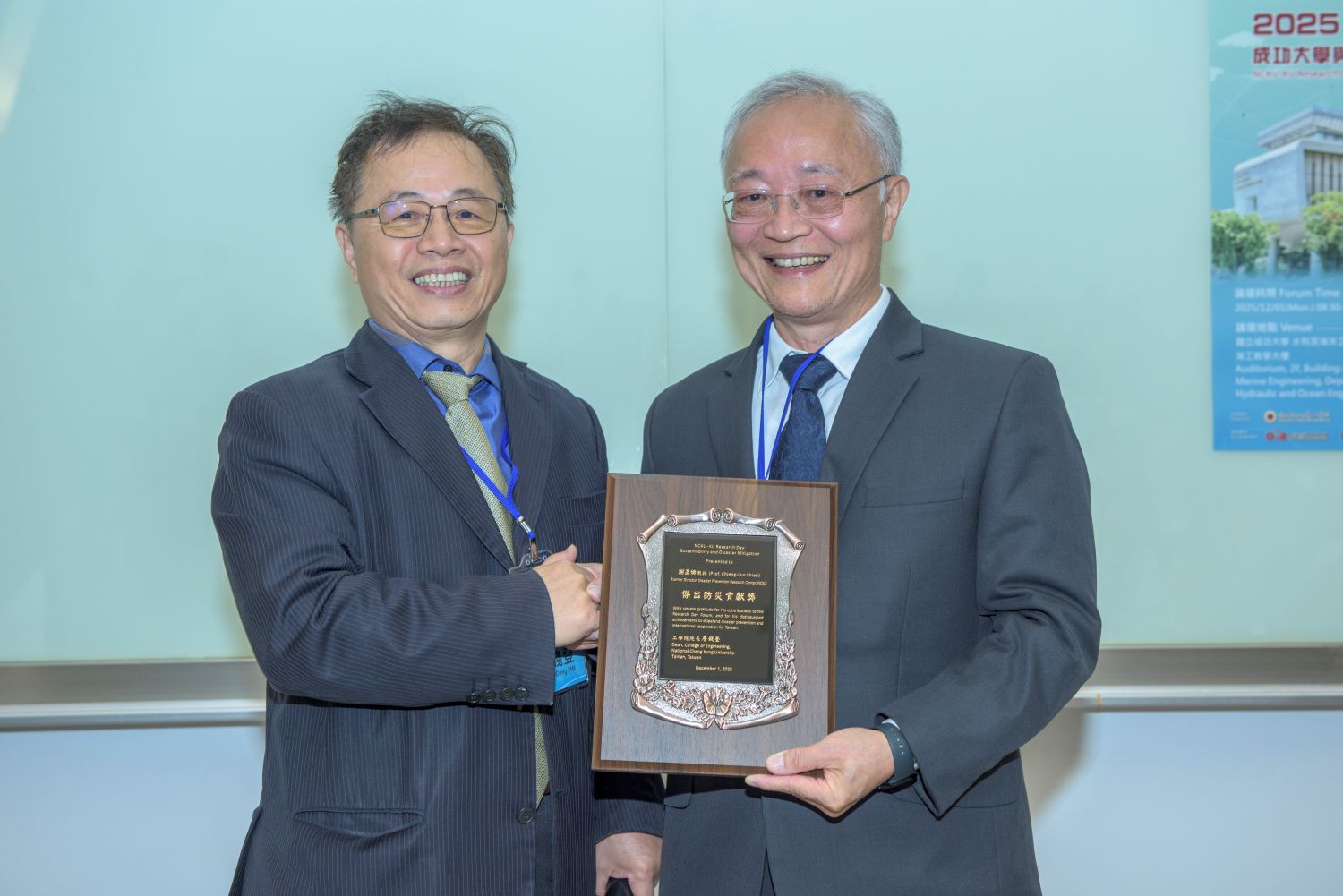
Dean Chien-Teng Chan (left) of the College of Engineering presented a commemorative plaque to honor Professor Emeritus Cheng-Lun Hsieh for his keynote lecture.