



SDG9
Taiwan’s Lilium-2 and Lilium-3 Satellites Achieve Successful Contact, Highlighting NCKU’s Expertise in LEO Satellite Development




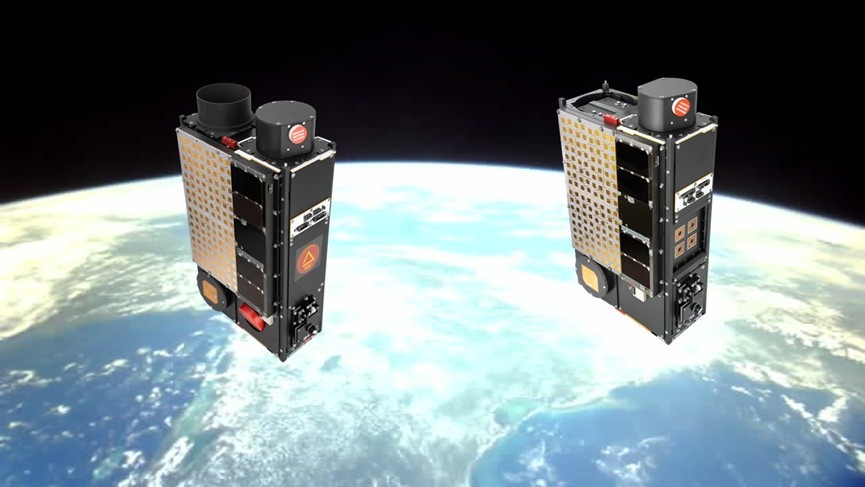
The two CubeSats, Taiwan Lilium-2 (Lilium-2) and Taiwan Lilium-3 (Lilium-3), developed by the CubeSat Research and Development Center at National Cheng Kung University (NCKU), were launched in the early hours of November 29, 2025, aboard SpaceX’s Falcon 9 rocket as part of the 15th dedicated rideshare mission (Transporter-15) from Vandenberg Space Force Base, California, USA, successfully reaching low Earth orbit at an altitude of approximately 520 kilometers.
Following orbital insertion, the NCKU team successfully established communication with both satellites the next day. After several days of continuous operation and verification, both Lilium-2 and Lilium-3 completed early orbit operations, achieved three-axis stabilization, and entered the mission-ready phase. Lilium-2 flew over the western side of Taiwan on December 11, and Lilium-3 followed on December 16. The team released onboard images captured during these overpasses to share with the public.
Professor Chih-Ching Chuang (莊智清) of the CubeSat Research and Development Center explained that the released footage was obtained in continuous imaging mode, which relies on the integration of multiple key technologies, including precise orbital positioning, stable attitude control, and complete data transmission. These systems work together to enable successful in-orbit imaging.
Professor Chuang also elaborated on early orbit operations, describing them as a critical phase following orbital insertion. The main objective is to verify the operational status and health of each subsystem and payload, forming the foundation for subsequent mission execution. During the satellite design, manufacturing, and testing phases, the team applied agile and lean systems engineering concepts, enabling the satellites to quickly complete system identification, verification, and three-axis stabilization, demonstrating the team’s high integration capability and operational efficiency.
Both Lilium-2 and Lilium-3 are 6U CubeSats, measuring 10 × 20 × 30 cm and weighing approximately 10 kilograms each. Following the completion of early orbit operations, the NCKU team will continue in-orbit validation of key technologies, including LEO communication, intelligent telemetry, inter-satellite communication, electric propulsion, and deployable mechanisms.
This mission not only strengthens Taiwan’s overall LEO satellite development capability, but also lays an important foundation for future commercial applications, national security, and the cultivation of space professionals.
Following orbital insertion, the NCKU team successfully established communication with both satellites the next day. After several days of continuous operation and verification, both Lilium-2 and Lilium-3 completed early orbit operations, achieved three-axis stabilization, and entered the mission-ready phase. Lilium-2 flew over the western side of Taiwan on December 11, and Lilium-3 followed on December 16. The team released onboard images captured during these overpasses to share with the public.
Professor Chih-Ching Chuang (莊智清) of the CubeSat Research and Development Center explained that the released footage was obtained in continuous imaging mode, which relies on the integration of multiple key technologies, including precise orbital positioning, stable attitude control, and complete data transmission. These systems work together to enable successful in-orbit imaging.
Professor Chuang also elaborated on early orbit operations, describing them as a critical phase following orbital insertion. The main objective is to verify the operational status and health of each subsystem and payload, forming the foundation for subsequent mission execution. During the satellite design, manufacturing, and testing phases, the team applied agile and lean systems engineering concepts, enabling the satellites to quickly complete system identification, verification, and three-axis stabilization, demonstrating the team’s high integration capability and operational efficiency.
Both Lilium-2 and Lilium-3 are 6U CubeSats, measuring 10 × 20 × 30 cm and weighing approximately 10 kilograms each. Following the completion of early orbit operations, the NCKU team will continue in-orbit validation of key technologies, including LEO communication, intelligent telemetry, inter-satellite communication, electric propulsion, and deployable mechanisms.
This mission not only strengthens Taiwan’s overall LEO satellite development capability, but also lays an important foundation for future commercial applications, national security, and the cultivation of space professionals.
Taiwan’s Lilium-2 and Lilium-3 CubeSats