



SDG13
NCKU Launches Taiwan’s First Net-Zero Green Skills Micro-Credit Program Aligned with Ministry of Environment Certification
National Cheng Kung University (NCKU), in response to Taiwan’s 2050 net-zero emissions goal, has undertaken a Ministry of Environment initiative to cultivate net-zero green talent and is actively promoting talent development in southern Taiwan. This year, NCKU became the first university in Taiwan to formally integrate the Ministry’s training curriculum into its academic system. Coordinated by the Office of Academic Affairs, the university launched a micro-credit program titled “Net-Zero Transition Strategies and Practices,” converting the Ministry’s training modules into credit-bearing courses. The program enables students from diverse departments and academic levels to receive systematic net-zero education. Upon completion, students are eligible to take the Ministry’s national certification examination, and those who pass will receive an official certification as qualified net-zero green professionals—achieving seamless alignment between campus learning and the national certification system.
Following course registration this semester, more than 100 students enrolled; however, due to classroom capacity, 90 students were admitted. Participants come from a wide range of disciplines, including chemical engineering, civil engineering, mechanical engineering, environmental engineering, as well as economics, law, history, and Taiwanese literature. This diversity highlights how net-zero issues transcend disciplinary boundaries and have become a shared interdisciplinary priority.
A senior student from the Department of Environmental Engineering noted that she had originally planned to pay for the training program independently, but the introduction of the micro-credit course allowed her to take it on campus while saving on training costs. She added that some course content aligns closely with her major, and she looks forward to more advanced topics such as the Carbon Border Adjustment Mechanism (CBAM) and carbon inventory in the latter part of the course.
A second-year master’s student from the Department of Business Administration shared that although graduate students typically cannot receive credit for undergraduate courses, she enrolled due to the relevance of green sustainability to her research. She hopes to deepen her understanding of ESG and net-zero issues and noted that the opportunity to directly take the Ministry’s certification exam after completing the course is highly attractive for her future career development.
A graduate student from the Department of Architecture explained that his research focuses on building-related carbon emissions. He hopes to learn calculation methods such as calorific values and emission factors through the course, as this knowledge will be essential for his future career in architecture or sustainability-related fields.
The course consists of 54 hours and 3 credits and adopts a collaborative teaching model involving academia, industry, and government. The teaching team includes distinguished experts such as former EPA Minister Tzu-Ching Chang and Mei-Kuei Chu, Chief Secretary of the Tainan Environmental Protection Bureau. Designed in accordance with the Ministry of Environment’s net-zero green talent training framework, the curriculum covers a comprehensive range of topics—from net-zero policies and carbon management to product carbon footprints. It spans global net-zero trends, carbon pricing, and CBAM, extending to Taiwan’s climate governance, carbon fee mechanisms, and related legal frameworks, equipping students with insights into both domestic and international policy developments.
The latter part of the course focuses on practical carbon management skills essential for industry, including greenhouse gas inventory procedures, registration and verification processes, principles of inventory reporting, as well as voluntary reduction projects and carbon market mechanisms. It also introduces Life Cycle Assessment (LCA) and Product Carbon Footprint (CFP), using case studies and calculation exercises to help students understand carbon quantification and labeling systems. Additionally, students visit The Magic School of Green Technologies at NCKU’s Li-Hsing Campus, a demonstration site for green buildings, to gain hands-on insights into energy efficiency and carbon reduction in architecture, bridging theory and practice.
As the Southern Taiwan Training Center under the Ministry of Environment’s Net-Zero Green Talent Alliance, NCKU has connected 15 universities and colleges across Chiayi, Tainan, Kaohsiung, and Pingtung to jointly promote green talent development in the region. Since last year, multiple training sessions have been offered to both university students and the general public. This year, by formally institutionalizing the training content into academic courses, NCKU has further advanced its strategy of embedding green education at the foundational level, cultivating a new generation of interdisciplinary and practice-oriented net-zero sustainability talent in southern Taiwan.
Following course registration this semester, more than 100 students enrolled; however, due to classroom capacity, 90 students were admitted. Participants come from a wide range of disciplines, including chemical engineering, civil engineering, mechanical engineering, environmental engineering, as well as economics, law, history, and Taiwanese literature. This diversity highlights how net-zero issues transcend disciplinary boundaries and have become a shared interdisciplinary priority.
A senior student from the Department of Environmental Engineering noted that she had originally planned to pay for the training program independently, but the introduction of the micro-credit course allowed her to take it on campus while saving on training costs. She added that some course content aligns closely with her major, and she looks forward to more advanced topics such as the Carbon Border Adjustment Mechanism (CBAM) and carbon inventory in the latter part of the course.
A second-year master’s student from the Department of Business Administration shared that although graduate students typically cannot receive credit for undergraduate courses, she enrolled due to the relevance of green sustainability to her research. She hopes to deepen her understanding of ESG and net-zero issues and noted that the opportunity to directly take the Ministry’s certification exam after completing the course is highly attractive for her future career development.
A graduate student from the Department of Architecture explained that his research focuses on building-related carbon emissions. He hopes to learn calculation methods such as calorific values and emission factors through the course, as this knowledge will be essential for his future career in architecture or sustainability-related fields.
The course consists of 54 hours and 3 credits and adopts a collaborative teaching model involving academia, industry, and government. The teaching team includes distinguished experts such as former EPA Minister Tzu-Ching Chang and Mei-Kuei Chu, Chief Secretary of the Tainan Environmental Protection Bureau. Designed in accordance with the Ministry of Environment’s net-zero green talent training framework, the curriculum covers a comprehensive range of topics—from net-zero policies and carbon management to product carbon footprints. It spans global net-zero trends, carbon pricing, and CBAM, extending to Taiwan’s climate governance, carbon fee mechanisms, and related legal frameworks, equipping students with insights into both domestic and international policy developments.
The latter part of the course focuses on practical carbon management skills essential for industry, including greenhouse gas inventory procedures, registration and verification processes, principles of inventory reporting, as well as voluntary reduction projects and carbon market mechanisms. It also introduces Life Cycle Assessment (LCA) and Product Carbon Footprint (CFP), using case studies and calculation exercises to help students understand carbon quantification and labeling systems. Additionally, students visit The Magic School of Green Technologies at NCKU’s Li-Hsing Campus, a demonstration site for green buildings, to gain hands-on insights into energy efficiency and carbon reduction in architecture, bridging theory and practice.
As the Southern Taiwan Training Center under the Ministry of Environment’s Net-Zero Green Talent Alliance, NCKU has connected 15 universities and colleges across Chiayi, Tainan, Kaohsiung, and Pingtung to jointly promote green talent development in the region. Since last year, multiple training sessions have been offered to both university students and the general public. This year, by formally institutionalizing the training content into academic courses, NCKU has further advanced its strategy of embedding green education at the foundational level, cultivating a new generation of interdisciplinary and practice-oriented net-zero sustainability talent in southern Taiwan.
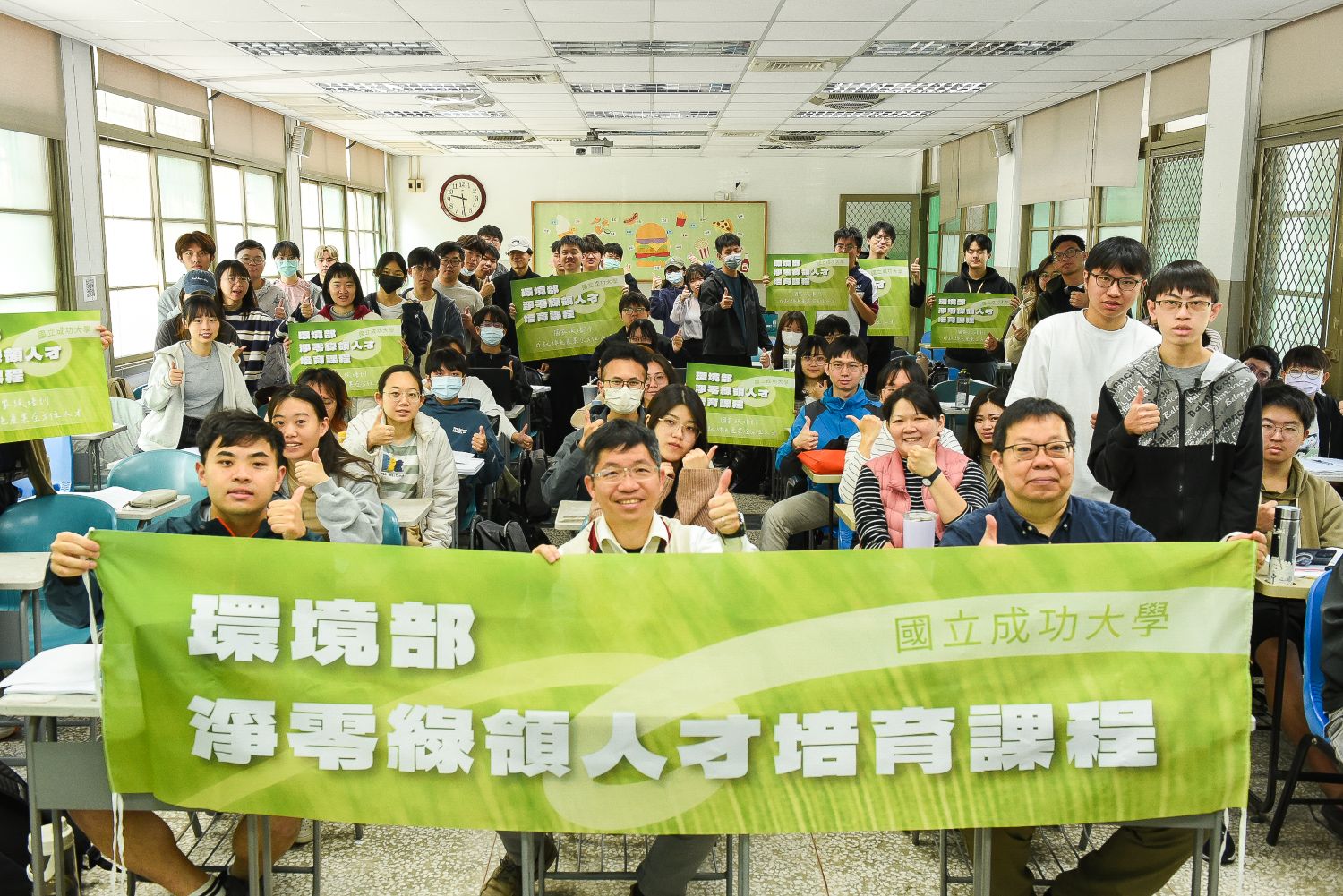
NCKU has introduced the Ministry of Environment’s net-zero green talent training content and launched a micro-credit course.
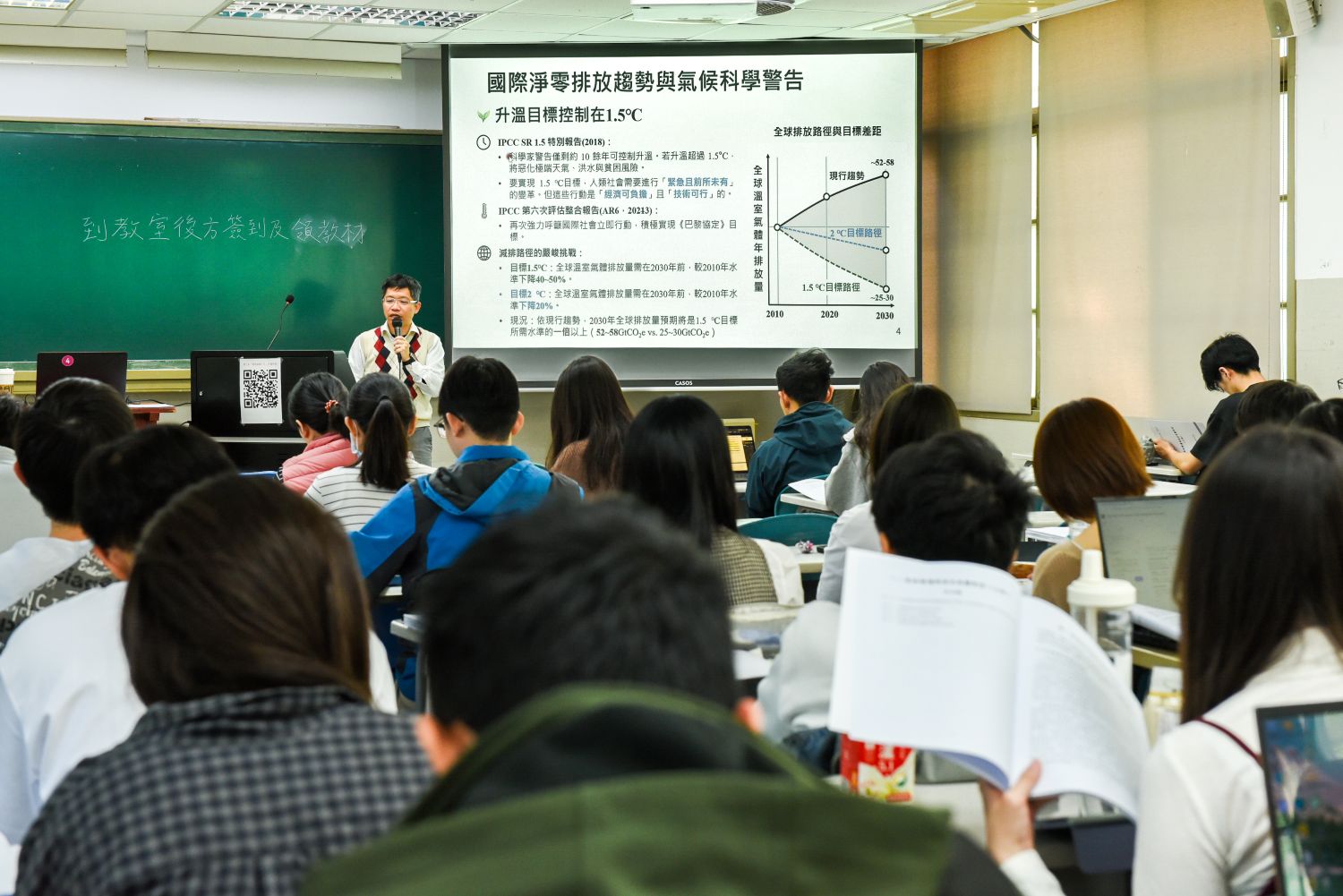
NCKU introduced the Ministry of Environment’s net-zero green talent training courses this semester, attracting strong student enrollment and filling all available seats, reflecting the high level of interest in net-zero issues on campus.