



SDG16
2026 Interior Renovation Legal Forum: Contracts & Market Governance




The “2026 Interior Design and Renovation Legal Forum,” co-hosted on March 21 at the College of Social Sciences by the College of Social Sciences and the Department of Law of National Cheng Kung University (NCKU), together with the National Federation of Interior Design and Renovation Associations of the Republic of China and the Tainan City Land Administration and Law Society, concluded successfully. The forum focused on the theme “The Gap Between Industry Practice and Consumer Protection under Standard Form Contracts in Interior Renovation.” The event was moderated by Prof. Shu-Li Wu of National Kaohsiung University of Science and Technology, a member of the Executive Yuan’s Consumer Protection Committee. Experts from government, industry, and academia gathered to discuss the institutional benefits and practical challenges under the implementation of the new regulatory framework.
With increasing demand for new home handovers and renovation of older buildings, interior design and renovation has become a high-value transaction characterized by significant information asymmetry, making it prone to consumer disputes. The National Land Management Agency of the Ministry of the Interior has promoted a standard form contract regulatory system under Article 17 of the Consumer Protection Act, establishing required and prohibited contractual clauses to enhance transparency and accountability. Director Chien-Yuan Yang of the Legal Affairs Office of the Tainan City Government noted that this system not only serves as a consumer protection tool but also involves building management and public safety, reflecting a hybrid governance model at the intersection of public and private law.
Associate Professor Wan-Ru Yeh of the Department of Law at NCKU pointed out that standard form contracts help transform verbal transactions into written, evidence-based contractual arrangements, while also facilitating the identification of legitimate operators and reducing informal market activity. However, the system faces several tensions, including the heterogeneity of the market and differences across business types, financial pressures on operators, and disparities in local review procedures that may lead to administrative cost transfer and concerns over competitive imbalance.
Chairman Yi-Hsin Liu of the National Federation of Interior Design and Renovation Associations emphasized that most renovation disputes arise from unregistered, illegal operators, while standard form contracts primarily regulate legitimate businesses. This may create an imbalance where compliant operators bear a disproportionate regulatory burden, highlighting the limitations of contract-based regulation alone. Chairman Chin-Yu Hung of the Regulatory Committee also noted that the current simplified renovation system has not been fully implemented, and differences in review fees and procedures across local governments—particularly regarding review standards and certification responsibilities under Articles 25 and 33 of renovation regulations—result in inconsistent enforcement. Such discrepancies increase compliance costs and create a gap between regulatory design and administrative implementation. Chairperson Wen-Jun Wu of the Interior Technician Promotion Committee further pointed out that while standard form contracts enhance transparency and consumer protection, they mainly apply to legitimate operators, potentially leading to a structural imbalance between heavily regulated legal businesses and low-cost illegal competitors.
Regarding future reform directions, participants suggested that government intervention in private contracts should be accompanied by more robust public communication, integration of industry perspectives, and respect for industry self-regulation and professional autonomy. This would help reduce the gap between policy design and practical implementation and avoid hindering market fairness. In response, Senior Engineer Chao-Hung Lu of the Building Management Division of the National Land Management Agency stated that the relevant required and prohibited contractual clauses are still under review, and feedback gathered from this forum will be incorporated into future revisions. Participants from government, industry, and academia jointly advocated for establishing a tiered contractual governance framework, integrating local review mechanisms, strengthening enforcement against illegal operators, and introducing performance guarantees and information disclosure systems to enhance transaction safety.
The forum highlighted that the legal framework for interior renovation is shifting from a focus on consumer protection toward broader market governance. Its effectiveness will depend on the coordinated operation of contractual regulation, administrative oversight, and industry practice, in order to achieve both institutional fairness and sound market development.
With increasing demand for new home handovers and renovation of older buildings, interior design and renovation has become a high-value transaction characterized by significant information asymmetry, making it prone to consumer disputes. The National Land Management Agency of the Ministry of the Interior has promoted a standard form contract regulatory system under Article 17 of the Consumer Protection Act, establishing required and prohibited contractual clauses to enhance transparency and accountability. Director Chien-Yuan Yang of the Legal Affairs Office of the Tainan City Government noted that this system not only serves as a consumer protection tool but also involves building management and public safety, reflecting a hybrid governance model at the intersection of public and private law.
Associate Professor Wan-Ru Yeh of the Department of Law at NCKU pointed out that standard form contracts help transform verbal transactions into written, evidence-based contractual arrangements, while also facilitating the identification of legitimate operators and reducing informal market activity. However, the system faces several tensions, including the heterogeneity of the market and differences across business types, financial pressures on operators, and disparities in local review procedures that may lead to administrative cost transfer and concerns over competitive imbalance.
Chairman Yi-Hsin Liu of the National Federation of Interior Design and Renovation Associations emphasized that most renovation disputes arise from unregistered, illegal operators, while standard form contracts primarily regulate legitimate businesses. This may create an imbalance where compliant operators bear a disproportionate regulatory burden, highlighting the limitations of contract-based regulation alone. Chairman Chin-Yu Hung of the Regulatory Committee also noted that the current simplified renovation system has not been fully implemented, and differences in review fees and procedures across local governments—particularly regarding review standards and certification responsibilities under Articles 25 and 33 of renovation regulations—result in inconsistent enforcement. Such discrepancies increase compliance costs and create a gap between regulatory design and administrative implementation. Chairperson Wen-Jun Wu of the Interior Technician Promotion Committee further pointed out that while standard form contracts enhance transparency and consumer protection, they mainly apply to legitimate operators, potentially leading to a structural imbalance between heavily regulated legal businesses and low-cost illegal competitors.
Regarding future reform directions, participants suggested that government intervention in private contracts should be accompanied by more robust public communication, integration of industry perspectives, and respect for industry self-regulation and professional autonomy. This would help reduce the gap between policy design and practical implementation and avoid hindering market fairness. In response, Senior Engineer Chao-Hung Lu of the Building Management Division of the National Land Management Agency stated that the relevant required and prohibited contractual clauses are still under review, and feedback gathered from this forum will be incorporated into future revisions. Participants from government, industry, and academia jointly advocated for establishing a tiered contractual governance framework, integrating local review mechanisms, strengthening enforcement against illegal operators, and introducing performance guarantees and information disclosure systems to enhance transaction safety.
The forum highlighted that the legal framework for interior renovation is shifting from a focus on consumer protection toward broader market governance. Its effectiveness will depend on the coordinated operation of contractual regulation, administrative oversight, and industry practice, in order to achieve both institutional fairness and sound market development.
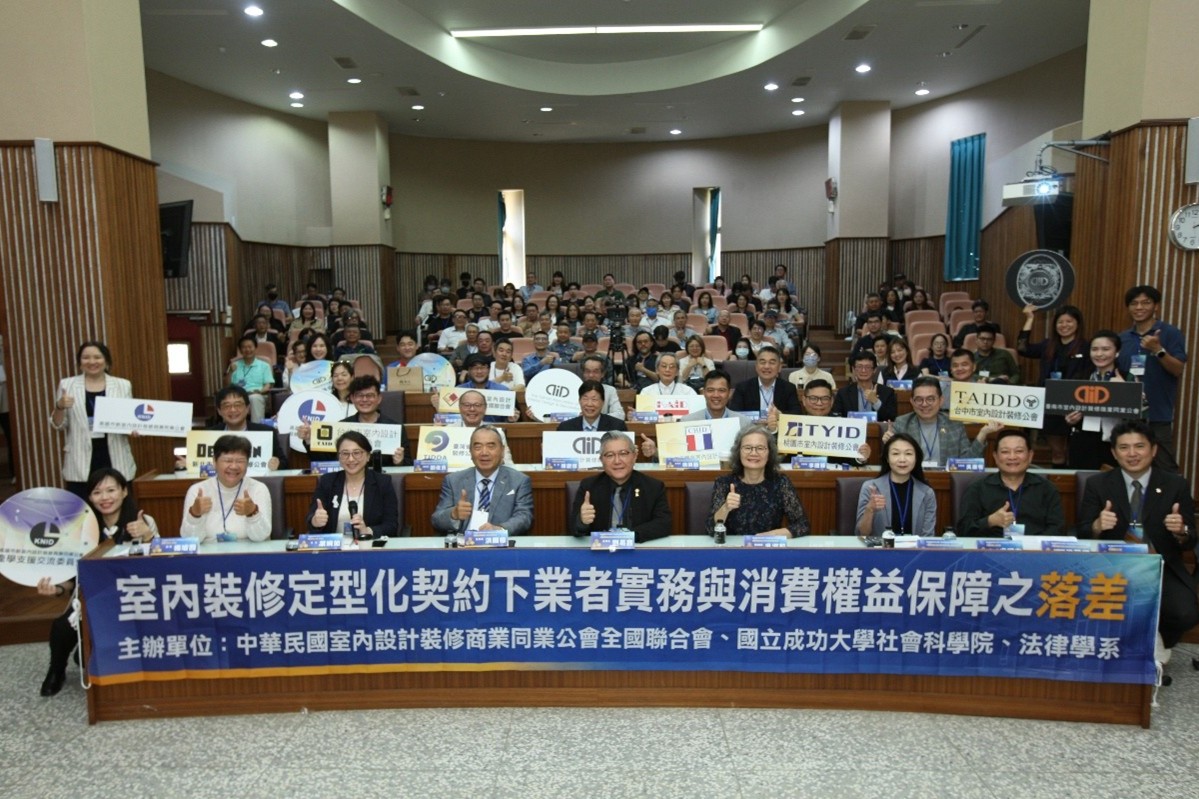
Experts from government, industry, and academia gathered at the “2026 Interior Design and Renovation Legal Forum.”
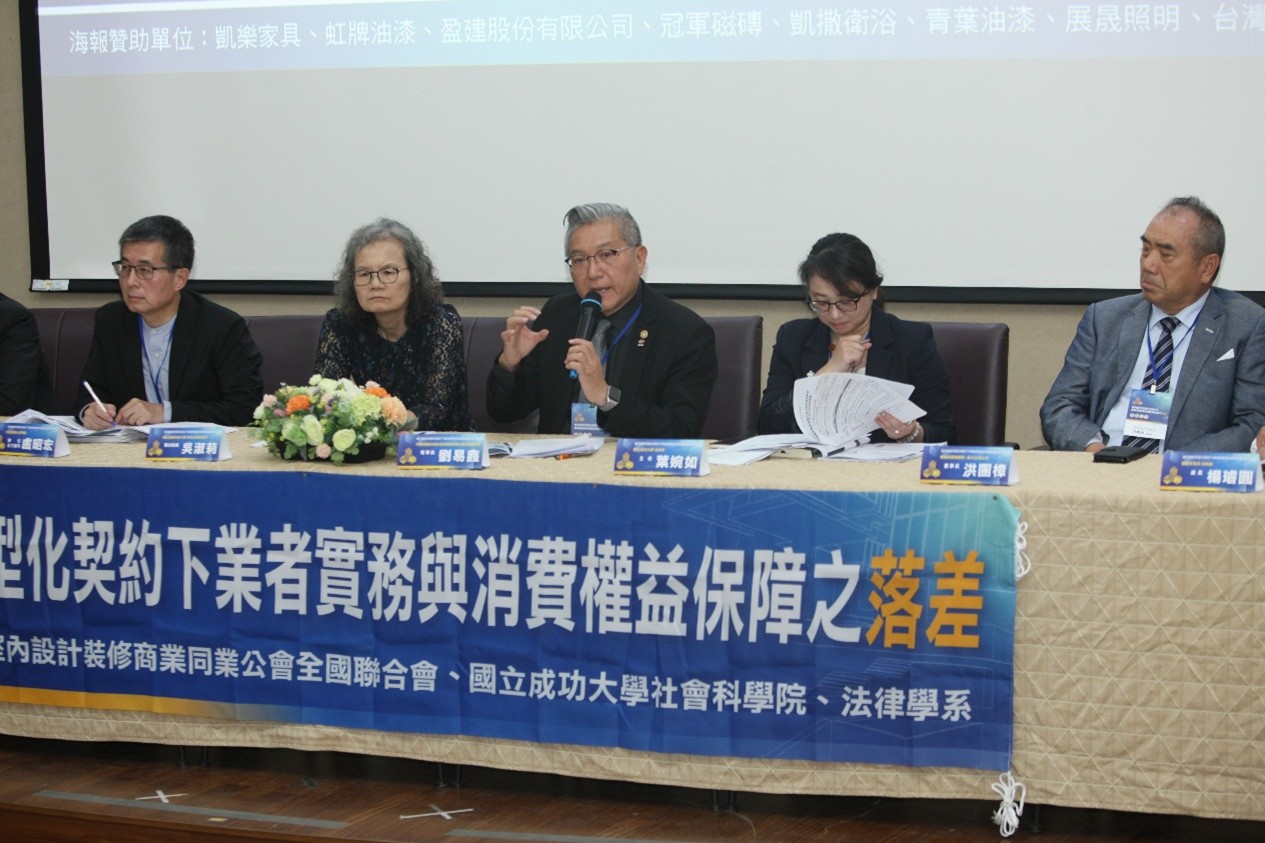
Participating experts and scholars engaged in lively discussions on the topic.
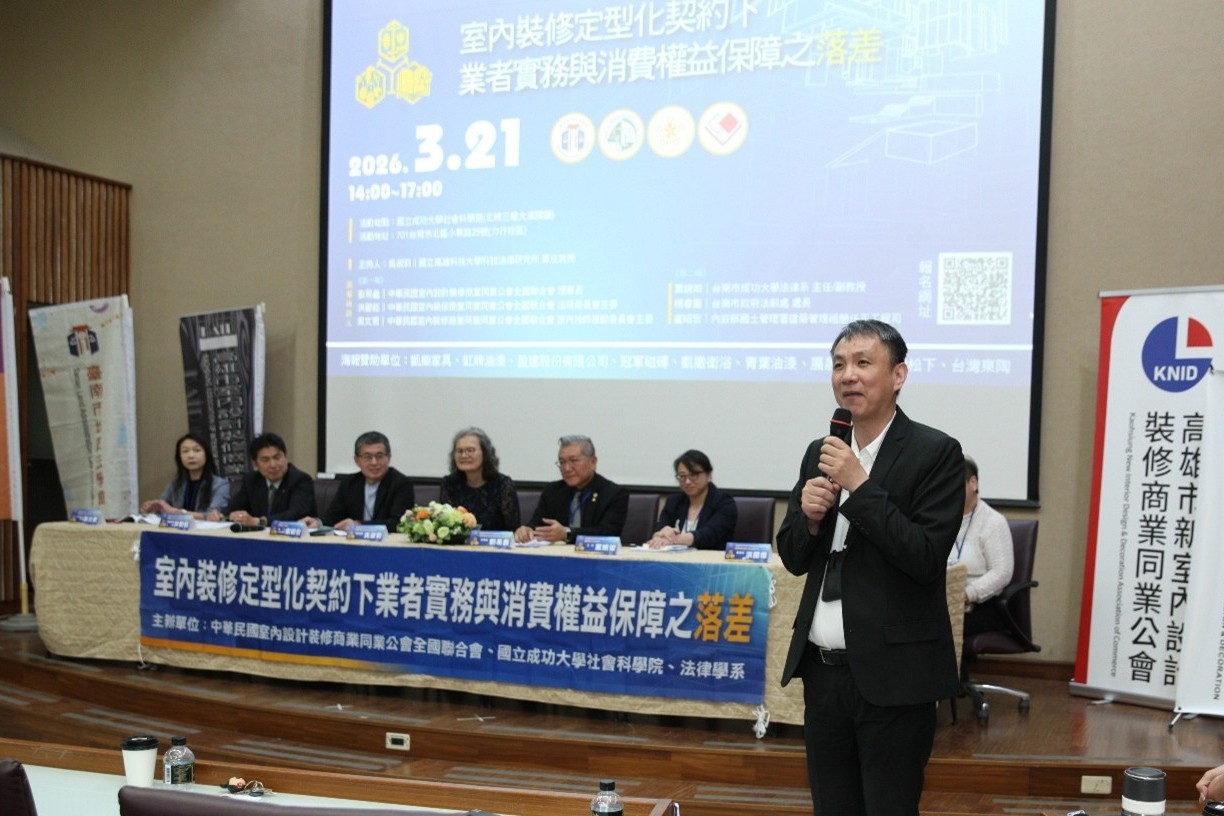
Dean Chun-Li Tsai of the College of Social Sciences encouraged participants to stay engaged with legal trends and industry developments, urging them to amplify the social impact of the social sciences.

SDG16NCKU Art Center presents the solo exhibition "Traumatic Landscapes, Cognitive Maps, and Memory Architecture" by Yun-Yi Liu.
View more
SDG16NCKU and the Central Weather Bureau signed an MOU for academic research exchange and talent development
View more