



SDG4
NCKU’s Ninth “Leadership and Action” Showcase Highlights Interdisciplinary Learning
The College of Social Sciences at National Cheng Kung University (NCKU) will hold the Ninth High School Student Learning Outcomes Presentation of its interdisciplinary credit program course, Leadership and Action, on June 7, 2026. The course has long been committed to fostering interdisciplinary exchange between universities and high schools. Through a mentorship-based approach, university students serve as facilitators and companions, guiding high school students to explore social issues, develop research skills, and strengthen critical thinking based on their own life experiences. The program aims to inspire innovative perspectives through cross-generational and interdisciplinary interaction while demonstrating the humanistic and social concerns at the core of the social sciences.
This year’s presentation is organized in collaboration with Tainan Municipal Yong-Ren Senior High School, Tzu Chi Senior High School, and Deguang Catholic High School. At the beginning of the semester, the course team visited all three schools to host information sessions introducing methods of independent learning and social issue research. A total of 21 student teams submitted proposals, and 13 teams were ultimately selected to participate in this year’s collaborative project.
Since March 2026, university and high school students have engaged in close collaboration centered on independent learning. By integrating university-level course resources and research methodologies, participants worked together through in-person discussions, online meetings, and periodic progress reviews. Over more than three months of exploration and refinement, students transformed their curiosity and social concerns into meaningful research projects. They will share both their findings and their learning journeys during the final presentation.
Reflecting the spirit of Taiwan’s 108 Curriculum Guidelines, which emphasize self-directed learning and diverse inquiry, this year’s research topics span a wide range of disciplines, including psychology, law, education, environmental studies, gender studies, media, and culture.
Several teams explored how experiences such as beach cleanups influence environmental behaviors and perceptions of marine conservation. Others examined the relationship between smartphone addiction, sleep disturbances, and classroom concentration. Additional projects investigated the stigmatization of mental illness, the connections between family attachment and romantic attachment styles, and psychological recovery following sports injuries.
Students also demonstrated a willingness to engage with complex and controversial public issues. Topics included whether civil protection orders truly enhance personal safety, reflections on juvenile correctional education systems, whether delayed justice can still be considered justice, and issues related to transitional justice and the reconstruction of historical memory.
In the fields of cultural and media studies, students analyzed the representation and transformation of gender stereotypes in the Japanese manga Demon Slayer: Kimetsu no Yaiba, explored emotional values and interpersonal relationships through the Chinese literary classic Dream of the Red Chamber, and applied Maslow’s Hierarchy of Needs to examine the motivations behind high school students’ posting behaviors on the social media platform Threads. Another team revisited the classic “Trolley Problem” to investigate how personality traits and value systems influence moral decision-making.
These diverse research topics not only reflect high school students’ keen observations of contemporary social issues but also demonstrate their ability to connect classroom learning with real-world challenges.
As the implementation of the 108 Curriculum Guidelines continues to mature, collaborative partnerships between universities and high schools have become increasingly meaningful. Through the Leadership and Action program, university students transform their academic knowledge into leadership and mentoring abilities while supporting high school students throughout the research process. Meanwhile, high school students gain access to more advanced research methods and broader academic perspectives through interaction with university students and faculty mentors, further strengthening their independent learning achievements.
From midterm presentations and mentoring sessions to the final showcase, students and educators have witnessed one another’s growth, extending the spirit of mutual learning beyond campus boundaries and creating lasting educational value through interschool collaboration.
The presentation will take place at 8:30 a.m. on Sunday, June 7, 2026, and will be open to both in-person and online participants. Due to limited seating for the on-site event, educators, students, and members of the public interested in social issue research, interdisciplinary learning, and university–high school collaborative education are encouraged to register early. Participants will have the opportunity to witness how young scholars use creativity, inquiry, and action to address important social issues. For more information, please visit the Social Data Science Credit Program website.
NCKU College of Social Sciences | Leadership and Action | 9th High School Student Learning Outcomes Presentation
Venue (In Person) | Lecture Hall, 3rd Floor, College of Social Sciences Building, Lixing Campus, National Cheng Kung University | Registration for In-Person Attendance
Program Booklet & Agenda | Online Participation Link | Meeting Code: zbs-ihji-rup
This year’s presentation is organized in collaboration with Tainan Municipal Yong-Ren Senior High School, Tzu Chi Senior High School, and Deguang Catholic High School. At the beginning of the semester, the course team visited all three schools to host information sessions introducing methods of independent learning and social issue research. A total of 21 student teams submitted proposals, and 13 teams were ultimately selected to participate in this year’s collaborative project.
Since March 2026, university and high school students have engaged in close collaboration centered on independent learning. By integrating university-level course resources and research methodologies, participants worked together through in-person discussions, online meetings, and periodic progress reviews. Over more than three months of exploration and refinement, students transformed their curiosity and social concerns into meaningful research projects. They will share both their findings and their learning journeys during the final presentation.
Reflecting the spirit of Taiwan’s 108 Curriculum Guidelines, which emphasize self-directed learning and diverse inquiry, this year’s research topics span a wide range of disciplines, including psychology, law, education, environmental studies, gender studies, media, and culture.
Several teams explored how experiences such as beach cleanups influence environmental behaviors and perceptions of marine conservation. Others examined the relationship between smartphone addiction, sleep disturbances, and classroom concentration. Additional projects investigated the stigmatization of mental illness, the connections between family attachment and romantic attachment styles, and psychological recovery following sports injuries.
Students also demonstrated a willingness to engage with complex and controversial public issues. Topics included whether civil protection orders truly enhance personal safety, reflections on juvenile correctional education systems, whether delayed justice can still be considered justice, and issues related to transitional justice and the reconstruction of historical memory.
In the fields of cultural and media studies, students analyzed the representation and transformation of gender stereotypes in the Japanese manga Demon Slayer: Kimetsu no Yaiba, explored emotional values and interpersonal relationships through the Chinese literary classic Dream of the Red Chamber, and applied Maslow’s Hierarchy of Needs to examine the motivations behind high school students’ posting behaviors on the social media platform Threads. Another team revisited the classic “Trolley Problem” to investigate how personality traits and value systems influence moral decision-making.
These diverse research topics not only reflect high school students’ keen observations of contemporary social issues but also demonstrate their ability to connect classroom learning with real-world challenges.
As the implementation of the 108 Curriculum Guidelines continues to mature, collaborative partnerships between universities and high schools have become increasingly meaningful. Through the Leadership and Action program, university students transform their academic knowledge into leadership and mentoring abilities while supporting high school students throughout the research process. Meanwhile, high school students gain access to more advanced research methods and broader academic perspectives through interaction with university students and faculty mentors, further strengthening their independent learning achievements.
From midterm presentations and mentoring sessions to the final showcase, students and educators have witnessed one another’s growth, extending the spirit of mutual learning beyond campus boundaries and creating lasting educational value through interschool collaboration.
The presentation will take place at 8:30 a.m. on Sunday, June 7, 2026, and will be open to both in-person and online participants. Due to limited seating for the on-site event, educators, students, and members of the public interested in social issue research, interdisciplinary learning, and university–high school collaborative education are encouraged to register early. Participants will have the opportunity to witness how young scholars use creativity, inquiry, and action to address important social issues. For more information, please visit the Social Data Science Credit Program website.
NCKU College of Social Sciences | Leadership and Action | 9th High School Student Learning Outcomes Presentation
Venue (In Person) | Lecture Hall, 3rd Floor, College of Social Sciences Building, Lixing Campus, National Cheng Kung University | Registration for In-Person Attendance
Program Booklet & Agenda | Online Participation Link | Meeting Code: zbs-ihji-rup
Poster for the 9th High School Student Learning Outcomes Presentation of NCKU’s “Leadership and Action” Program
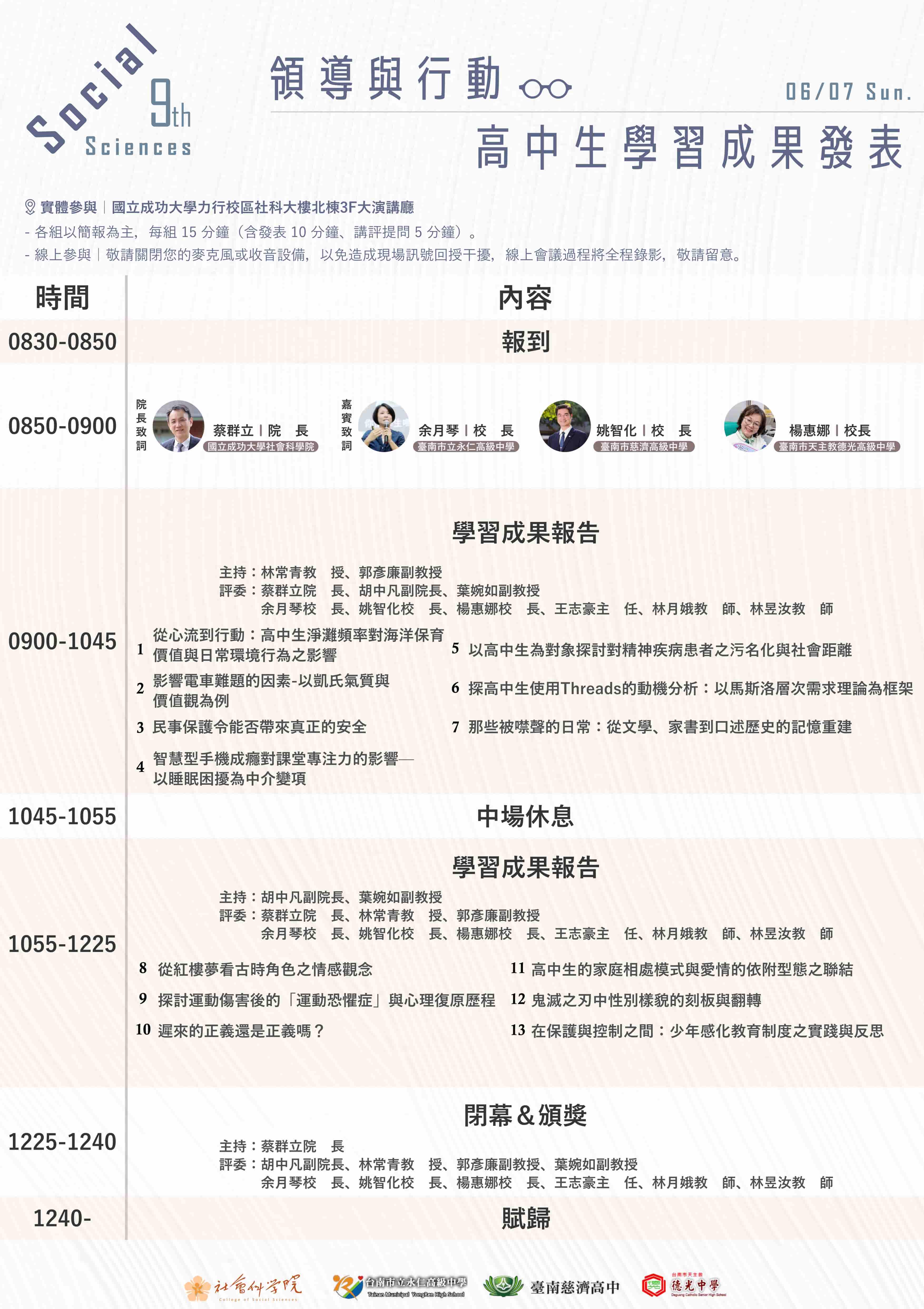
NCKU “Leadership and Action” Program 9th High School Student Learning Outcomes Presentation Agenda