



SDG3
Assisting the Fight Against Liver Cancer! NIAR and NCKU AI Platform Measures Liver Lipid Droplets with 98% Accuracy


Metabolic-dysfunction associated steatohepatitis (MASH) has replaced viral hepatitis as the leading cause of liver cancer in Taiwan! According to a 2025 survey by the Liver Disease Prevention & Treatment Research Foundation, the prevalence rate of fatty liver in Taiwan is as high as 54.8%. Another study pointed out that for every 10,000 fatty liver patients, 8 might deteriorate into liver cancer, and MASH is precisely the critical stage leading to liver cirrhosis and liver cancer. The National Center for Biomodels (NCB) under the National Institutes of Applied Research (NIAR) and Distinguished Professor Pau-Choo Chung from the Department of Electrical Engineering at National Cheng Kung University (NCKU) collaborated across fields to launch the "AI+MASH Pathology Quantification Platform." Through AI image analysis technology, the production time of mouse liver pathological test reports was shortened to one-fourth of the original time, helping research teams quickly evaluate the intervention effects of drugs on disease progression and boosting the efficiency of steatohepatitis drug screening!
The AI+MASH Platform Accelerates the Completion of Interpretation Reports, Assisting Drug Research and Development
Fatty liver can potentially cause MASH, further progress to fibrosis, and eventually form liver cirrhosis and liver cancer. If appropriate drug treatment is administered in a timely manner during MASH or even the initial stages of fibrosis, there is an opportunity to restore health.
Therefore, the team from NCB induced fatty liver models in experimental mice by administering a high-fat and high-sugar diet. They then utilized the "AI+MASH Pathology Quantification Platform" to precisely evaluate the degree of fatty liver, MASH, and fibrosis in mice, which can be used to test the therapeutic efficacy of various drugs.
The traditional method for evaluating liver pathological progression involves pathologists examining liver pathological sections, selecting a small portion for semi-quantitative scoring, and determining the lipid droplet content, inflammatory lesion density, and fibrosis area in the liver to infer pathological progression. The "AI+MASH Pathology Quantification Platform," co-developed by the team from NCB and NCKU, utilizes "panoramic scanning" and "AI automated analysis" to examine mouse liver pathological sections.
Yu-Chia Su, a researcher at NCB, pointed out that manual interpretation of liver pathological sections is not only time-consuming and easily affected by subjective factors, but it can also only infer based on partial areas of the liver pathological sections, which may generate errors. Through the human-machine collaboration of the "AI+MASH Platform," AI automated analysis is applied to all areas of the liver pathological sections, expanding from local sampling to panoramic objective analysis, removing subjective errors, and establishing absolute statistical standards. The consistency between the accuracy and manual professional interpretation is as high as 98%. Furthermore, it takes only 2 weeks for the quantitative report to be issued, which is then submitted for manual analysis and verification. Compared with traditional fully manual interpretation, which takes at least 2 months, the timeline for AI human-machine collaboration was shortened to one-fourth. This significantly enhances the capacity for pathological diagnosis of steatohepatitis, demonstrates the high potential of AI technology in the field of liver pathological research, and makes it a super teammate for pathologists.
The "AI+MASH Pathology Quantification Platform" combines the preclinical animal testing expertise of NCB, the AI image analysis technology of Professor Pau-Choo Chung's team from the Department of Electrical Engineering at NCKU, and the high-performance computing resources of the National Center for High-performance Computing (NCHC) under NIAR, achieving the advantages of "panoramic objectivity, rapid high-throughput, and consistent standards" in pathological analysis. In addition to quickly and accurately interpreting mouse liver pathological sections, pathological images can also be reviewed synchronously across countries, facilitating discussions among global drug R&D teams. The platform can also assist in preclinical trials of various MASH drugs, such as GLP-1 receptor agonists and FXR agonists.
High-Fat and High-Sugar Diet Accelerates Lesions; AI Model Precisely Identifies Pathological Evolution
Using the "AI+MASH Pathology Quantification Platform," the team from NCB discovered that the "distribution area of fatty liver cells" in the livers of the high-fat and high-sugar diet group of mice was as high as 88.39%, compared to only about 0.09% in the normal diet group, showing that diet has a significant impact on liver fat accumulation.
The AI model can precisely quantify the lipid droplet accumulation, inflammatory lesion density, and the distribution proportions of fatty liver cells and liver fibrosis across the entire area of the section. For example, a normal liver section has only 3.07 inflammatory lesions per square millimeter, while the steatohepatitis group has as many as 39.7. The research team can evaluate the intervention effects of drugs on disease progression through the aforementioned four types of pathological quantification.
The platform can simultaneously provide a "liver panoramic visualization map" function, which identifies various pathological characteristics of steatohepatitis based on different models, marks their locations, and assists in quickly locating lesion positions. Thereby, it serves as an important indicator for evaluating the severity and affected areas of steatohepatitis, providing objective data for drug efficacy evaluation.
Hsian-Jean Chin, Director General of NCB, emphasized that this technology not only improves the efficiency of pathological analysis but also provides critical assistance for MASH drug screening, accelerating the clinical translation of therapeutic solutions. In the future, the platform will continue to be optimized, combined with more pathological models, and support global steatohepatitis drug R&D, benefiting public health and well-being while enhancing the international competitiveness of Taiwan's biotechnology industry.
The AI+MASH Platform Accelerates the Completion of Interpretation Reports, Assisting Drug Research and Development
Fatty liver can potentially cause MASH, further progress to fibrosis, and eventually form liver cirrhosis and liver cancer. If appropriate drug treatment is administered in a timely manner during MASH or even the initial stages of fibrosis, there is an opportunity to restore health.
Therefore, the team from NCB induced fatty liver models in experimental mice by administering a high-fat and high-sugar diet. They then utilized the "AI+MASH Pathology Quantification Platform" to precisely evaluate the degree of fatty liver, MASH, and fibrosis in mice, which can be used to test the therapeutic efficacy of various drugs.
The traditional method for evaluating liver pathological progression involves pathologists examining liver pathological sections, selecting a small portion for semi-quantitative scoring, and determining the lipid droplet content, inflammatory lesion density, and fibrosis area in the liver to infer pathological progression. The "AI+MASH Pathology Quantification Platform," co-developed by the team from NCB and NCKU, utilizes "panoramic scanning" and "AI automated analysis" to examine mouse liver pathological sections.
Yu-Chia Su, a researcher at NCB, pointed out that manual interpretation of liver pathological sections is not only time-consuming and easily affected by subjective factors, but it can also only infer based on partial areas of the liver pathological sections, which may generate errors. Through the human-machine collaboration of the "AI+MASH Platform," AI automated analysis is applied to all areas of the liver pathological sections, expanding from local sampling to panoramic objective analysis, removing subjective errors, and establishing absolute statistical standards. The consistency between the accuracy and manual professional interpretation is as high as 98%. Furthermore, it takes only 2 weeks for the quantitative report to be issued, which is then submitted for manual analysis and verification. Compared with traditional fully manual interpretation, which takes at least 2 months, the timeline for AI human-machine collaboration was shortened to one-fourth. This significantly enhances the capacity for pathological diagnosis of steatohepatitis, demonstrates the high potential of AI technology in the field of liver pathological research, and makes it a super teammate for pathologists.
The "AI+MASH Pathology Quantification Platform" combines the preclinical animal testing expertise of NCB, the AI image analysis technology of Professor Pau-Choo Chung's team from the Department of Electrical Engineering at NCKU, and the high-performance computing resources of the National Center for High-performance Computing (NCHC) under NIAR, achieving the advantages of "panoramic objectivity, rapid high-throughput, and consistent standards" in pathological analysis. In addition to quickly and accurately interpreting mouse liver pathological sections, pathological images can also be reviewed synchronously across countries, facilitating discussions among global drug R&D teams. The platform can also assist in preclinical trials of various MASH drugs, such as GLP-1 receptor agonists and FXR agonists.
High-Fat and High-Sugar Diet Accelerates Lesions; AI Model Precisely Identifies Pathological Evolution
Using the "AI+MASH Pathology Quantification Platform," the team from NCB discovered that the "distribution area of fatty liver cells" in the livers of the high-fat and high-sugar diet group of mice was as high as 88.39%, compared to only about 0.09% in the normal diet group, showing that diet has a significant impact on liver fat accumulation.
The AI model can precisely quantify the lipid droplet accumulation, inflammatory lesion density, and the distribution proportions of fatty liver cells and liver fibrosis across the entire area of the section. For example, a normal liver section has only 3.07 inflammatory lesions per square millimeter, while the steatohepatitis group has as many as 39.7. The research team can evaluate the intervention effects of drugs on disease progression through the aforementioned four types of pathological quantification.
The platform can simultaneously provide a "liver panoramic visualization map" function, which identifies various pathological characteristics of steatohepatitis based on different models, marks their locations, and assists in quickly locating lesion positions. Thereby, it serves as an important indicator for evaluating the severity and affected areas of steatohepatitis, providing objective data for drug efficacy evaluation.
Hsian-Jean Chin, Director General of NCB, emphasized that this technology not only improves the efficiency of pathological analysis but also provides critical assistance for MASH drug screening, accelerating the clinical translation of therapeutic solutions. In the future, the platform will continue to be optimized, combined with more pathological models, and support global steatohepatitis drug R&D, benefiting public health and well-being while enhancing the international competitiveness of Taiwan's biotechnology industry.
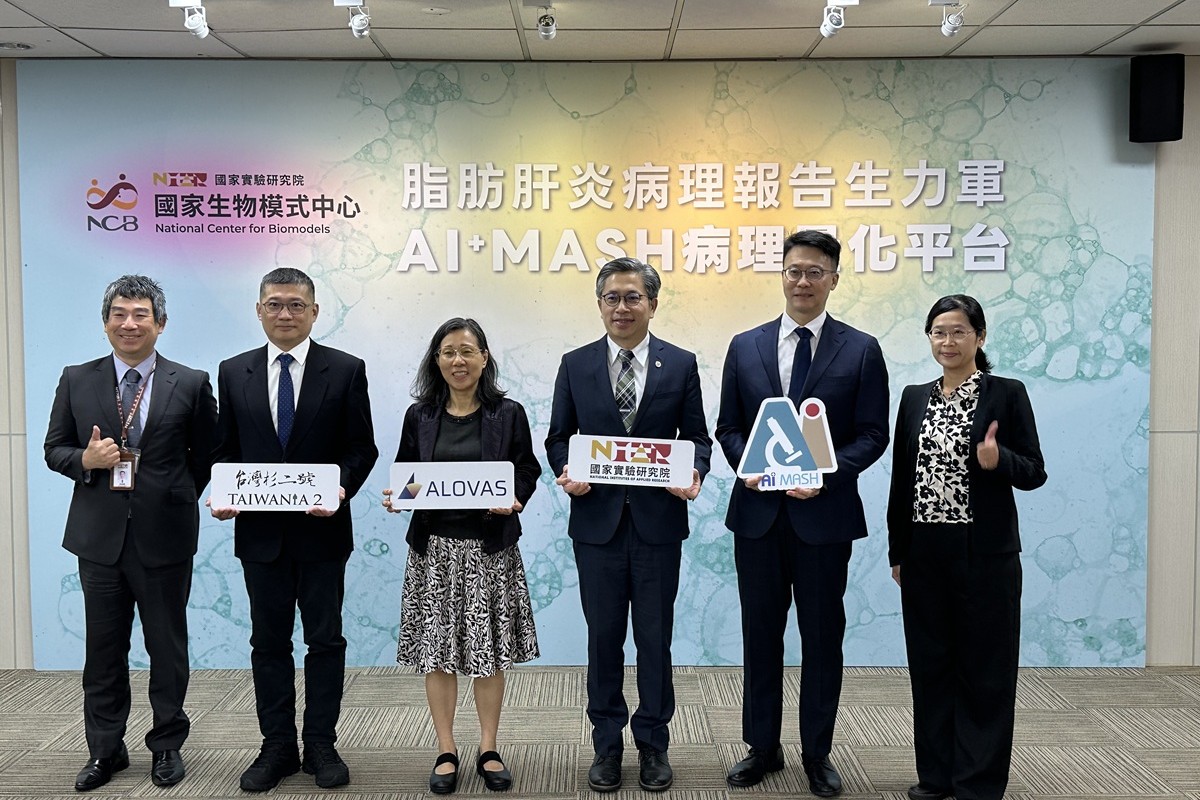
Group photo, from left: Lung-Yao Chang, Director of the Department of Operations and Promotion at NIAR; Yu-Tai Wang, Researcher at NCHC, NIAR; Distinguished Professor Pau-Choo Chung from the Department of Electrical Engineering at NCKU; President Hung-Yin Tsai of NIAR; Deputy Director General Yu-Chia Su of NCB; and Hui-Fen Zheng, Associate Researcher at NCB.

Sharing by Distinguished Professor Pau-Choo Chung from NCKU

SDG3【94th Anniversary】 Anniversary Themed Book Fair Series: “The Failed Laboratory” – Exploring the Multiple Meanings of Failure
View more
SDG3Let the 80-year-old Dream Tree Blossom - NCKU Continues the Friendship of Le Chi in Pingtung
View more