




SDG11
Tech Meets Tradition: NCKU and Schools Partner to Preserve Song-Jiang Battle Array


Jung-Ta Yang, Director of the NCKU Center for Humanities and Social Sciences, stated that the Song-Jiang Battle Array is an indigenous sport format in Taiwan. Viewed from its historical development, it represents a self-defense mechanism for local villages, which further evolved into diversified battle array styles exclusive to local characteristics. The preservation of local traditional culture should not just remain in museums; it must be integrated into the daily lives of the next generation through diverse interpretations, making the Song-Jiang Battle Array a part of everyday life. This event not only fostered a cross-school community network linking Tainan’s local schools—including National Cheng Kung University, Liujia Junior High School, Jingliao Elementary School, and Longtian Elementary School—but also went deep into the field, fully preserving the precious skills and physical memories of veteran martial arts masters through video recordings. Furthermore, modern motion capture and interactive technology were introduced, transforming complex martial array fist techniques into digital experiences that the younger generation can easily learn and wants to learn. This is not merely a combination of techniques, but the utilization of modern technology to sustain the future of traditional culture, opening up a cross-generational cultural dialogue and inheritance with new tools.
Under the close cooperation between the project team and local schools, this Song-Jiang Battle Array performance was co-presented by Coach Jun-Yi Cai, leading NCKU, Liujia Junior High School, Jingliao Elementary School, Longtian Elementary School, and veteran master Xian-Jun Du from the Jian-Xing Martial Arts Hall. Local veteran masters Guo-Zhao He, Yin-Ding Huang, and Fu-Li Zheng, along with Chief Yu-Ling Zheng from the Tainan Municipal Cultural Heritage Office, who has long promoted the inheritance of intangible cultural heritage skills, were also invited to provide guidance on-site. By leveraging the fist techniques and array variations transformed from the Song-Jiang Battle Array, the masters used physical movements, sounds, and an all-out spirit to teach by example rather than words, serving as a communication tool across generations. Through martial arts gymnastics that offer fitness benefits, the complex basic skills of the traditional Song-Jiang Battle Array were transformed into body movements easy for children to learn, allowing this precious cultural asset to take root at the grassroots level of campuses and achieving true generational inheritance.
In terms of historical and cultural preservation, Professor Jian-Sheng Wu from National Chiayi University and research expert Zhi-Chang Chen from the NCKU College of Liberal Arts led the team to conduct in-depth fieldwork and interviews with local veteran masters in Tainan. They transformed martial arts moves and array variations, which were previously mostly passed down orally, into precious digital texts and videos, forming an important foundation for compiling the martial arts gymnastics manual. Another highlight of the event was the introduction of modern technology. On-site, Professor Jia-Qi Cai from the Department of Electrical Engineering demonstrated the latest "motion capture technology," and Professor Yan-Cheng Lin's team from the Department of Industrial Design showcased the "interactive technology platform" they designed, digitally and accurately recording the masters' martial arts movements. In the future, teachers and students in primary and secondary schools will be able to learn Song-Jiang Battle Array movements across boundaries through this interactive platform without time and space constraints, utilizing technological tools to significantly enhance the promotion efficiency and scalability of traditional martial arts.
In addition to cultural inheritance and technological promotion, the event analyzed the relationship between traditional martial arts and the human body from a scientific and health perspective. The results of the "Cross-Sectional Study Exploring the Physical and Mental Performance of Song-Jiang Martial Array Masters" showed that participating masters experienced significant positive benefits in mental health, muscular endurance, and overall health promotion. This endows traditional martial arrays with new value in modern public health research from a scientific viewpoint, and can serve as a theoretical foundation for promoting the Song-Jiang Battle Array to the general public. Additionally, Professor Xue-Wen Zhou from the Institute of Physical Education, Health and Leisure Studies, and Professor Hong-Jun Huang from the Physical Education Office, compiled the martial arts gymnastics manual based on safety and physical comfort, which will serve as a medium for subsequent public promotion.
The Song-Jiang Battle Array is not only a folk sport but also an intangible cultural asset that binds local emotions. Looking ahead, the project will combine long-term achievements accumulated by the public sector to continuously deepen community cooperation among universities, junior high schools, and elementary schools. Efforts will be made to simplify the complexity of martial arts gymnastics, further reinforcing movements that prioritize safety and physical comfort. Weapons will be transformed into readily available everyday items, such as towels and water bottles, to be promoted to communities and senior citizen universities. Through community and individual promotion using more diverse methods, the Song-Jiang Battle Array culture will once again become an all-age sport in the everyday lives of ordinary people.
A group photo of the NCKU project team, Master Guo-Zhao He (seated center), and martial arts masters from Jian-Xing Martial Arts Hall at the "Shocking Taiwan" event, held on June 14 at the NCKU Miin-Chuan Gymnasium.
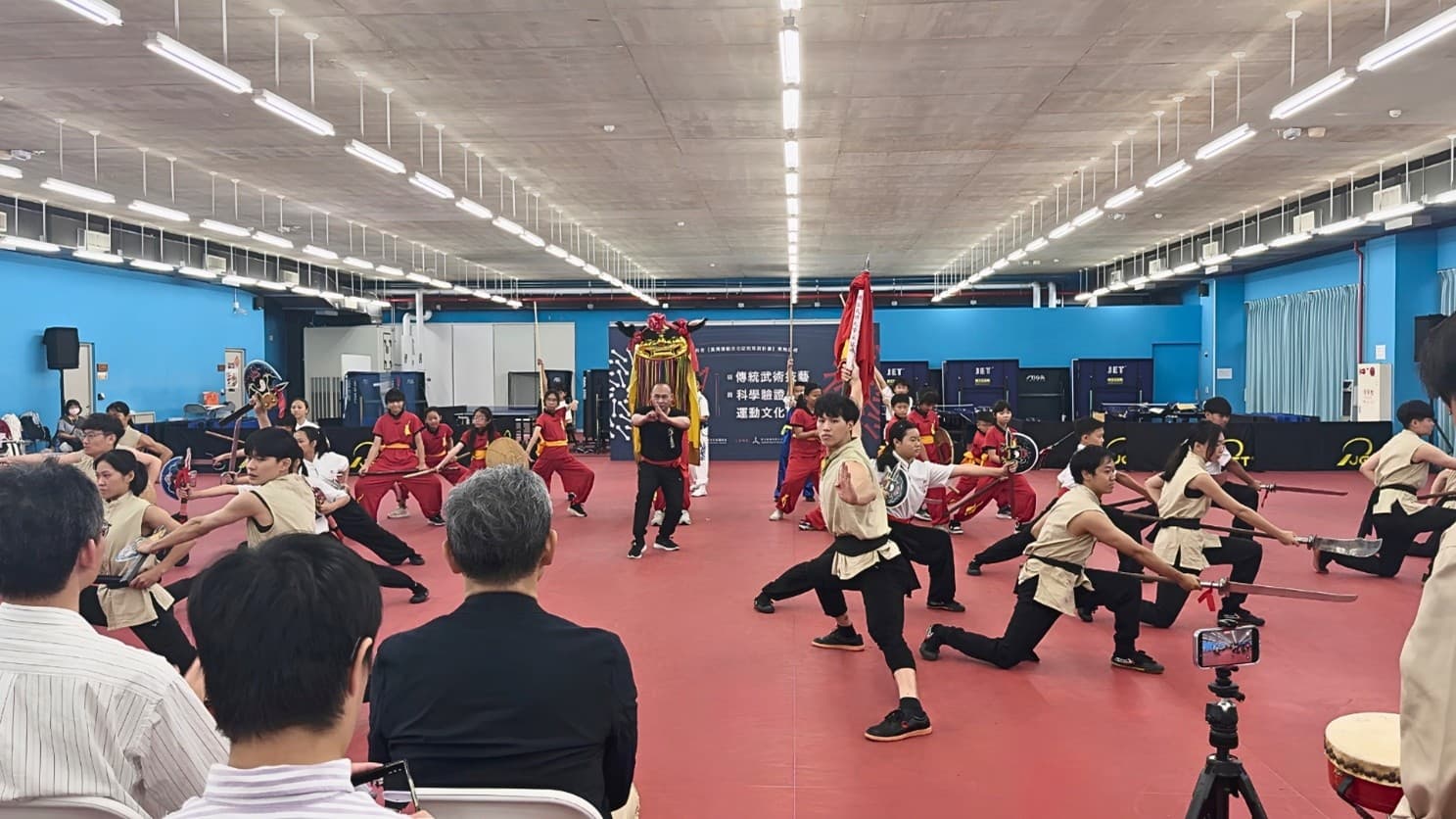
The event gathered the energy of cross-generational participation.

Introduction to Motion Capture Technology
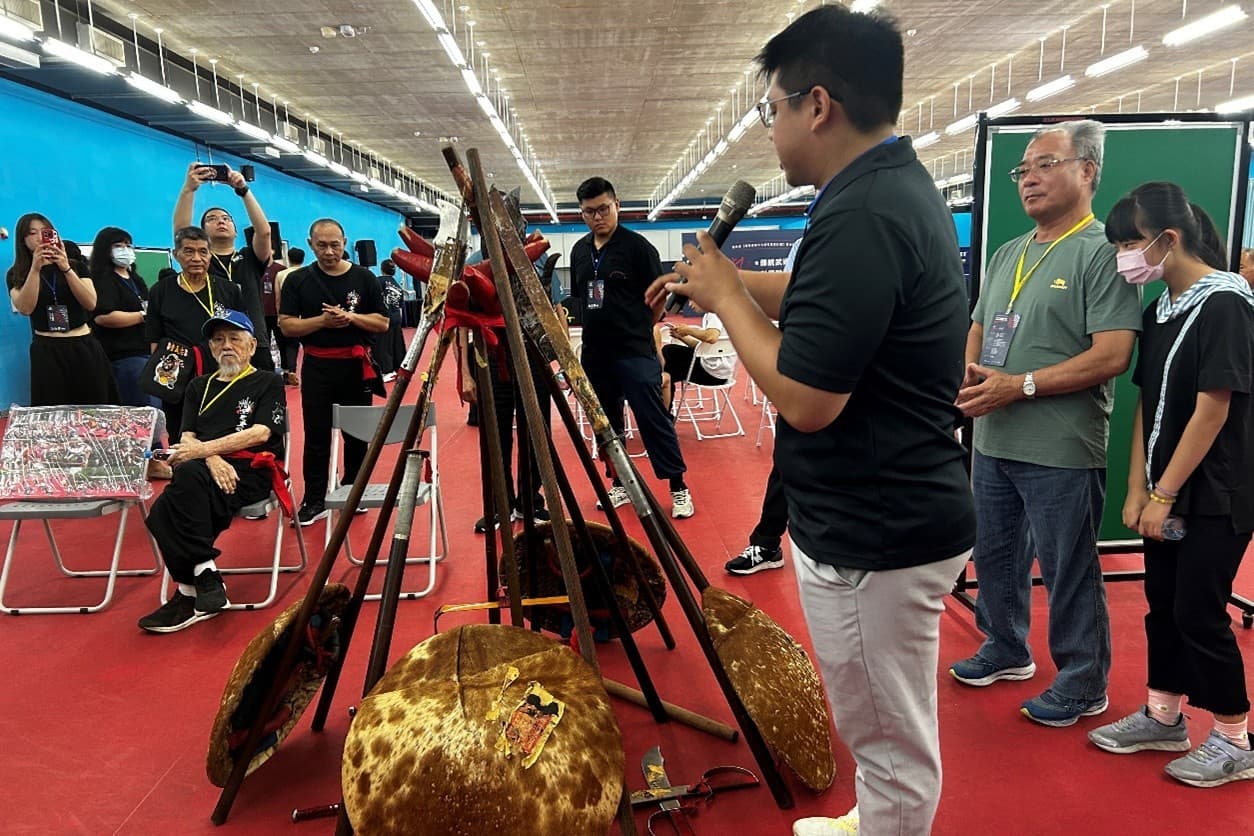
Master Guo-Zhao He (seated) and Coach Fu-Li Zheng (second from right) listen to the project team’s explanation of the Song-Jiang Battle Array weapons.