



SDG16
NCKU College of Social Sciences Leads Discussion on the New Digital Twin Order in the Metaverse

With the rapid evolution of artificial intelligence and digital twin technologies, the Department of Political Science at National Cheng Kung University (NCKU) hosted a seminar titled "Is the Soul Beyond AI Control?—Prospects for a Brave New Order of Digital Twins" at Hall D, 3F, Prince Hall on August 14, 2026. Bringing together scholars in law, political science, and computer science from top universities across Taiwan, the seminar conducted in-depth analyses of digital regulation and platform responsibility experiences in the United States, China, and the European Union. It also explored the impacts of Extended Reality (XR) on physical society within the metaverse, aiming to construct a forward-looking blueprint for institutional innovation and rights protection in the digital twin era.
Divided into four sessions, the seminar spanned the fields of law, politics, and computer science—ranging from the tripartite regulatory approaches of the US, China, and the EU to the intersection of physical and virtual realities in extended reality—to deeply analyze order construction and rights protection in the "digital twin" age. This highlights that interdisciplinary collaboration among experts and scholars is an urgent necessity for future humanistic reflections on AI.
The first session, titled "A Brave New Order of Digital Twins: Focusing on the U.S. Legal System," focused on how to concretely translate abstract human rights and ethical values into AI system norms and designs.
Centering on the U.S. rule of law, this session explored how abstract human dignity and personal autonomy can be truly converted into concrete technical safeguards and system protections, ensuring technology serves societal well-being rather than dictating or depriving human freedom of choice.
This session was chaired by Prof. Chun-Li Tsai, Dean of the College of Social Sciences at NCKU, with Associate Prof. Hsin-Hsuan Lin of the NCKU Department of Political Science—the internal project leader for the Social Sciences Development Plan—serving as the presenter. The session invited prominent digital twin legal scholars in Taiwan, Associate Prof. Ping-Hua Hsu of the Department of Financial and Economic Law at CTBC Business School and Assistant Prof. Chieh-Jan Sun of the School of Law at National Yang Ming Chiao Tung University, as discussants to jointly explore emerging legal issues surrounding digital twins and formulate policy solutions balancing theory and practice.
The second session, "The Chinese Government's Management Policy on Domestic Digital Twins: Taking the Real-Name Registration System and Social Credit System as Examples," deeply deconstructed the entanglement of the online real-name system and the social credit system under an authoritarian regime, revealing the profound challenges high-tech social surveillance poses to digital citizenship rights.
This session further examined how an authoritarian government integrates digital tools such as online real-name registration and social credit systems to perform comprehensive digital tracking and behavioral supervision over individuals and their "digital twins," exposing the deep impacts of high-tech surveillance models on personal privacy and digital freedoms.
Chaired by Assistant Prof. Yu-Tsang Wu of the Institute of Marine Law at National Taiwan Ocean University, the session featured Associate Prof. Yi-En Tso of the Department of Political Science at Soochow University as the presenter, with Associate Prof. Yu-Chen Tseng of the Institute of Strategic Studies at National Defense University as the discussant. Together, they analyzed authoritarian digital surveillance and social credit mechanisms from multiple perspectives of law, politics, and national security strategy.
The third session, "Extended Reality, Digital Twins, and Potential Real-World Impacts," approached the topic from the perspective of computer science scholars. It enabled legal and political experts to understand technical implementation details on the cutting edge while prompting technology developers to reflect on the ethical constraints of algorithms and spatial computing on human society, demonstrating NCKU's visionary leadership in driving interdisciplinary academic discourse.
Chaired by Assistant Prof. Tse-Yu Pan of the Graduate Institute of Artificial Intelligence Interdisciplinary Technology at National Taiwan University of Science and Technology, the session featured Assistant Prof. Hung-Ruei Guo of the NCKU Department of Computer Science and Information Engineering as the presenter, and Assistant Prof. Fu-Yin Cheng from the same department as the discussant. Cutting into Extended Reality (XR) from the foundational level of computer science and technology, they provided substantial technical background and physical impact analysis to support the preceding legal and political discussions.
The fourth session, "Digital Fairness and Platform Accountability in Digital Twin Governance: Insights from EU Digital Consumer Protection Laws," drew upon the benchmark of EU digital legislation to analyze large platform governance responsibilities and digital fairness, defining an institutional blueprint for digital consumer protection and rights maintenance.
The fourth session demonstrated exceptionally high practical value and policy foresight. The presenting team operationalized highly abstract governance concepts into specific consumer protection clauses and platform regulation indicators, offering a practical reference model for domestic authorities formulating internet platform management rules.
Chaired by Associate Prof. Szu-Ting Chen of the NCKU Department of Law, the session featured Associate Prof. Wan-Ju Yeh, Chair of the NCKU Department of Law, as the presenter, and Associate Prof. Shu-Ju Lee of the Department of Political Legal Studies at National University of Kaohsiung as the discussant. By focusing on EU legal systems, consumer protection, and the legal liabilities of large platforms, the session showcased the research strength of southern university institutions in digital governance legislation.
The organizers noted that the rapid evolution of AI and digital twin technologies has transformed from a single technology development issue into a complex challenge involving fundamental individual rights, metaverse platform hegemony, and the international rule of law. Against this backdrop, Taiwanese academia has the opportunity to extract a local institutional blueprint that balances technological innovation, consumer protection, and human dignity from the differing governance models of the US, China, and the EU.
The co-organizing departments, NCKU's Department of Political Science and Department of Law, highlighted that through the resource support of the College of Social Sciences Development Plan and dedication to emerging AI topics, this seminar not only showcased NCKU's research capability in frontier technology governance but also further embodied the practical significance of "cross-disciplinary dialogue." By bringing together interdisciplinary research across legal-political theory and computer science, they hope to provide concrete and feasible legal imaginations for democratic governance and digital constitutionalism in the digital twin era.
The seminar concluded successfully. Through four consecutive, high-intensity deep exchanges across the day, participating scholars collectively accumulated domestic research momentum in digital rights and AI governance, laying an important foundation for future international legal alignment and metaverse regulatory policy development.
Divided into four sessions, the seminar spanned the fields of law, politics, and computer science—ranging from the tripartite regulatory approaches of the US, China, and the EU to the intersection of physical and virtual realities in extended reality—to deeply analyze order construction and rights protection in the "digital twin" age. This highlights that interdisciplinary collaboration among experts and scholars is an urgent necessity for future humanistic reflections on AI.
The first session, titled "A Brave New Order of Digital Twins: Focusing on the U.S. Legal System," focused on how to concretely translate abstract human rights and ethical values into AI system norms and designs.
Centering on the U.S. rule of law, this session explored how abstract human dignity and personal autonomy can be truly converted into concrete technical safeguards and system protections, ensuring technology serves societal well-being rather than dictating or depriving human freedom of choice.
This session was chaired by Prof. Chun-Li Tsai, Dean of the College of Social Sciences at NCKU, with Associate Prof. Hsin-Hsuan Lin of the NCKU Department of Political Science—the internal project leader for the Social Sciences Development Plan—serving as the presenter. The session invited prominent digital twin legal scholars in Taiwan, Associate Prof. Ping-Hua Hsu of the Department of Financial and Economic Law at CTBC Business School and Assistant Prof. Chieh-Jan Sun of the School of Law at National Yang Ming Chiao Tung University, as discussants to jointly explore emerging legal issues surrounding digital twins and formulate policy solutions balancing theory and practice.
The second session, "The Chinese Government's Management Policy on Domestic Digital Twins: Taking the Real-Name Registration System and Social Credit System as Examples," deeply deconstructed the entanglement of the online real-name system and the social credit system under an authoritarian regime, revealing the profound challenges high-tech social surveillance poses to digital citizenship rights.
This session further examined how an authoritarian government integrates digital tools such as online real-name registration and social credit systems to perform comprehensive digital tracking and behavioral supervision over individuals and their "digital twins," exposing the deep impacts of high-tech surveillance models on personal privacy and digital freedoms.
Chaired by Assistant Prof. Yu-Tsang Wu of the Institute of Marine Law at National Taiwan Ocean University, the session featured Associate Prof. Yi-En Tso of the Department of Political Science at Soochow University as the presenter, with Associate Prof. Yu-Chen Tseng of the Institute of Strategic Studies at National Defense University as the discussant. Together, they analyzed authoritarian digital surveillance and social credit mechanisms from multiple perspectives of law, politics, and national security strategy.
The third session, "Extended Reality, Digital Twins, and Potential Real-World Impacts," approached the topic from the perspective of computer science scholars. It enabled legal and political experts to understand technical implementation details on the cutting edge while prompting technology developers to reflect on the ethical constraints of algorithms and spatial computing on human society, demonstrating NCKU's visionary leadership in driving interdisciplinary academic discourse.
Chaired by Assistant Prof. Tse-Yu Pan of the Graduate Institute of Artificial Intelligence Interdisciplinary Technology at National Taiwan University of Science and Technology, the session featured Assistant Prof. Hung-Ruei Guo of the NCKU Department of Computer Science and Information Engineering as the presenter, and Assistant Prof. Fu-Yin Cheng from the same department as the discussant. Cutting into Extended Reality (XR) from the foundational level of computer science and technology, they provided substantial technical background and physical impact analysis to support the preceding legal and political discussions.
The fourth session, "Digital Fairness and Platform Accountability in Digital Twin Governance: Insights from EU Digital Consumer Protection Laws," drew upon the benchmark of EU digital legislation to analyze large platform governance responsibilities and digital fairness, defining an institutional blueprint for digital consumer protection and rights maintenance.
The fourth session demonstrated exceptionally high practical value and policy foresight. The presenting team operationalized highly abstract governance concepts into specific consumer protection clauses and platform regulation indicators, offering a practical reference model for domestic authorities formulating internet platform management rules.
Chaired by Associate Prof. Szu-Ting Chen of the NCKU Department of Law, the session featured Associate Prof. Wan-Ju Yeh, Chair of the NCKU Department of Law, as the presenter, and Associate Prof. Shu-Ju Lee of the Department of Political Legal Studies at National University of Kaohsiung as the discussant. By focusing on EU legal systems, consumer protection, and the legal liabilities of large platforms, the session showcased the research strength of southern university institutions in digital governance legislation.
The organizers noted that the rapid evolution of AI and digital twin technologies has transformed from a single technology development issue into a complex challenge involving fundamental individual rights, metaverse platform hegemony, and the international rule of law. Against this backdrop, Taiwanese academia has the opportunity to extract a local institutional blueprint that balances technological innovation, consumer protection, and human dignity from the differing governance models of the US, China, and the EU.
The co-organizing departments, NCKU's Department of Political Science and Department of Law, highlighted that through the resource support of the College of Social Sciences Development Plan and dedication to emerging AI topics, this seminar not only showcased NCKU's research capability in frontier technology governance but also further embodied the practical significance of "cross-disciplinary dialogue." By bringing together interdisciplinary research across legal-political theory and computer science, they hope to provide concrete and feasible legal imaginations for democratic governance and digital constitutionalism in the digital twin era.
The seminar concluded successfully. Through four consecutive, high-intensity deep exchanges across the day, participating scholars collectively accumulated domestic research momentum in digital rights and AI governance, laying an important foundation for future international legal alignment and metaverse regulatory policy development.
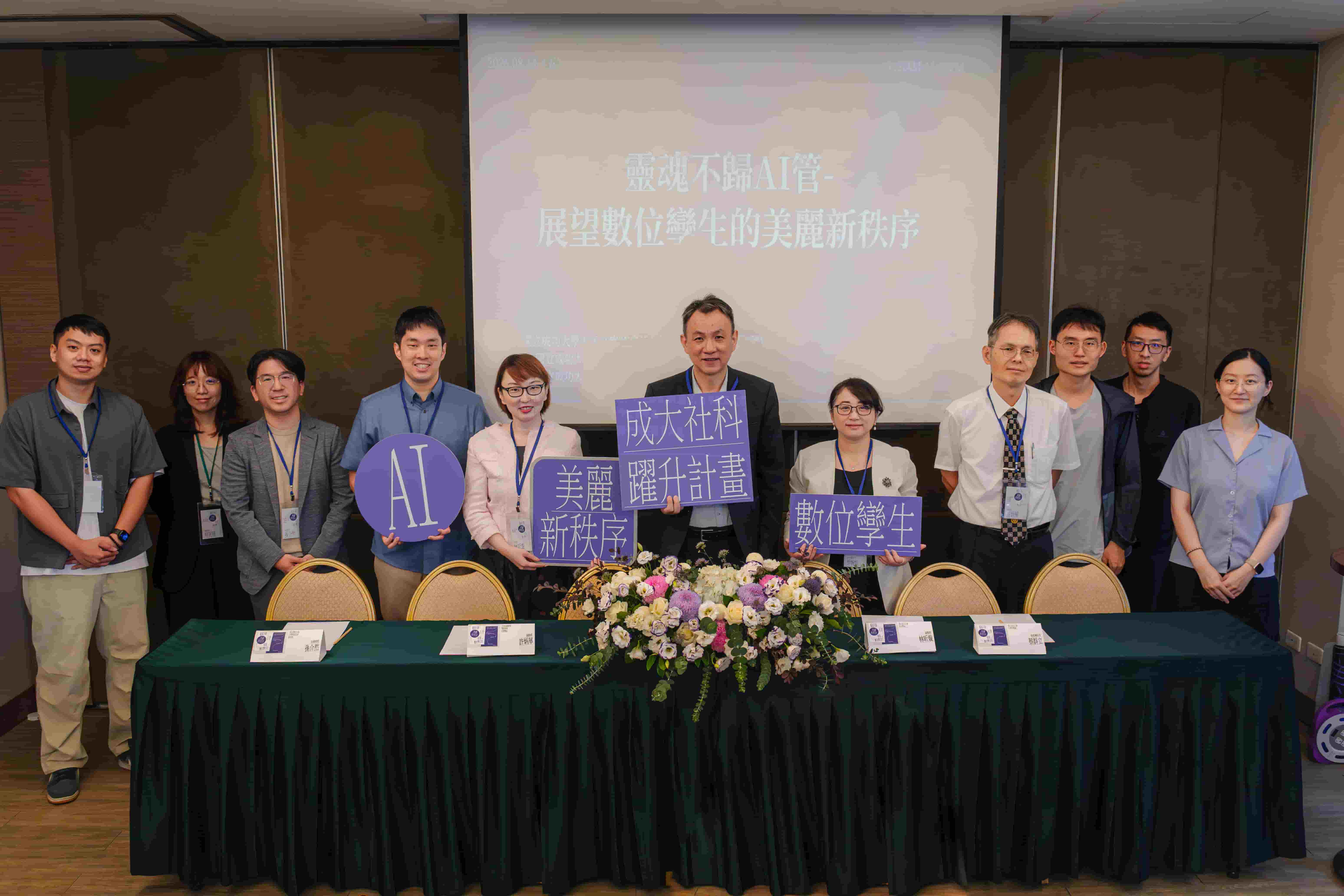
Group photo (from left to right): Assistant Prof. Tse-Yu Pan (Graduate Institute of Artificial Intelligence Interdisciplinary Technology, National Taiwan University of Science and Technology), Assistant Prof. Fu-Yin Cheng (Department of Computer Science and Information Engineering, National Cheng Kung University), Assistant Prof. Chieh-Jan Sun (School of Law, National Yang Ming Chiao Tung University), Assistant Prof. Hung-Ruei Guo (Department of Computer Science and Information Engineering, National Cheng Kung University), Associate Prof. Hsin-Hsuan Lin (Department of Political Science, National Cheng Kung University), Prof. Chun-Li Tsai (Dean of the College of Social Sciences, National Cheng Kung University), Associate Prof. Wan-Ju Yeh (Department of Law, National Cheng Kung University), Associate Prof. Ping-Hua Hsu (Department of Financial and Economic Law, CTBC Business School), and attending students.
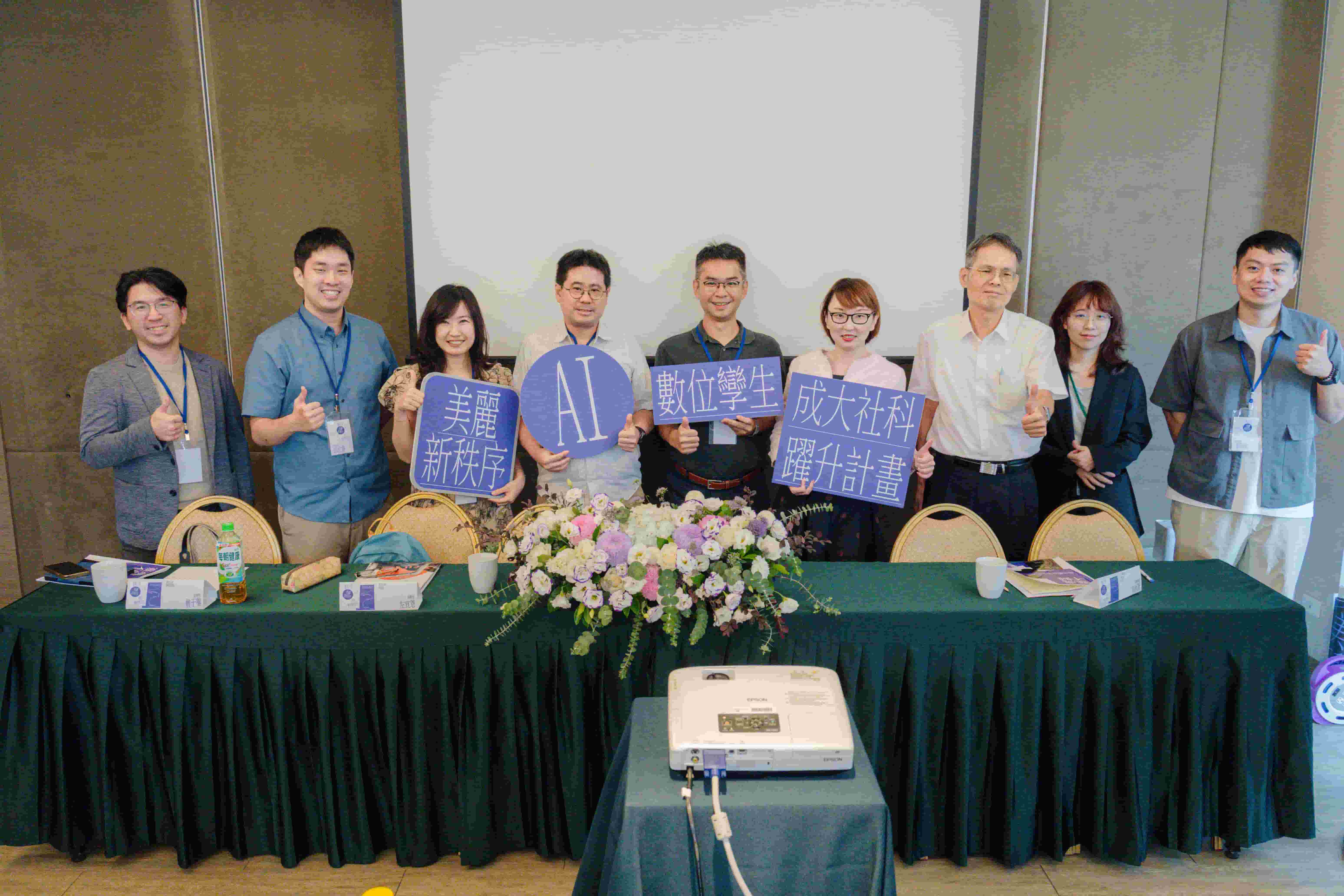
Group photo of Session 2 (from left to right): Session 1 discussant Assistant Prof. Chieh-Jan Sun, Session 3 presenter Assistant Prof. Hung-Ruei Guo, Session 2 discussant Associate Prof. Yu-Chen Tseng, Session 2 presenter Associate Prof. Yi-En Tso, Session 2 chair Assistant Prof. Yu-Tsang Wu, Session 1 presenter Associate Prof. Hsin-Hsuan Lin, Session 1 discussant Associate Prof. Ping-Hua Hsu, Session 3 discussant Assistant Prof. Fu-Yin Cheng, and Session 3 chair Assistant Prof. Tse-Yu Pan.
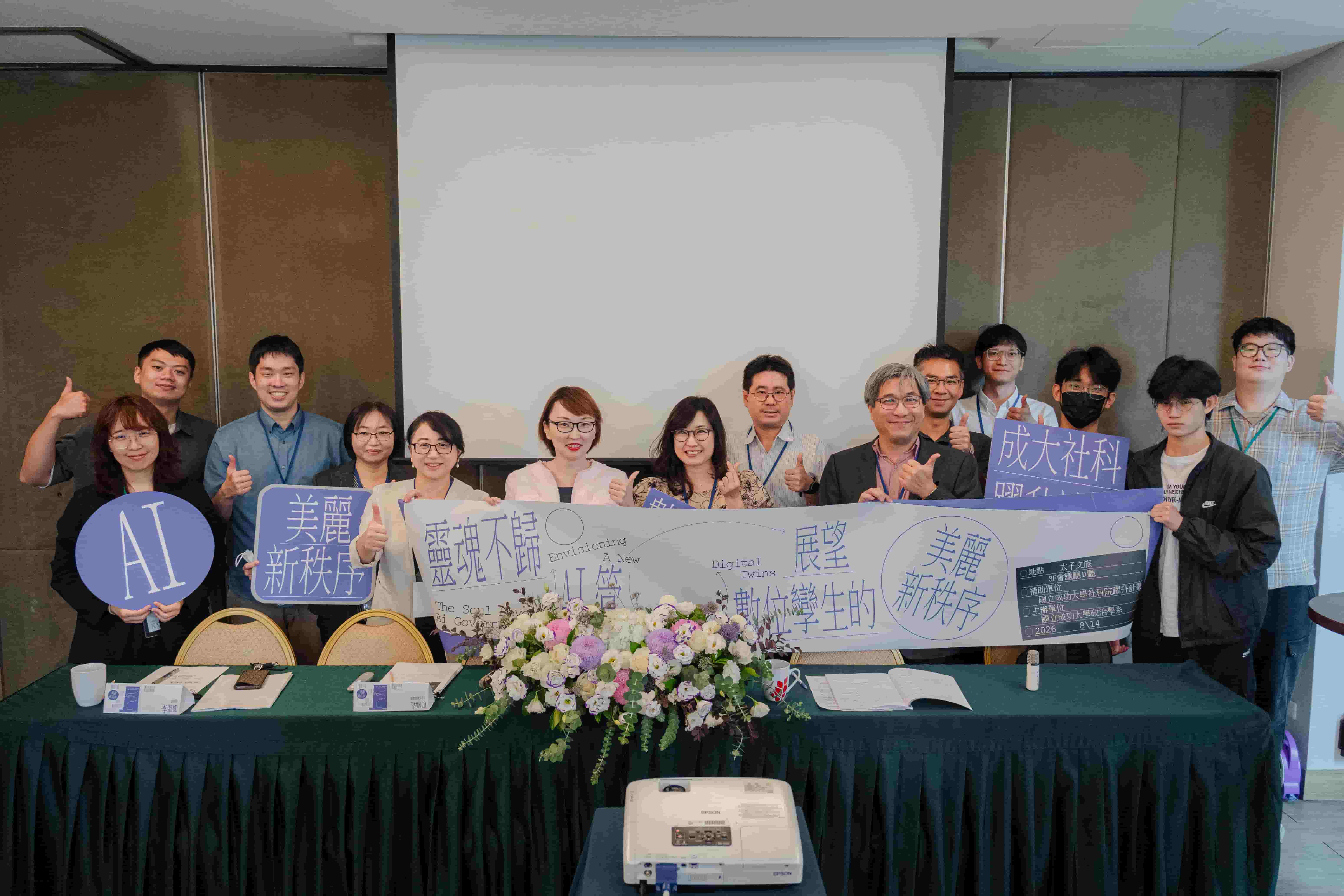
Group photo of Session 4 (from left to right): Session 3 discussant Assistant Prof. Fu-Yin Cheng, Session 3 chair Assistant Prof. Tse-Yu Pan, Session 3 presenter Assistant Prof. Hung-Ruei Guo, Session 4 chair Associate Prof. Szu-Ting Chen, Session 4 presenter Associate Prof. Wan-Ju Yeh, Session 1 presenter Associate Prof. Hsin-Hsuan Lin, Session 2 discussant Associate Prof. Yu-Chen Tseng, Session 2 presenter Associate Prof. Yi-En Tso, Session 4 discussant Associate Prof. Shu-Ju Lee, Session 2 chair Assistant Prof. Yu-Tsang Wu, and attending students.