



SDG6
Prof. Ronaldo I. Borja Wins 2 International Medals, Advancing Taiwan's Land Subsidence Research

Professor Ronaldo I. Borja, a Yushan Scholar in the Department of Hydraulic and Ocean Engineering at National Cheng Kung University (NCKU), has been awarded the John Booker Excellence Medal by the International Association for Computer Methods and Advances in Geomechanics (IACMAG) and the Mary F. Wheeler Medal by the U.S. Association for Computational Mechanics (USACM). These honors recognize his long-standing contributions to geomechanics and computational mechanics. Continuing his involvement in NCKU's research as a Yushan Scholar, Prof. Borja directly applies his world-class expertise in computational mechanics to key hydrogeomechanical and environmental challenges in Taiwan, further enhancing NCKU’s international research collaborations and academic capabilities in related fields.
The John Booker Excellence Medal, awarded by IACMAG, honors scholars who have made significant contributions to non-linear and time-dependent problems in geomechanics, covering analytical and computational methods, constitutive modeling, consolidation, and contaminant transport. The award places strong emphasis on mathematical rigor and refinement, as well as the impact of research findings on understanding engineering and physical phenomena.
The Mary F. Wheeler Medal, presented by USACM, recognizes outstanding and sustained contributions in interdisciplinary and emerging research areas such as earth, environmental, and energy sciences, valuing work that advances related theories, methods, and applications. In its citation, the association specifically highlighted Prof. Borja's contributions to computational poroelasticity and computational plasticity, which have driven advancements in earth, environmental, and energy science research.
Prof. Borja received his Ph.D. from Stanford University in 1984 and is currently a professor in the Department of Civil and Environmental Engineering at Stanford. His research focuses on computational mechanics, geomechanics, and geosciences, including coupled analyses of fluid flow and solid deformation in porous media, strain localization and failure models for soil and rock, and finite element modeling of faulting, fracturing, and fracture processes in quasi-brittle materials. Through theoretical and numerical methods, he explores the mechanisms from stress deformation to localized failure in materials, analyzing how different physical interactions combined affect the behavior of soil and rock.
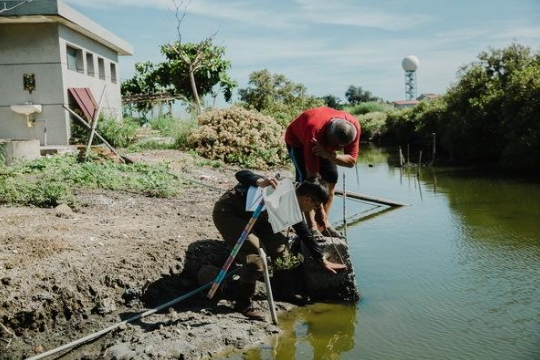
Prof. Borja began collaborating with the research team led by Prof. Wei-Cheng Lo of NCKU’s Department of Hydraulic and Ocean Engineering in 2016. After being selected as a Ministry of Education Yushan Scholar in 2025, their joint efforts focused further on Taiwan's land subsidence issues. A key highlight of this collaboration is combining the extensive field testing and monitoring experience accumulated by Prof. Lo and the NCKU team with the advanced computational modeling expertise of Prof. Borja’s team. Based at the land subsidence laboratory in Yunlin and Changhua, the Yushan Scholar project utilizes magnetic-ring multi-layer land subsidence monitoring wells and multi-layer groundwater observation wells to measure compaction and pore water pressure changes across different soil depths, further examining the impact of groundwater extraction on soil deformation. Prof. Lo and his research team play a crucial bridging role in connecting Taiwan’s actual field sites and observation data with international computational mechanics methods, ensuring the research starts from practical issues in Taiwan before applying cutting-edge international theories and numerical methods for analysis.
The project plans to build numerical models using porous media theory and finite element methods, combined with machine learning to estimate soil parameters from field observation data. This will allow for deeper analysis of ground responses under different pumping rates, pumping depths, and simultaneous operations of multiple wells. The goal is to deepen the physical understanding of land subsidence mechanisms and provide a scientific foundation for evaluating groundwater use plans and mitigation strategies. For Taiwan, this collaboration directly integrates advanced international computational methods into land subsidence research in Yunlin and Changhua. For NCKU, it integrates field monitoring, theoretical mechanics, numerical simulation, and machine learning, continuously building interdisciplinary research capabilities tailored to Taiwan's local contexts.
Prof. Borja currently serves as a Visiting Distinguished Chair Professor in NCKU's Department of Hydraulic and Ocean Engineering for three months each year, maintaining active research collaboration and academic exchange. This ongoing collaboration, active since 2016, not only aligns NCKU and Taiwanese research teams with international developments in computational mechanics and geomechanics, but also underscores the importance of integrating international scholars, NCKU research teams, and local field sites. Leveraging the foundation of local monitoring and field testing built by Prof. Lo’s team alongside Prof. Borja’s theoretical and computational expertise, NCKU brings top-tier international research methodologies to bear on groundwater usage and land deformation challenges, laying a solid scientific foundation for future land subsidence prevention and groundwater management assessments.
The John Booker Excellence Medal, awarded by IACMAG, honors scholars who have made significant contributions to non-linear and time-dependent problems in geomechanics, covering analytical and computational methods, constitutive modeling, consolidation, and contaminant transport. The award places strong emphasis on mathematical rigor and refinement, as well as the impact of research findings on understanding engineering and physical phenomena.
The Mary F. Wheeler Medal, presented by USACM, recognizes outstanding and sustained contributions in interdisciplinary and emerging research areas such as earth, environmental, and energy sciences, valuing work that advances related theories, methods, and applications. In its citation, the association specifically highlighted Prof. Borja's contributions to computational poroelasticity and computational plasticity, which have driven advancements in earth, environmental, and energy science research.
Prof. Borja received his Ph.D. from Stanford University in 1984 and is currently a professor in the Department of Civil and Environmental Engineering at Stanford. His research focuses on computational mechanics, geomechanics, and geosciences, including coupled analyses of fluid flow and solid deformation in porous media, strain localization and failure models for soil and rock, and finite element modeling of faulting, fracturing, and fracture processes in quasi-brittle materials. Through theoretical and numerical methods, he explores the mechanisms from stress deformation to localized failure in materials, analyzing how different physical interactions combined affect the behavior of soil and rock.
Prof. Borja began collaborating with the research team led by Prof. Wei-Cheng Lo of NCKU’s Department of Hydraulic and Ocean Engineering in 2016. After being selected as a Ministry of Education Yushan Scholar in 2025, their joint efforts focused further on Taiwan's land subsidence issues. A key highlight of this collaboration is combining the extensive field testing and monitoring experience accumulated by Prof. Lo and the NCKU team with the advanced computational modeling expertise of Prof. Borja’s team. Based at the land subsidence laboratory in Yunlin and Changhua, the Yushan Scholar project utilizes magnetic-ring multi-layer land subsidence monitoring wells and multi-layer groundwater observation wells to measure compaction and pore water pressure changes across different soil depths, further examining the impact of groundwater extraction on soil deformation. Prof. Lo and his research team play a crucial bridging role in connecting Taiwan’s actual field sites and observation data with international computational mechanics methods, ensuring the research starts from practical issues in Taiwan before applying cutting-edge international theories and numerical methods for analysis.
The project plans to build numerical models using porous media theory and finite element methods, combined with machine learning to estimate soil parameters from field observation data. This will allow for deeper analysis of ground responses under different pumping rates, pumping depths, and simultaneous operations of multiple wells. The goal is to deepen the physical understanding of land subsidence mechanisms and provide a scientific foundation for evaluating groundwater use plans and mitigation strategies. For Taiwan, this collaboration directly integrates advanced international computational methods into land subsidence research in Yunlin and Changhua. For NCKU, it integrates field monitoring, theoretical mechanics, numerical simulation, and machine learning, continuously building interdisciplinary research capabilities tailored to Taiwan's local contexts.
Prof. Borja currently serves as a Visiting Distinguished Chair Professor in NCKU's Department of Hydraulic and Ocean Engineering for three months each year, maintaining active research collaboration and academic exchange. This ongoing collaboration, active since 2016, not only aligns NCKU and Taiwanese research teams with international developments in computational mechanics and geomechanics, but also underscores the importance of integrating international scholars, NCKU research teams, and local field sites. Leveraging the foundation of local monitoring and field testing built by Prof. Lo’s team alongside Prof. Borja’s theoretical and computational expertise, NCKU brings top-tier international research methodologies to bear on groundwater usage and land deformation challenges, laying a solid scientific foundation for future land subsidence prevention and groundwater management assessments.
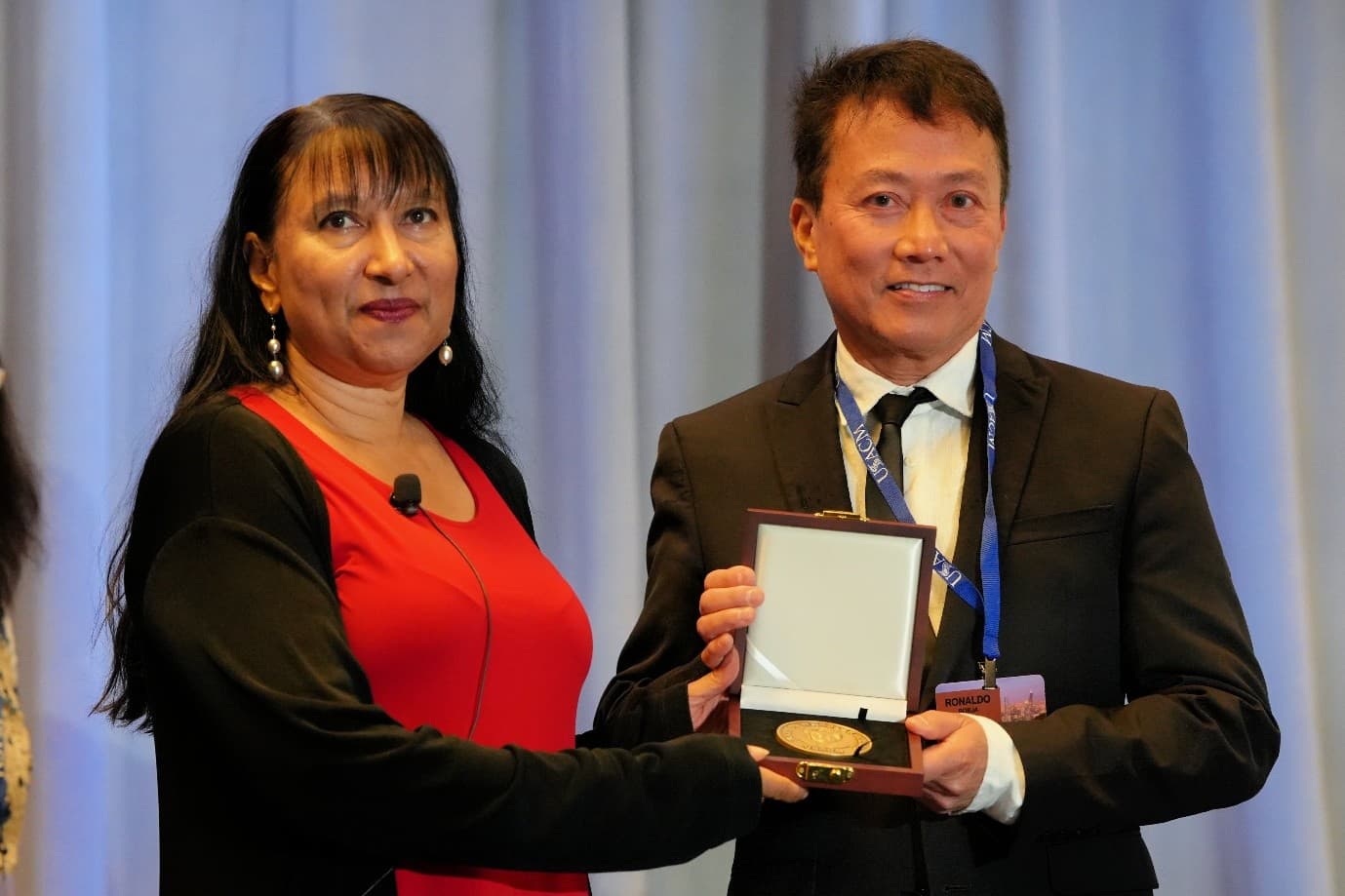
Prof. Borja awarded the Mary F. Wheeler Medal at the USNCCM conference in Chicago.