



SDG7
NCKU Team Achieves Major Breakthrough in Seawater Electrolysis Marking a Vital Milestone for Hydrogen Energy Development

Written by Jyh-Ming Ting.Image credit to NCKU News Center.
Hydrogen is widely regarded as a key green energy carrier in the global transition toward net-zero emissions. Direct hydrogen production from seawater would be especially attractive, offering an abundant and virtually inexhaustible resource. However, the high salinity and chloride content of seawater cause severe corrosion to electrodes and system components, which has long remained a major technical barrier.
A research team led by Jyh-Ming Ting, Chair Professor in the Department of Materials Science and Engineering at National Cheng Kung University, has developed highly corrosion-resistant electrocatalysts and demonstrated their performance in an anion exchange membrane water electrolysis (AEMWE) system under seawater conditions. In addition, the team has further showcased the design and scalability potential of multi-cell stack systems, laying the groundwork for future commercialization. The results have been published in high-impact journals, including 《Advanced Functional Materials》Defect-Rich Carbon-Encapsulated NiMoFe/MoO2: A High-Performance Electrocatalyst for Efficient and Stable Anion Exchange Membrane Electrolysis and 《Chemical Engineering Journal》Chlorine-resistant high-entropy spinel oxide catalyst for efficient and durable seawater anion exchange membrane water electrolysis, drawing international attention.
Using AEMWE as the validation platform, the team conducted operation tests directly in seawater, verifying both the performance and durability of the corrosion-resistant catalysts at the system level. These results highlight strong application potential, and collaborative efforts with industry are already underway to accelerate technology deployment.
According to Prof. Ting, hydrogen-powered vehicles are entering commercialization, while hydrogen ships and fuel cell technologies continue to advance, indicating rapid expansion of hydrogen applications. Beyond being a clean energy carrier, hydrogen is also an important industrial feedstock, for example, it can replace coke as a reducing agent in steelmaking, significantly reducing CO₂ emissions.
Currently, most commercial hydrogen production still relies on natural gas. Steam methane reforming (SMR), while mature, produces large amounts of CO₂ and is referred to as “gray hydrogen.” To mitigate emissions, “blue hydrogen” has been developed by integrating carbon capture and storage (CCS). Methane pyrolysis, which produces solid carbon instead of CO₂, is often classified as “turquoise hydrogen,” though it still faces challenges related to energy consumption and cost.
Among the various pathways, water electrolysis powered by renewable energy such as solar power is considered the most promising green hydrogen route, as it produces no direct carbon emissions. However, freshwater-based electrolysis raises concerns about competition for water resources. Seawater, by contrast, is abundant, but its harsh chemical environment accelerates material degradation and compromises system stability. Although hydrogen-powered ships are already being explored, integrating onboard electrolysis systems still faces challenges related to water treatment and cost.
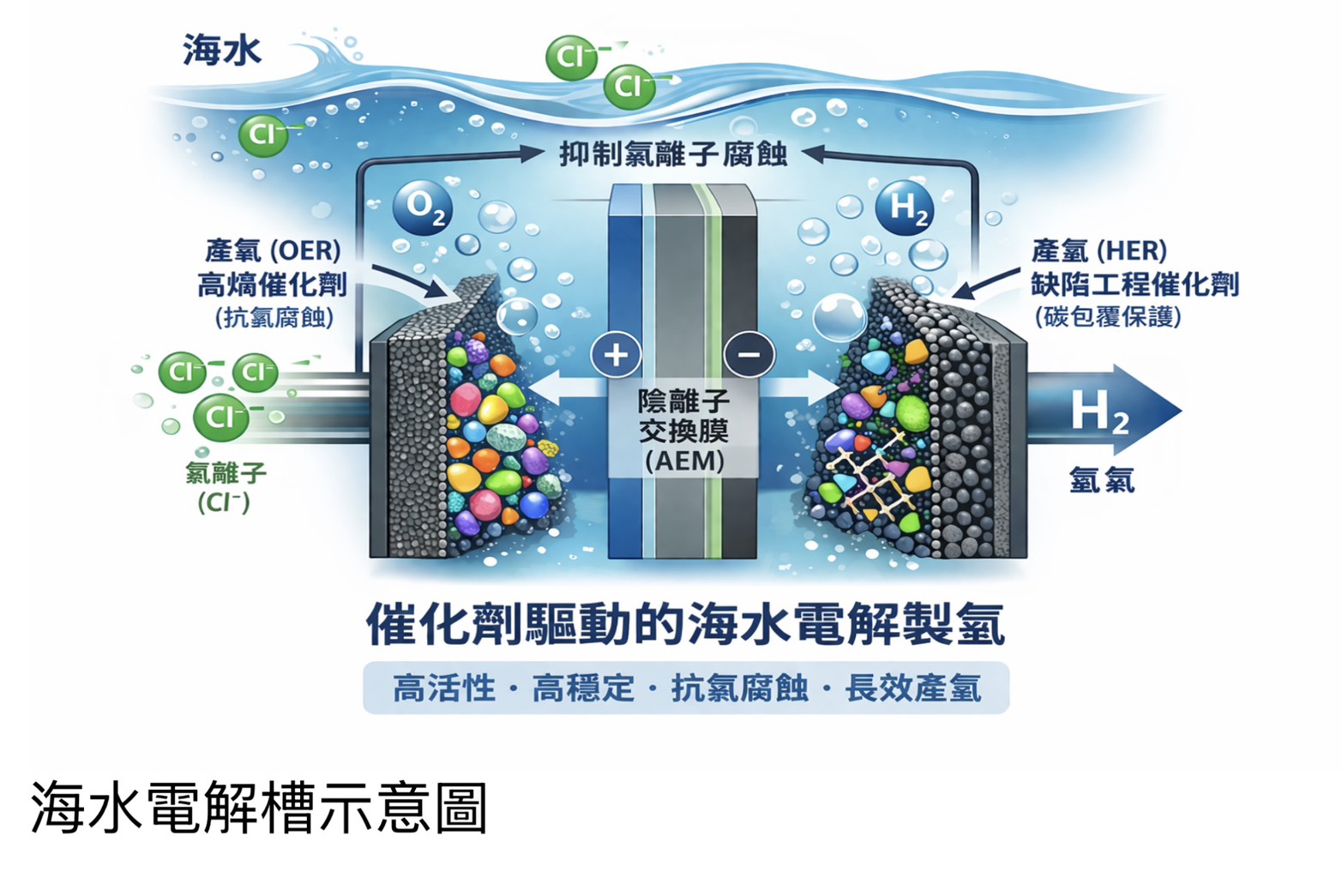
Supported by Taiwan’s National Science and Technology Council under the “2050 Net-Zero Emissions” initiative, the team developed both hydrogen evolution reaction (HER) and oxygen evolution reaction (OER) catalysts that exhibit high activity and long-term stability under seawater conditions. These catalysts were integrated into an AEMWE platform capable of stable operation in harsh environments.
For the HER at the cathode, a dual design strategy combining defect engineering and carbon encapsulation was employed, significantly enhancing catalytic activity and structural stability. The catalyst demonstrated stable operation for over 2000 hours at a high current density of 500 mA cm-2, with negligible performance degradation.
For the OER at the anode, the team introduced a high-entropy material design to leverage multi-element synergistic effects, improving both activity and stability. Even under seawater conditions, only minor performance loss was observed, indicating excellent resistance to chloride-induced corrosion.
Overall system testing showed that at a current density of 1 A cm⁻², the AEMWE system operates stably at 1.89 V and can sustain hydrogen production for extended periods (nearly 600 hours), achieving near-100% Faradaic efficiency and favorable energy conversion performance. Building on single-cell validation, the team has also established the design and operation of multi-cell stack systems, reaching performance levels close to the U.S.
Department of Energy’s 2030 targets at low current densities. A ~3 kW system is expected to be completed by the end of May, and the related technologies have already been patented.
The team emphasized that while many efforts on seawater electrolysis remain at the material level, few have demonstrated validation under seawater conditions within a functioning electrolysis system. This work not only advances catalyst design but also achieves system-level validation using AEMWE and demonstrates scalability toward practical deployment. It highlights Taiwan’s capabilities in hydrogen-related materials and system integration, and provides a concrete, actionable pathway for green hydrogen production and energy conversion.
Provider: NCKU News Center
Date: 2026-04-21
Hydrogen is widely regarded as a key green energy carrier in the global transition toward net-zero emissions. Direct hydrogen production from seawater would be especially attractive, offering an abundant and virtually inexhaustible resource. However, the high salinity and chloride content of seawater cause severe corrosion to electrodes and system components, which has long remained a major technical barrier.
A research team led by Jyh-Ming Ting, Chair Professor in the Department of Materials Science and Engineering at National Cheng Kung University, has developed highly corrosion-resistant electrocatalysts and demonstrated their performance in an anion exchange membrane water electrolysis (AEMWE) system under seawater conditions. In addition, the team has further showcased the design and scalability potential of multi-cell stack systems, laying the groundwork for future commercialization. The results have been published in high-impact journals, including 《Advanced Functional Materials》Defect-Rich Carbon-Encapsulated NiMoFe/MoO2: A High-Performance Electrocatalyst for Efficient and Stable Anion Exchange Membrane Electrolysis and 《Chemical Engineering Journal》Chlorine-resistant high-entropy spinel oxide catalyst for efficient and durable seawater anion exchange membrane water electrolysis, drawing international attention.
Using AEMWE as the validation platform, the team conducted operation tests directly in seawater, verifying both the performance and durability of the corrosion-resistant catalysts at the system level. These results highlight strong application potential, and collaborative efforts with industry are already underway to accelerate technology deployment.
According to Prof. Ting, hydrogen-powered vehicles are entering commercialization, while hydrogen ships and fuel cell technologies continue to advance, indicating rapid expansion of hydrogen applications. Beyond being a clean energy carrier, hydrogen is also an important industrial feedstock, for example, it can replace coke as a reducing agent in steelmaking, significantly reducing CO₂ emissions.
Currently, most commercial hydrogen production still relies on natural gas. Steam methane reforming (SMR), while mature, produces large amounts of CO₂ and is referred to as “gray hydrogen.” To mitigate emissions, “blue hydrogen” has been developed by integrating carbon capture and storage (CCS). Methane pyrolysis, which produces solid carbon instead of CO₂, is often classified as “turquoise hydrogen,” though it still faces challenges related to energy consumption and cost.
Among the various pathways, water electrolysis powered by renewable energy such as solar power is considered the most promising green hydrogen route, as it produces no direct carbon emissions. However, freshwater-based electrolysis raises concerns about competition for water resources. Seawater, by contrast, is abundant, but its harsh chemical environment accelerates material degradation and compromises system stability. Although hydrogen-powered ships are already being explored, integrating onboard electrolysis systems still faces challenges related to water treatment and cost.
Supported by Taiwan’s National Science and Technology Council under the “2050 Net-Zero Emissions” initiative, the team developed both hydrogen evolution reaction (HER) and oxygen evolution reaction (OER) catalysts that exhibit high activity and long-term stability under seawater conditions. These catalysts were integrated into an AEMWE platform capable of stable operation in harsh environments.
For the HER at the cathode, a dual design strategy combining defect engineering and carbon encapsulation was employed, significantly enhancing catalytic activity and structural stability. The catalyst demonstrated stable operation for over 2000 hours at a high current density of 500 mA cm-2, with negligible performance degradation.
For the OER at the anode, the team introduced a high-entropy material design to leverage multi-element synergistic effects, improving both activity and stability. Even under seawater conditions, only minor performance loss was observed, indicating excellent resistance to chloride-induced corrosion.
Overall system testing showed that at a current density of 1 A cm⁻², the AEMWE system operates stably at 1.89 V and can sustain hydrogen production for extended periods (nearly 600 hours), achieving near-100% Faradaic efficiency and favorable energy conversion performance. Building on single-cell validation, the team has also established the design and operation of multi-cell stack systems, reaching performance levels close to the U.S.
Department of Energy’s 2030 targets at low current densities. A ~3 kW system is expected to be completed by the end of May, and the related technologies have already been patented.
The team emphasized that while many efforts on seawater electrolysis remain at the material level, few have demonstrated validation under seawater conditions within a functioning electrolysis system. This work not only advances catalyst design but also achieves system-level validation using AEMWE and demonstrates scalability toward practical deployment. It highlights Taiwan’s capabilities in hydrogen-related materials and system integration, and provides a concrete, actionable pathway for green hydrogen production and energy conversion.
Provider: NCKU News Center
Date: 2026-04-21
A team led by Jyh-Ming Ting, Chair Professor in the Department of Materials Science and Engineering at National Cheng Kung University, has developed a catalyst made of special materials for use in anion exchange membrane water electrolysis systems. This catalyst exhibits high activity, high stability, resistance to chlorine corrosion, and long-lasting hydrogen production.
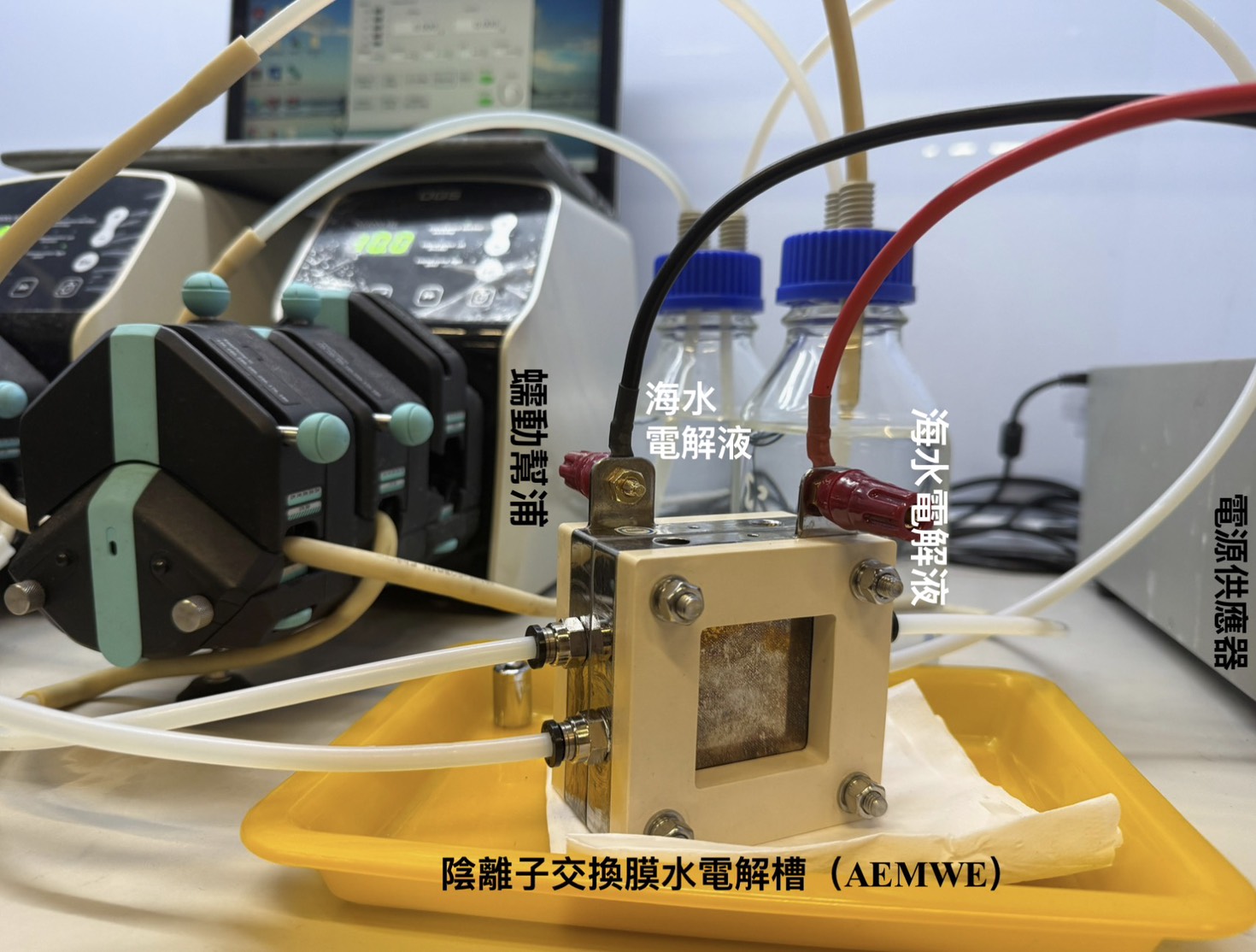
A team led by Jyh-Ming Ting, Chair Professor in the Department of Materials Science and Engineering at National Cheng Kung University, has developed a catalyst made of special materials. This catalyst, applied to anion exchange membrane water electrolysis systems, overcomes the problem of seawater corrosion and enables stable hydrogen production.
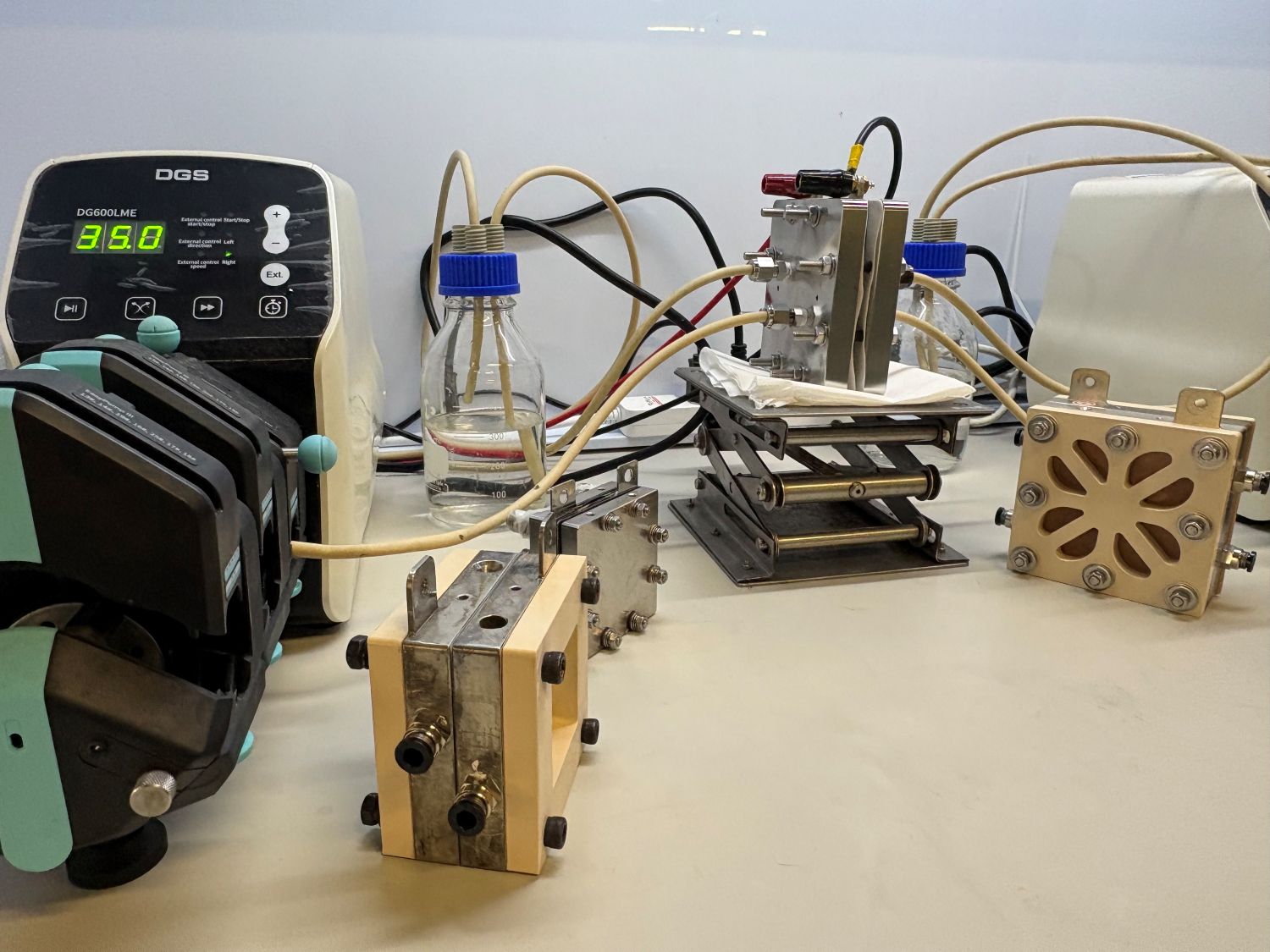
A team led by Jyh-Ming Ting, Chair Professor in the Department of Materials Science and Engineering at National Cheng Kung University, has developed a catalyst made of special materials. This catalyst, applied to anion exchange membrane water electrolysis systems, overcomes the problem of seawater corrosion and enables stable hydrogen production.
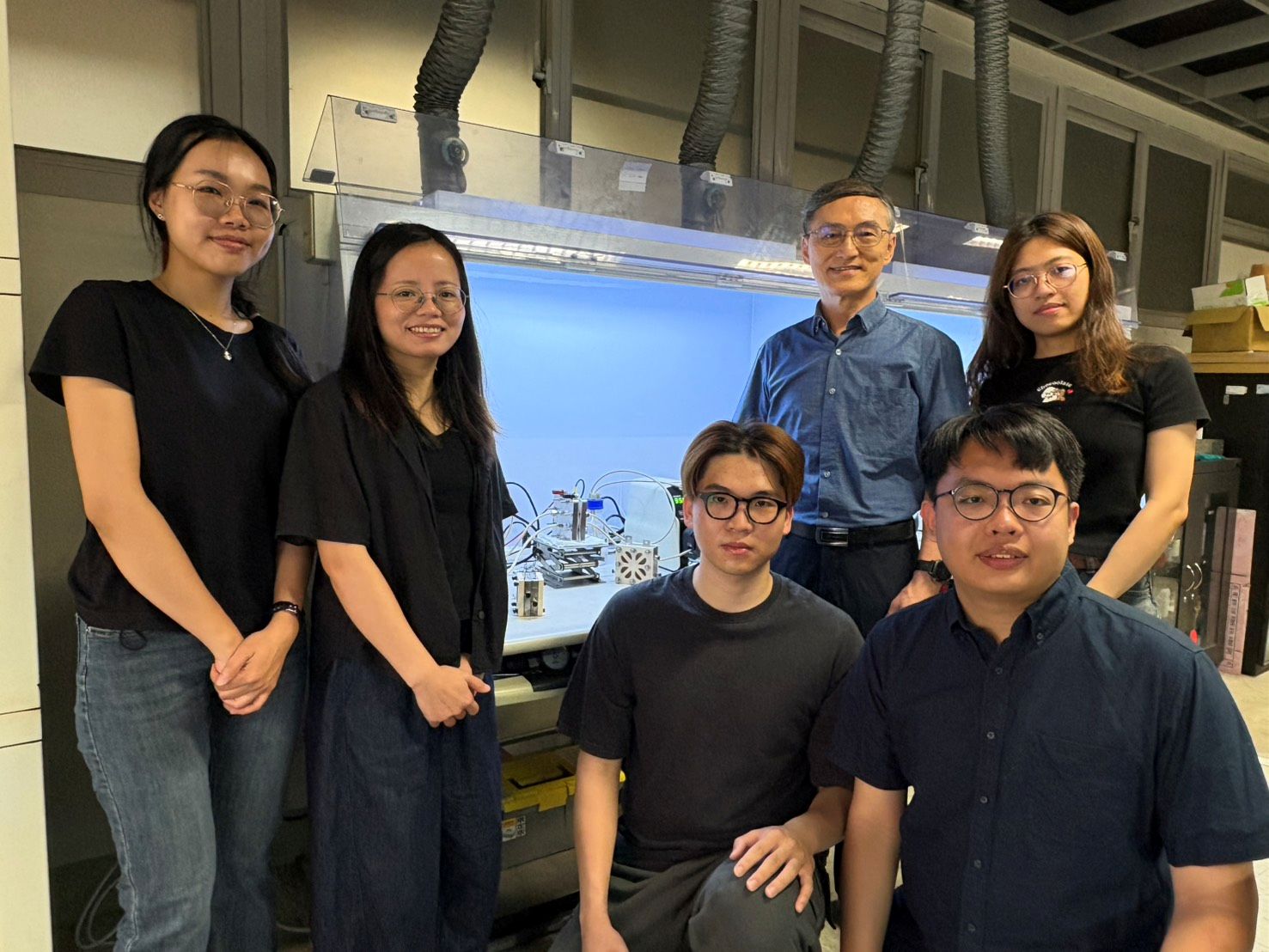
The same team led by Jyh-Ming Ting at National Cheng Kung University is shown. Prof. Ting is positioned at the center of the back row, with Research Assistant Yi-Zheng Song on the right. In the front row (from left to right) are Vietnamese Research Assistant Phuong Nguyen, Vietnamese postdoctoral researcher Thi Xuyen Nguyen, Master’s student Bo-Chen Zhang-Jian, and Jian-An Wu.
SDG7Collaboration between NCKU Department of Mechanical Engineering and Kwang Yang Motor is being showcased
View more
SDG7NCKU and LITE-ON open the "LITE-ON-NCKU Joint Research Center," focusing on cutting-edge fields to develop talented researchers
View more