



SDG9
NCKU CSIE “114 Academic Year IT Project Development & Implementation Exhibition” Successfully Held


On the morning of June 5, the Department of Computer Science and Information Engineering (CSIE) at National Cheng Kung University (NCKU) held the “Academic Year 114 Information Technology Project Development and Implementation Exhibition” on the first floor of the Mouse Hall in the department’s new building. Undergraduate students from the “Intelligent Systems Implementation Track” (first- and second-year students) presented project outcomes completed over two semesters.
A total of 13 practical projects were showcased, covering areas such as edge computing and embedded systems, smart healthcare and smart living, as well as autonomous robotics. The exhibition fully demonstrated students’ ability to apply information technology and artificial intelligence to real-world problem solving, as well as their experience in completing full-cycle system development—from requirements analysis to system implementation.
A distinctive feature of this two-semester course is that students begin project-based group development in the first semester and collaborate with industry partners. Companies provide real-world requirements and application scenarios, guiding students through the full system development process. Over the two semesters, student teams progressed through specification analysis, system design, and implementation, ultimately delivering projects with practical application value. Through this end-to-end development experience, students not only strengthened their technical skills but also enhanced their problem-solving abilities.
The exhibition invited industry experts from companies including C SUN Manufacturing, Asia Cement Corporation, Innolux Corporation, Novatek Microelectronics, and Wistron Corporation to serve as judges. Through a professional evaluation process, they assessed teams based on technological innovation, system completeness, and practical application value, while also providing industry insights and suggestions to help students better understand industrial needs and technological trends.
After comprehensive evaluation by the judges, the first-place team demonstrated outstanding system integration capabilities in robotics by successfully developing a Mars rover capable of autonomous mobility and traversing complex terrain. The project showcased interdisciplinary achievements in mechanical design and assembly, sensing, planning, and control.
The second-place team successfully ported the open-source Linux operating system (Ubuntu 22.04) for ARM64 processors onto Novatek’s NT98690 development board, establishing a stable bootable Ubuntu environment. This serves as a foundation for subsequent hardware acceleration interface development and robotic operating system applications, demonstrating strong embedded systems development capability.
The third-place team implemented a hardware accelerator IP compliant with RFC 8439 for ChaCha20-Poly1305. Using an FPGA platform, they designed a hardware implementation of both the ChaCha20 stream cipher and the Poly1305 message authentication code. By leveraging parallelization and pipelining techniques, they effectively reduced CPU load and improved the overall performance of large-scale data encryption and authentication, showcasing strong expertise in information security and hardware design.
After the exhibition, faculty members and industry partners held informal discussions over lunch to review the year’s collaboration outcomes and jointly plan future cooperation directions and project topics for the next academic year. Through the continuous accumulation of collaborative achievements and experience sharing, the “Intelligent Systems Implementation Track” has gradually developed a stable and distinctive industry–academia teaching model.
In the future, the program will continue to deepen partnerships with industry, introduce more diverse practical requirements and forward-looking technological topics, and build a six-year integrated talent cultivation ecosystem spanning undergraduate and graduate education. From the first year of university, students will progressively develop system development, interdisciplinary integration, innovation, and problem-solving abilities through structured coursework, project-based practice, industry collaboration, and research training. This forms a complete talent pipeline bridging education and industry, cultivating information technology professionals with strong theoretical foundations, practical skills, and innovative vision.
A total of 13 practical projects were showcased, covering areas such as edge computing and embedded systems, smart healthcare and smart living, as well as autonomous robotics. The exhibition fully demonstrated students’ ability to apply information technology and artificial intelligence to real-world problem solving, as well as their experience in completing full-cycle system development—from requirements analysis to system implementation.
A distinctive feature of this two-semester course is that students begin project-based group development in the first semester and collaborate with industry partners. Companies provide real-world requirements and application scenarios, guiding students through the full system development process. Over the two semesters, student teams progressed through specification analysis, system design, and implementation, ultimately delivering projects with practical application value. Through this end-to-end development experience, students not only strengthened their technical skills but also enhanced their problem-solving abilities.
The exhibition invited industry experts from companies including C SUN Manufacturing, Asia Cement Corporation, Innolux Corporation, Novatek Microelectronics, and Wistron Corporation to serve as judges. Through a professional evaluation process, they assessed teams based on technological innovation, system completeness, and practical application value, while also providing industry insights and suggestions to help students better understand industrial needs and technological trends.
After comprehensive evaluation by the judges, the first-place team demonstrated outstanding system integration capabilities in robotics by successfully developing a Mars rover capable of autonomous mobility and traversing complex terrain. The project showcased interdisciplinary achievements in mechanical design and assembly, sensing, planning, and control.
The second-place team successfully ported the open-source Linux operating system (Ubuntu 22.04) for ARM64 processors onto Novatek’s NT98690 development board, establishing a stable bootable Ubuntu environment. This serves as a foundation for subsequent hardware acceleration interface development and robotic operating system applications, demonstrating strong embedded systems development capability.
The third-place team implemented a hardware accelerator IP compliant with RFC 8439 for ChaCha20-Poly1305. Using an FPGA platform, they designed a hardware implementation of both the ChaCha20 stream cipher and the Poly1305 message authentication code. By leveraging parallelization and pipelining techniques, they effectively reduced CPU load and improved the overall performance of large-scale data encryption and authentication, showcasing strong expertise in information security and hardware design.
After the exhibition, faculty members and industry partners held informal discussions over lunch to review the year’s collaboration outcomes and jointly plan future cooperation directions and project topics for the next academic year. Through the continuous accumulation of collaborative achievements and experience sharing, the “Intelligent Systems Implementation Track” has gradually developed a stable and distinctive industry–academia teaching model.
In the future, the program will continue to deepen partnerships with industry, introduce more diverse practical requirements and forward-looking technological topics, and build a six-year integrated talent cultivation ecosystem spanning undergraduate and graduate education. From the first year of university, students will progressively develop system development, interdisciplinary integration, innovation, and problem-solving abilities through structured coursework, project-based practice, industry collaboration, and research training. This forms a complete talent pipeline bridging education and industry, cultivating information technology professionals with strong theoretical foundations, practical skills, and innovative vision.
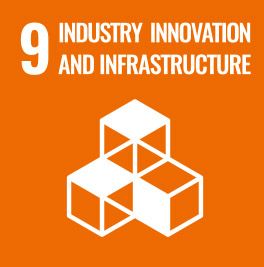
Associate Professor Sheng-Fu Liang, Associate Chair of the Department of Computer Science and Information Engineering at NCKU, delivered a speech at the exhibition.
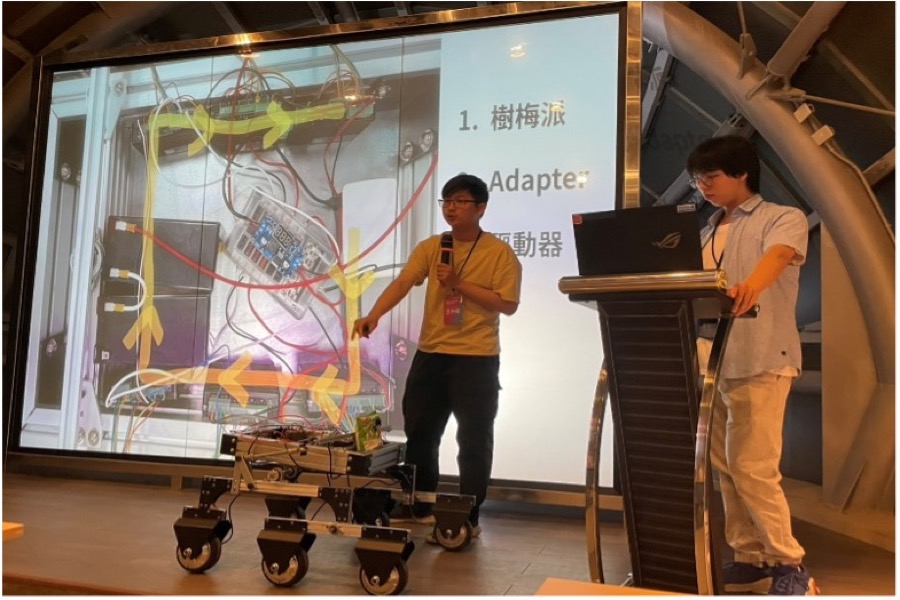
The first-place project in the exhibition was the “Mars Rover” work.
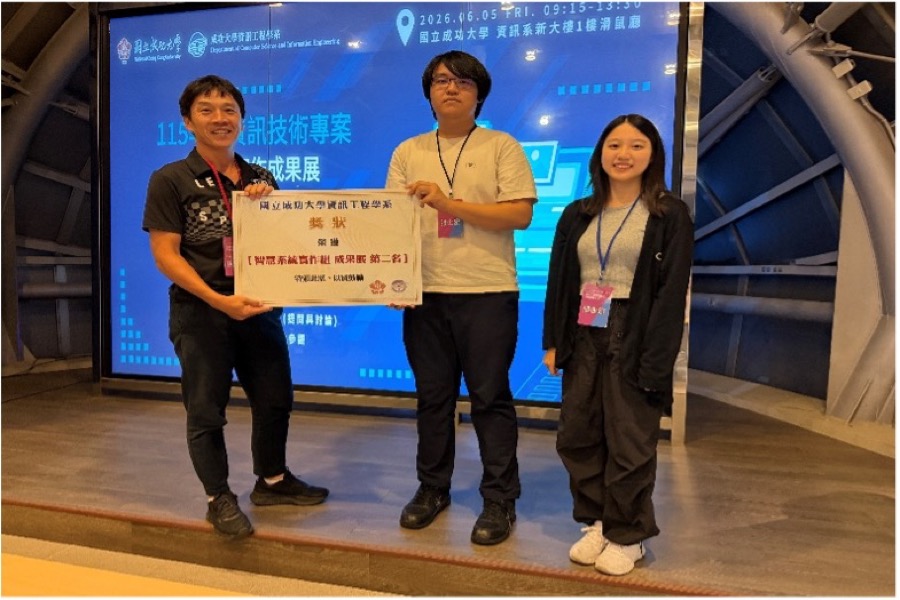
The second-place winning team was the “Novatek NT98690 ROS2 Applications” team.