




SDG12
NCKU Architecture Steps onto European Stage: Prof. Liou’s Keynote Leads to 2 Transnational Collaborations
By C-Cube Lab, Department of Architecture, NCKU
On June 25, Prof. Shuenn-Ren Liou of the Department of Architecture at National Cheng Kung University (NCKU) was invited to the M Museum in Leuven, Belgium, to deliver a keynote speech at the "2026 Belgium–Taiwan Social Sciences and Humanities Research Days." He shared research outcomes on the marine circular economy and intertidal ecological restoration in Penghu. Prof. Chia-Han Yang, Director of the Institute of Creative Industries Design at NCKU, also attended the event. The presentation received enthusiastic responses from European scholars present and further facilitated two concrete collaborations, including a planned visit to Taiwan next year by the Faculty of Architecture at Université libre de Bruxelles to sign a Memorandum of Understanding (MOU), as well as plans by the Faculty of Architecture at KU Leuven to co-host a summer workshop in Penghu with Prof. Shuenn-Ren Liou’s laboratory (C-Cube Lab) at NCKU, opening new opportunities for international cooperation for the NCKU Department of Architecture.
Co-organized by the Science and Technology Division of the Taipei Representative Office in the EU and Belgium, the Centre for R&D Monitoring (ECOOM) at KU Leuven, and the Science and Technology Policy Research and Information Center (STPI) of the National Applied Research Laboratories, the event opened on June 25 at the M Museum in Leuven and moved to UCLouvain on June 26 for further exchanges. Attracting over a hundred top Taiwanese and European scholars, it was the first Taiwan Research Day in nearly three years centered on social sciences and humanities. Distinguished guests including Mayor of Leuven Mohamed Ridouani, Ambassador Jhy-Wey Shieh of the Taipei Representative Office in the EU and Belgium, and Vice-Rector Prof. Dirk Hermans of KU Leuven attended the opening to deliver speeches, affirming the extension of Taiwan's research capabilities from hard technologies such as semiconductors and quantum computing to soft power demonstrations in social governance and cultural dimensions.
During the highly anticipated keynote presentation titled "Architecture and Economy in Circular Economy and Sustainable Development," Prof. Shuenn-Ren Liou shared how Penghu transforms locally discarded oyster shells and coral rubble (rubble of dead coral reefs) into low-carbon circular building materials. Applying biomimetic design, the team developed the "Coral Rubble 3D Ecological Reef," which not only provides habitats for corals and fish schools, but also integrates architectural design to develop public space systems, realizing community regeneration.
Following the presentation, Ambassador Jhy-Wey Shieh of the Taipei Representative Office in the EU and Belgium specifically expressed his deep moving sentiment to Prof. Shuenn-Ren Liou, sharing his personal family connection with Penghu. His grandmother came from Qimei Island in Penghu and later moved to Cijin, Kaohsiung. This memory made listening to the research sharing on the intertidal zone and circular economy exceptionally resonant for him. On site, professors from the Faculty of Architecture at KU Leuven and the Faculty of Architecture at Université libre de Bruxelles immediately expressed their willingness to deepen cooperation. Multiple attending Taiwanese and foreign scholars also openly stated that they were deeply impressed by the research outcomes, expressing pleasant surprise that Taiwan could produce such splendid and meticulous practical achievements in the field of sustainable architecture.
The research achievements that stepped onto the international stage this time originated from the long-standing design teaching tradition of the NCKU Department of Architecture rooted in Taiwan's offshore islands. As early as 2020, Prof. Tay-Sheng Jeng of the NCKU Department of Architecture led an inter-college team to execute the master plan for the transformation and regeneration of Matsu's battlefield heritage, while Prof. Shuenn-Ren Liou simultaneously launched research on Penghu's circular sustainable revitalization. Both professors independently explored highly challenging and experimental integrated design topics of contemporary relevance. To bring real-world sites into design course practice and enhance students' operational capabilities in micro and macro sustainable design, the Master's program of the NCKU Department of Architecture has, since 2021, used "Island 2030: Global Issues, Local Matters" as the theme in its M.Arch II design courses. Integrating the two sites of Matsu and Penghu, the program leads students to rethink the imaginations and visions for the islands' next decade: the Matsu site featured "Gazing Fortress Matsu" as its theme to conduct spatial renovation and curating for military strongholds; while Penghu featured "Regional Revitalization and Circular Economy" as its theme to respond to local living wisdom and develop sustainable circular industries, gradually accumulating island-based design discourses.
In the past two years, Prof. Shuenn-Ren Liou's team further received technology project subsidies from the Ocean Affairs Council, collaborating with the Penghu Fisheries Research Center under the Ministry of Agriculture's Fisheries Research Institute and industry partners Techome (Lotos) and Coraal. They brought the design theories accumulated in the classroom into practical implementation in the intertidal zone of Penghu, developing the "Coral Rubble 3D Ecological Reef" and "Penghu Settlement Public Space" systems. These became the key research outcomes that stood on the European academic stage and received high acclaim from the international academic community.
This Research Day was not only an academic exchange, but also opened concrete opportunities for international cooperation for the NCKU Department of Architecture. The Faculty of Architecture at Université libre de Bruxelles is expected to visit NCKU next year, where both sides will negotiate and sign an MOU to establish a long-term exchange mechanism; meanwhile, the Faculty of Architecture at KU Leuven plans to collaborate with Prof. Shuenn-Ren Liou’s laboratory (C-Cube Lab) at NCKU next year to co-host a summer workshop in Penghu, allowing European students to participate on-site in Penghu's circular economy and ecological restoration practices.
Prof. Shuenn-Ren Liou stated that this presentation made him deeply feel the high interest and recognition from European academia regarding Taiwan's island sustainability practices. He looks forward to facilitating mutual exchanges between the island design research accumulated over many years by the NCKU Department of Architecture and the energy of top European universities through the subsequent MOU signing and summer workshop.
On June 25, Prof. Shuenn-Ren Liou of the Department of Architecture at National Cheng Kung University (NCKU) was invited to the M Museum in Leuven, Belgium, to deliver a keynote speech at the "2026 Belgium–Taiwan Social Sciences and Humanities Research Days." He shared research outcomes on the marine circular economy and intertidal ecological restoration in Penghu. Prof. Chia-Han Yang, Director of the Institute of Creative Industries Design at NCKU, also attended the event. The presentation received enthusiastic responses from European scholars present and further facilitated two concrete collaborations, including a planned visit to Taiwan next year by the Faculty of Architecture at Université libre de Bruxelles to sign a Memorandum of Understanding (MOU), as well as plans by the Faculty of Architecture at KU Leuven to co-host a summer workshop in Penghu with Prof. Shuenn-Ren Liou’s laboratory (C-Cube Lab) at NCKU, opening new opportunities for international cooperation for the NCKU Department of Architecture.
Co-organized by the Science and Technology Division of the Taipei Representative Office in the EU and Belgium, the Centre for R&D Monitoring (ECOOM) at KU Leuven, and the Science and Technology Policy Research and Information Center (STPI) of the National Applied Research Laboratories, the event opened on June 25 at the M Museum in Leuven and moved to UCLouvain on June 26 for further exchanges. Attracting over a hundred top Taiwanese and European scholars, it was the first Taiwan Research Day in nearly three years centered on social sciences and humanities. Distinguished guests including Mayor of Leuven Mohamed Ridouani, Ambassador Jhy-Wey Shieh of the Taipei Representative Office in the EU and Belgium, and Vice-Rector Prof. Dirk Hermans of KU Leuven attended the opening to deliver speeches, affirming the extension of Taiwan's research capabilities from hard technologies such as semiconductors and quantum computing to soft power demonstrations in social governance and cultural dimensions.
During the highly anticipated keynote presentation titled "Architecture and Economy in Circular Economy and Sustainable Development," Prof. Shuenn-Ren Liou shared how Penghu transforms locally discarded oyster shells and coral rubble (rubble of dead coral reefs) into low-carbon circular building materials. Applying biomimetic design, the team developed the "Coral Rubble 3D Ecological Reef," which not only provides habitats for corals and fish schools, but also integrates architectural design to develop public space systems, realizing community regeneration.
Following the presentation, Ambassador Jhy-Wey Shieh of the Taipei Representative Office in the EU and Belgium specifically expressed his deep moving sentiment to Prof. Shuenn-Ren Liou, sharing his personal family connection with Penghu. His grandmother came from Qimei Island in Penghu and later moved to Cijin, Kaohsiung. This memory made listening to the research sharing on the intertidal zone and circular economy exceptionally resonant for him. On site, professors from the Faculty of Architecture at KU Leuven and the Faculty of Architecture at Université libre de Bruxelles immediately expressed their willingness to deepen cooperation. Multiple attending Taiwanese and foreign scholars also openly stated that they were deeply impressed by the research outcomes, expressing pleasant surprise that Taiwan could produce such splendid and meticulous practical achievements in the field of sustainable architecture.
The research achievements that stepped onto the international stage this time originated from the long-standing design teaching tradition of the NCKU Department of Architecture rooted in Taiwan's offshore islands. As early as 2020, Prof. Tay-Sheng Jeng of the NCKU Department of Architecture led an inter-college team to execute the master plan for the transformation and regeneration of Matsu's battlefield heritage, while Prof. Shuenn-Ren Liou simultaneously launched research on Penghu's circular sustainable revitalization. Both professors independently explored highly challenging and experimental integrated design topics of contemporary relevance. To bring real-world sites into design course practice and enhance students' operational capabilities in micro and macro sustainable design, the Master's program of the NCKU Department of Architecture has, since 2021, used "Island 2030: Global Issues, Local Matters" as the theme in its M.Arch II design courses. Integrating the two sites of Matsu and Penghu, the program leads students to rethink the imaginations and visions for the islands' next decade: the Matsu site featured "Gazing Fortress Matsu" as its theme to conduct spatial renovation and curating for military strongholds; while Penghu featured "Regional Revitalization and Circular Economy" as its theme to respond to local living wisdom and develop sustainable circular industries, gradually accumulating island-based design discourses.
In the past two years, Prof. Shuenn-Ren Liou's team further received technology project subsidies from the Ocean Affairs Council, collaborating with the Penghu Fisheries Research Center under the Ministry of Agriculture's Fisheries Research Institute and industry partners Techome (Lotos) and Coraal. They brought the design theories accumulated in the classroom into practical implementation in the intertidal zone of Penghu, developing the "Coral Rubble 3D Ecological Reef" and "Penghu Settlement Public Space" systems. These became the key research outcomes that stood on the European academic stage and received high acclaim from the international academic community.
This Research Day was not only an academic exchange, but also opened concrete opportunities for international cooperation for the NCKU Department of Architecture. The Faculty of Architecture at Université libre de Bruxelles is expected to visit NCKU next year, where both sides will negotiate and sign an MOU to establish a long-term exchange mechanism; meanwhile, the Faculty of Architecture at KU Leuven plans to collaborate with Prof. Shuenn-Ren Liou’s laboratory (C-Cube Lab) at NCKU next year to co-host a summer workshop in Penghu, allowing European students to participate on-site in Penghu's circular economy and ecological restoration practices.
Prof. Shuenn-Ren Liou stated that this presentation made him deeply feel the high interest and recognition from European academia regarding Taiwan's island sustainability practices. He looks forward to facilitating mutual exchanges between the island design research accumulated over many years by the NCKU Department of Architecture and the energy of top European universities through the subsequent MOU signing and summer workshop.
Prof. Shuenn-Ren Liou of the NCKU Department of Architecture gave a keynote speech on the European academic stage, facilitating transnational collaborations.
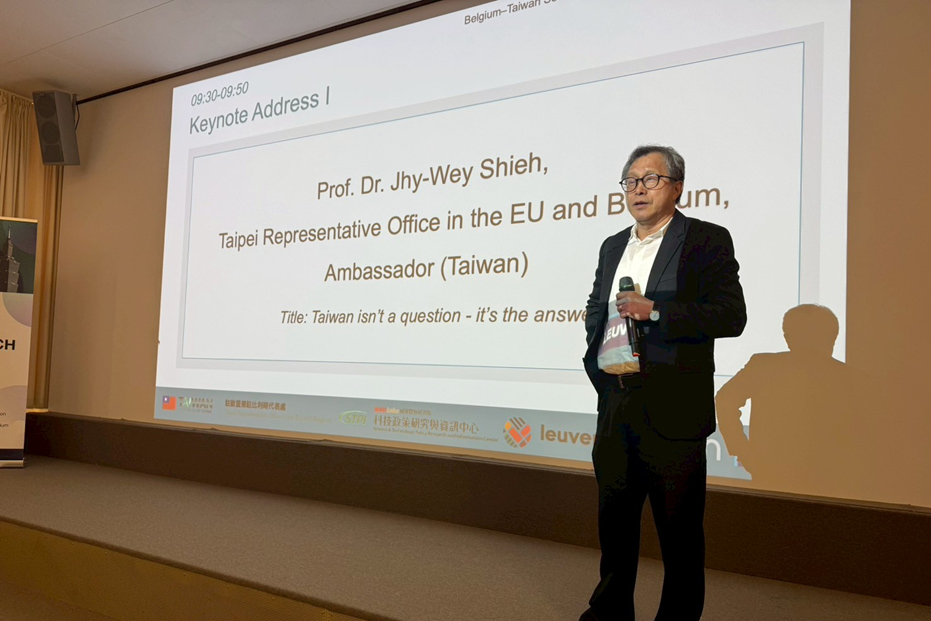
Ambassador Jhy-Wey Shieh of the Taipei Representative Office in the EU and Belgium.
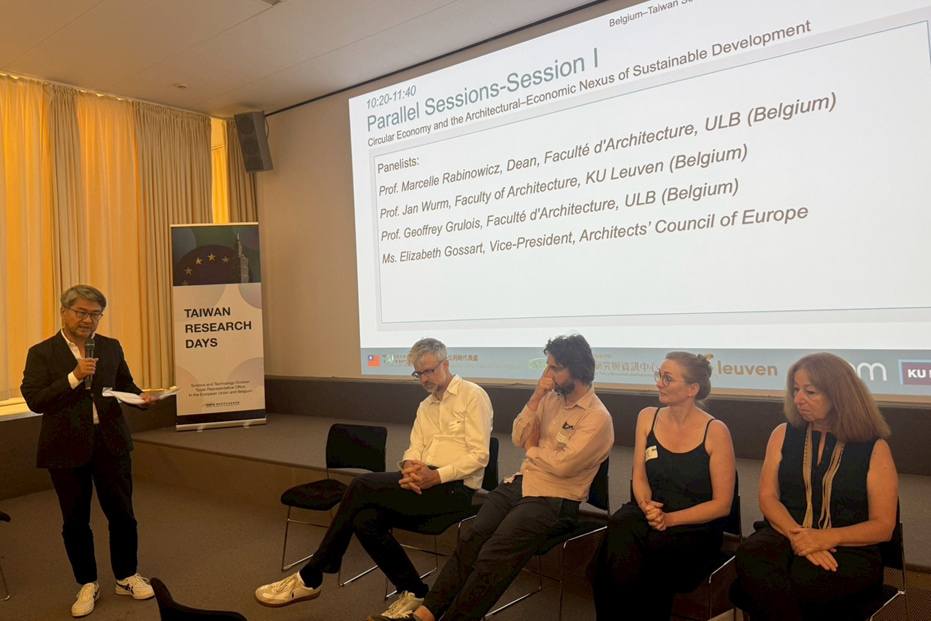
Prof. Shuenn-Ren Liou hosted the "Circular Economy and Sustainable Development Forum."