



SDG12
NCKU Architecture Student Work Forest of Drifting Lights Wins Gold at the 2025 Sustainable Lighting Creative Exhibition

Graduate students Juei-Rui Baarieweng (珇睿.巴阿里甕) and Cheng-Yun Yeh (葉承昀) from the Graduate Institute of Architecture at National Cheng Kung University (NCKU) created Forest of Floating Light (漂光之森), a work crafted from driftwood using low-carbon, recycled techniques that explores the coexistence of natural materials and digital craftsmanship. The installation competed in the “2025 Sustainable Lighting Creative Exhibition (2025 永續光環境創意展),” hosted by the Chung Yuan Cultural And Creative Park under the Taoyuan City Cultural Affairs Bureau, and emerged as the Gold Award winner among more than a hundred works nationwide.
The exhibition aims to encourage the development and application of sustainable materials, showcasing sustainability awareness and creative design. Guided by the theme “Sustainability · Innovation · Experimentation,” the competition for lighting art installations is now in its second edition (2025). It seeks to inspire young and diverse creative teams, discover outstanding artists, and promote Taiwan’s potential for sustainable material development and the flourishing of everyday aesthetics.
The design concept of Forest of Floating Light begins with “the regenerative journey of driftwood,” resulting in a closed-loop structure composed entirely of driftwood, allowing form and the concept of circulation to mutually reinforce each other. The creative process integrates natural materials with digital fabrication technologies, using digital craftsmanship as a tool to illustrate the cycle of regeneration. Nearly discarded driftwood is reintroduced into the urban environment as a low-carbon construction material. The project challenges the over-standardization of materials in architecture and art, prompting a rethinking of the inherent value of natural materials.
To realize this concept, the production strategy adhered to a “minimal processing” principle, applying mechanical arm processing only at necessary points such as joint connections, while allowing the driftwood’s natural form to guide other sections. This process involved three key technologies: 3D scanning and modeling, digital twin simulation, and digital fabrication. 3D scanning and modeling established the digital identity of each non-standard driftwood piece through point cloud data, capturing its unique external shape. The digital database was then used to sample and match pieces capable of forming a closed-loop structure, simulating the interlocking relationships at the joints. Finally, the mechanical arm executed precise multi-dimensional machining at the joint areas under the guidance of the digital twin model, enabling the driftwood pieces to interlock and form the desired looped structure.
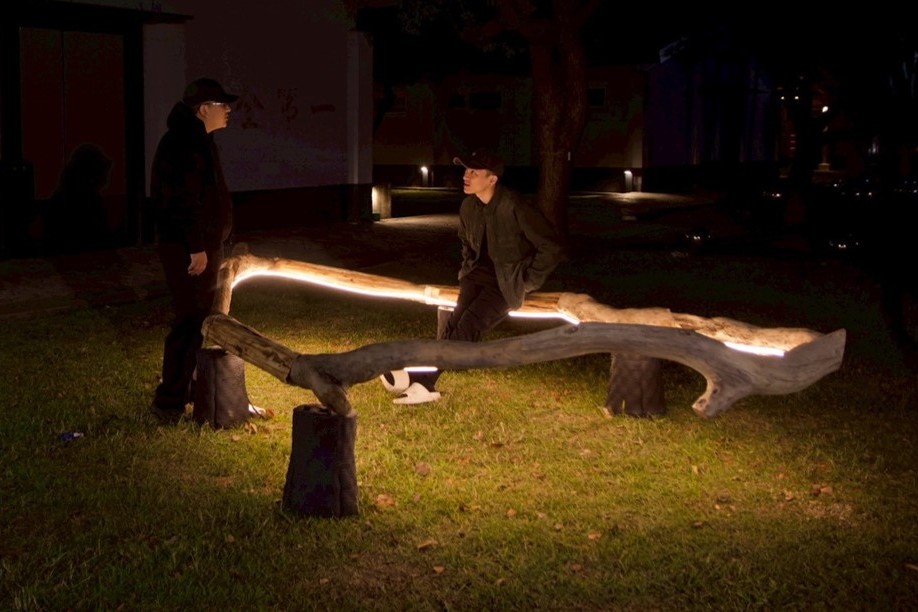
The most striking effect of Forest of Floating Light appears at night when the lights illuminate the driftwood. The light extends along the wooden forms, revealing the previously hidden material and creating an ambiguous state between natural object and luminous presence. The illumination not only highlights the material but also reshapes the perceptual relationship between humans and the environment, allowing viewers to experience layered spatial relationships through movement and stillness.
Supporting the forest is a black 3D-printed cement base, whose surface resembles rippling water during the day, evoking the imagery of drift and flow. At night, the dark base recedes visually, emphasizing the contrast between light and wood, making the installation appear to hover above the landscape in a stable yet floating state. By integrating natural materials, digital fabrication, and light, Forest of Floating Light presents a vision of sustainability based on coexistence rather than opposition.
When presenting their concept, Juei-Rui Baarieweng and Cheng-Yun Yeh emphasized that Forest of Floating Light does not aim for dramatic formal expression. Instead, they sought to let the material’s journey, the intervention of light, and the restrained use of fabrication techniques create an installation that can be perceived, lingered with, and reflected upon. Their advisor, Professor Yang-Ting Shen, noted that beyond its artistic value, the work demonstrates how low-carbon digital craftsmanship can pave a near-zero-loop path for integrating natural materials into living environments and even architectural design, showcasing a sustainable approach where humans and nature coexist through technological art.
The exhibition aims to encourage the development and application of sustainable materials, showcasing sustainability awareness and creative design. Guided by the theme “Sustainability · Innovation · Experimentation,” the competition for lighting art installations is now in its second edition (2025). It seeks to inspire young and diverse creative teams, discover outstanding artists, and promote Taiwan’s potential for sustainable material development and the flourishing of everyday aesthetics.
The design concept of Forest of Floating Light begins with “the regenerative journey of driftwood,” resulting in a closed-loop structure composed entirely of driftwood, allowing form and the concept of circulation to mutually reinforce each other. The creative process integrates natural materials with digital fabrication technologies, using digital craftsmanship as a tool to illustrate the cycle of regeneration. Nearly discarded driftwood is reintroduced into the urban environment as a low-carbon construction material. The project challenges the over-standardization of materials in architecture and art, prompting a rethinking of the inherent value of natural materials.
To realize this concept, the production strategy adhered to a “minimal processing” principle, applying mechanical arm processing only at necessary points such as joint connections, while allowing the driftwood’s natural form to guide other sections. This process involved three key technologies: 3D scanning and modeling, digital twin simulation, and digital fabrication. 3D scanning and modeling established the digital identity of each non-standard driftwood piece through point cloud data, capturing its unique external shape. The digital database was then used to sample and match pieces capable of forming a closed-loop structure, simulating the interlocking relationships at the joints. Finally, the mechanical arm executed precise multi-dimensional machining at the joint areas under the guidance of the digital twin model, enabling the driftwood pieces to interlock and form the desired looped structure.
The most striking effect of Forest of Floating Light appears at night when the lights illuminate the driftwood. The light extends along the wooden forms, revealing the previously hidden material and creating an ambiguous state between natural object and luminous presence. The illumination not only highlights the material but also reshapes the perceptual relationship between humans and the environment, allowing viewers to experience layered spatial relationships through movement and stillness.
Supporting the forest is a black 3D-printed cement base, whose surface resembles rippling water during the day, evoking the imagery of drift and flow. At night, the dark base recedes visually, emphasizing the contrast between light and wood, making the installation appear to hover above the landscape in a stable yet floating state. By integrating natural materials, digital fabrication, and light, Forest of Floating Light presents a vision of sustainability based on coexistence rather than opposition.
When presenting their concept, Juei-Rui Baarieweng and Cheng-Yun Yeh emphasized that Forest of Floating Light does not aim for dramatic formal expression. Instead, they sought to let the material’s journey, the intervention of light, and the restrained use of fabrication techniques create an installation that can be perceived, lingered with, and reflected upon. Their advisor, Professor Yang-Ting Shen, noted that beyond its artistic value, the work demonstrates how low-carbon digital craftsmanship can pave a near-zero-loop path for integrating natural materials into living environments and even architectural design, showcasing a sustainable approach where humans and nature coexist through technological art.

The collaborative work Forest of Floating Light by Juei-Rui Baarieweng (left) and Cheng-Yun Yeh (right) won the Gold Award at the 2025 Sustainable Lighting Creative Exhibition.
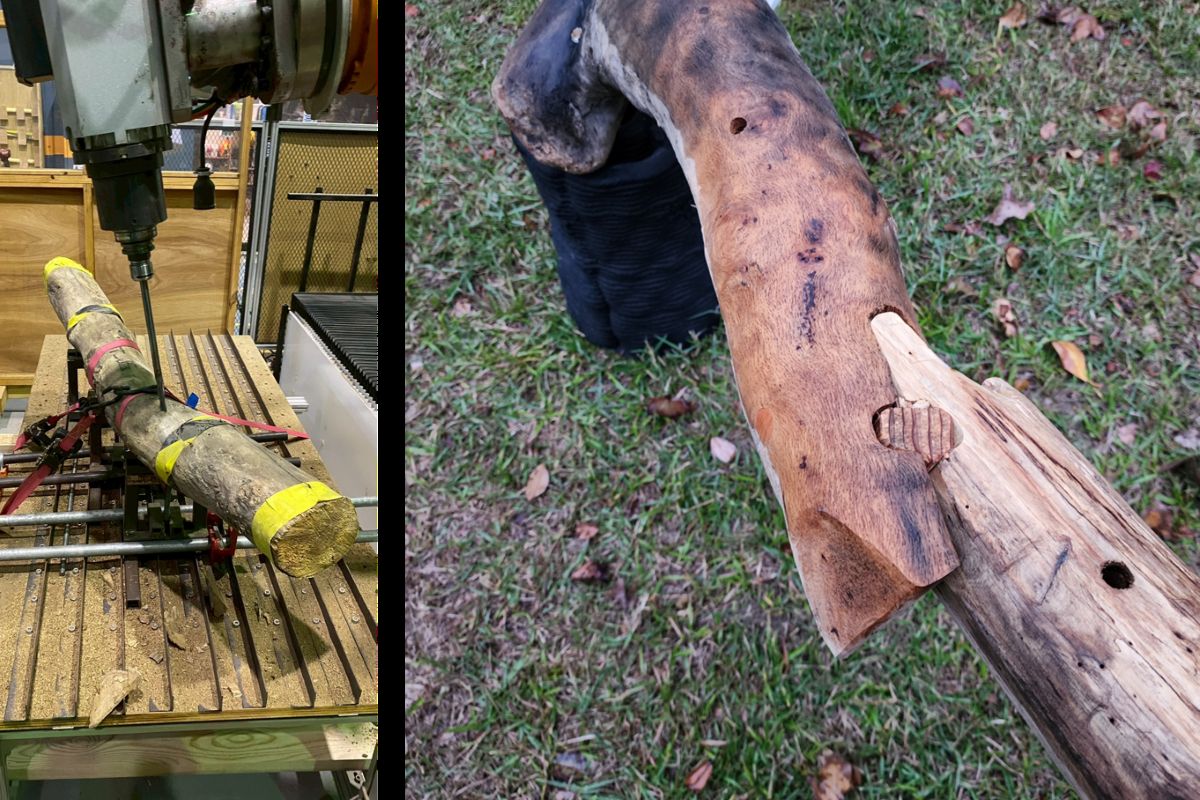
Using the multi-dimensional machining capabilities of a robotic arm, precise processing was performed at the joints under the guidance of the digital twin model, enabling the pieces to interlock and form the desired looped structure.
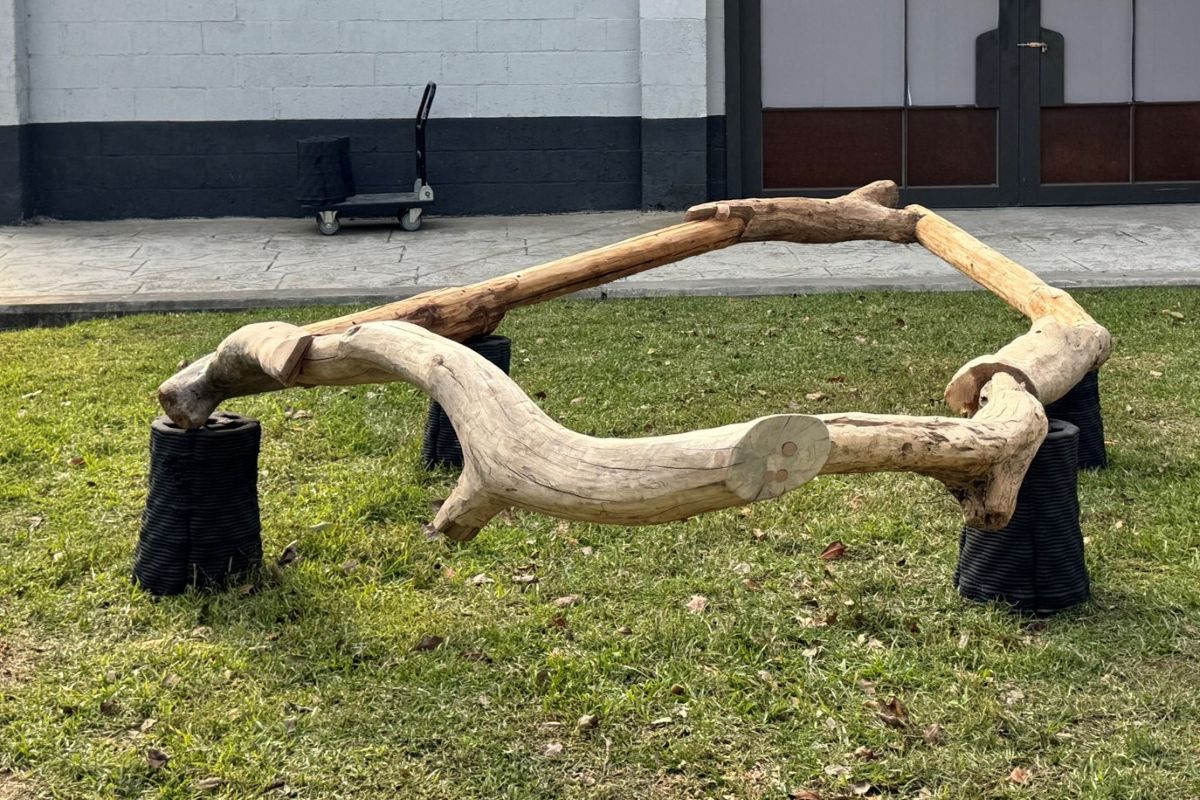
The design concept of Forest of Floating Light originates from “the regenerative journey of driftwood,” resulting in a closed-loop structure composed entirely of driftwood.
The Floating Imagery of Forest of Floating Light at Night
![[Phoenix Lecture] Academician Yuan-Tseh Lee Visits NCKU to Discuss "New Development Models for Human Sustainable Existence"](/userfiles/images/20240612032058268.jpg)
SDG12[Phoenix Lecture] Academician Yuan-Tseh Lee Visits NCKU to Discuss "New Development Models for Human Sustainable Existence"
View more
SDG12The series finale, "Decoding Carbon Credits," explored carbon trading and corporate responsibility.
View more