

SDG3
NCKU Symposium Explores Hospice Care, Medical Ethics, and Sinology: From Clinical Practice to Zhuangzi’s Wisdom
To promote interdisciplinary exchange between the medical humanities and Sinology, the Center for Sinology Research and Development at National Cheng Kung University (NCKU) and the Tainan City Chih-Shan Education Foundation co-hosted a symposium titled "Hospice and Palliative Care, Medical Ethics, and Sinological Humanities." The event featured a dialogue among three distinguished speakers: Dr. Jui-Hung Tsai, Director of the Hospice Palliative Combined Care Center at NCKU Hospital; Dr. Hsiao-Fan Yeh, Assistant Professor in the Department of Medical Humanities and Social Sciences at Chang Gung University; and Dr. Kang-Ning Chen, Associate Professor in the Department of Chinese Literature at NCKU. Together, they explored the medical humanities from the three perspectives of medicine, philosophy, and Sinology. In addition to students from the College of Liberal Arts, students from the College of Medicine and the College of Engineering also attended. Department of Chinese Literature Chair Wei-Hung Yen and Professor Su-Chuan Lin were also present, contributing to an enthusiastic response from faculty and students across colleges.
Held on the morning of October 6, 2026, at the International Conference Hall of NCKU’s College of Liberal Arts, the symposium focused on palliative care, patient autonomy, and end-of-life companionship, guiding the audience back to Sinology’s fundamental concern with "birth, aging, illness, and death." Through the Daoist concepts of "all things are equal without distinction of high or low" (wu wu gui jian) and the "piping of Heaven" (tian lai), the discussion reflected on how physicians and family members can let go of preconceptions and truly listen to others when facing the end of life, accompanying patients with profound respect through their final journey to restore ultimate dignity and fulfillment.
Speaking on "The True Meaning of Hospice Care," Director Jui-Hung Tsai discussed the founding and philosophy of NCKU’s "Yuan-En Ward," explaining that medical practice is about forming connections with all sentient beings and that patients are also teachers to physicians. Director Tsai emphasized that palliative care is by no means giving up treatment or hastening death; rather, it adheres to the principles of "neither deliberately prolonging life nor deliberately shortening the course of illness" and "relieving suffering while upholding dignity." Drawing on the clinical experience of a patient named Ms. Yi-Hui, from inpatient palliative care to home care, the NCKU medical team demonstrated the essence of alleviating pain and preserving life's dignity, thereby fostering strong bonds among physicians, patients, and families.
Assistant Professor Hsiao-Fan Yeh shared her teaching experiences regarding the design and practice of medical humanities courses. In her "Thanatology" (Life and Death Studies) course, she invites palliative care specialists, anatomy instructors, and humanities scholars to explore holistic physical, mental, and spiritual comfort at the end of life and the art of listening to patients' needs. Breaking away from traditional formats, she eliminated final exams and written reports, having students instead write and perform clinical ethics plays that realistically simulate medical scenarios—even tackling cutting-edge ethical dilemmas such as "AI digital twins." Professor Yeh stressed that medicine is not merely a natural science, but a "practical science centered on the ethics of care." The essence of humanities education is not to provide standard answers, but to cultivate listening, negotiation, and empathy, with the ultimate goal of making patients genuinely feel, "I am so glad it was you I met at that moment."
Associate Professor Kang-Ning Chen delved into the essence of end-of-life care through the philosophy of Zhuangzi. Citing the allegory of Shentu Jia and Zichan from the "Signs of Virtue Complete" (De Chong Fu) chapter, Professor Chen pointed out that conventional social norms often view others through rigid classifications and aesthetic standards, imposing expectations that inflict a form of violence upon them. Drawing on Zhuangzi’s philosophy that "from the perspective of the Dao, things have no nobility or baseness" and the "piping of Heaven" ("blowing on ten thousand things differently so that each becomes itself"), he emphasized respecting the diversity of life rather than defining others by a single standard. Furthermore, incorporating the "Mei-Yun case" studied by Professor Der-Heuy Yu’s research team, Professor Chen explained that accompanying the dying requires practicing Zhuangzi’s "ethics of the other"—letting go of subjective biases and keenly sensing the patient’s context, circumstances, and shifting relationships to respond in a way close to their heart, thereby achieving the highest state of "synchronous companionship."
During the concluding panel discussion, the three scholars engaged in a vibrant exchange with the students. Director Tsai compared medical ethics courses to seeds that gradually sprout in a physician's heart when confronting life-and-death dilemmas in practice, noting that palliative care has no "one-size-fits-all SOP" and requires healthcare professionals to listen attentively to the voice of every unique life. Professor Yeh added that while clinical fundamentals and SOPs are indispensable, when faced with unexpected twists of fate, Zhuangzi’s concept of "fasting of the mind" (xin zhai) becomes crucial for returning to a clear, open state of awareness. Finally, Professor Chen concluded the dialogue with a quote from Laozi: "In the pursuit of learning, every day something is acquired; in the pursuit of the Dao, every day something is dropped." He underscored that end-of-life care often requires "dropping" excessive subjectivity and rigid frameworks, for only through "synchronous companionship" can one truly be present with a suffering life.
The medical humanities encourage medical students to direct their attention toward patients' cultural backgrounds, relational networks, and social contexts, emphasizing listening, empathy, and care—seeing not just the "disease," but the "person"—which resonates deeply with the ethical wisdom of the Sinological tradition. Hosted by the Center for Sinology Research and Development, this enriching symposium concluded successfully amidst a profound weaving of clinical practice, medical ethics, and Sinological wisdom.
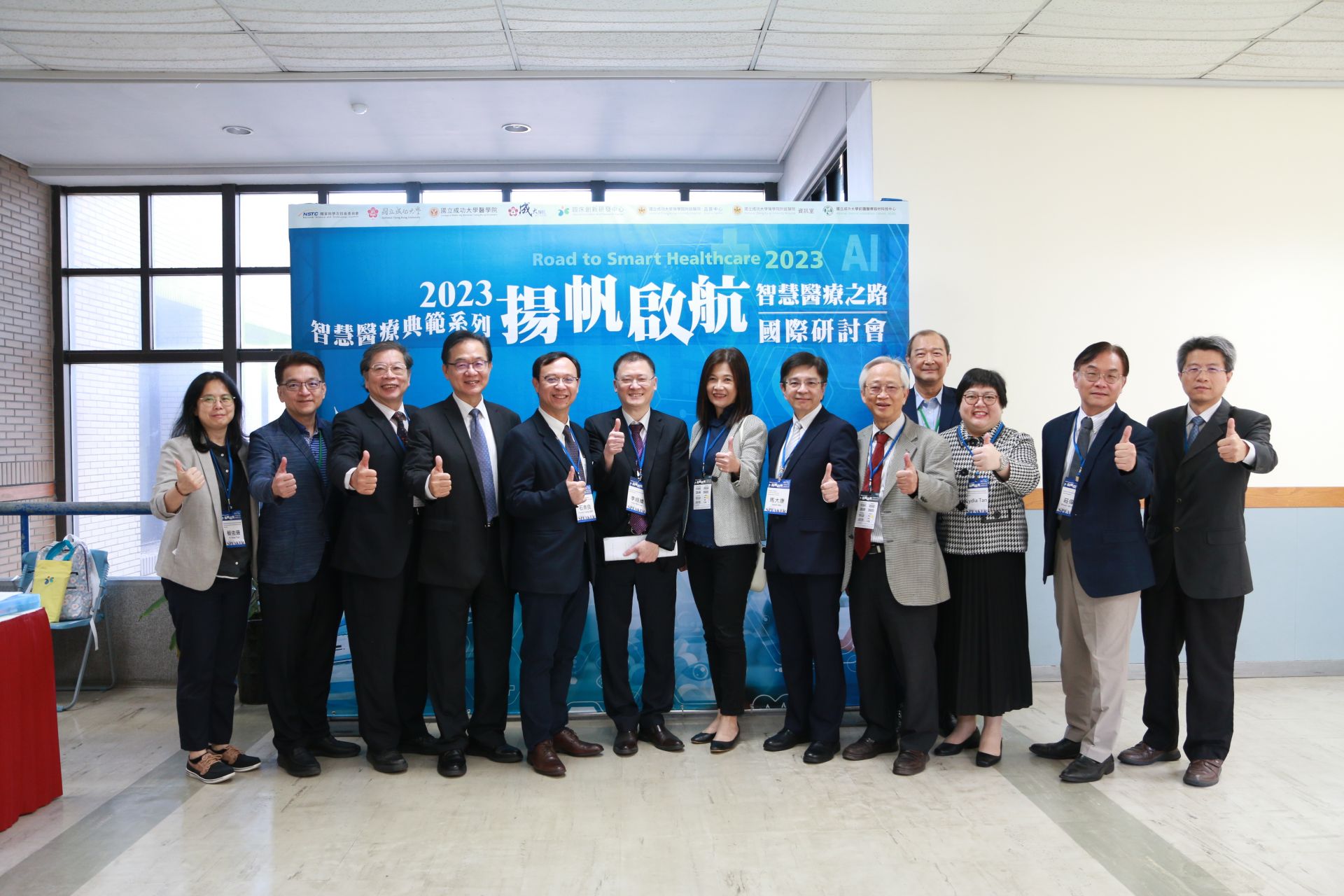
Group photo of Department Chair Wei-Hung Yen (front row, first from left), Assistant Professor Hsiao-Fan Yeh (front row, second from left), Director Jui-Hung Tsai (front row, third from left), Associate Professor Kang-Ning Chen (front row, fourth from left), and distinguished guests.