



SDG3
NCKU Geomatics Team Develops AI-Driven Real-Time Map of Non-Methane Hydrocarbons, Published in Top Journal

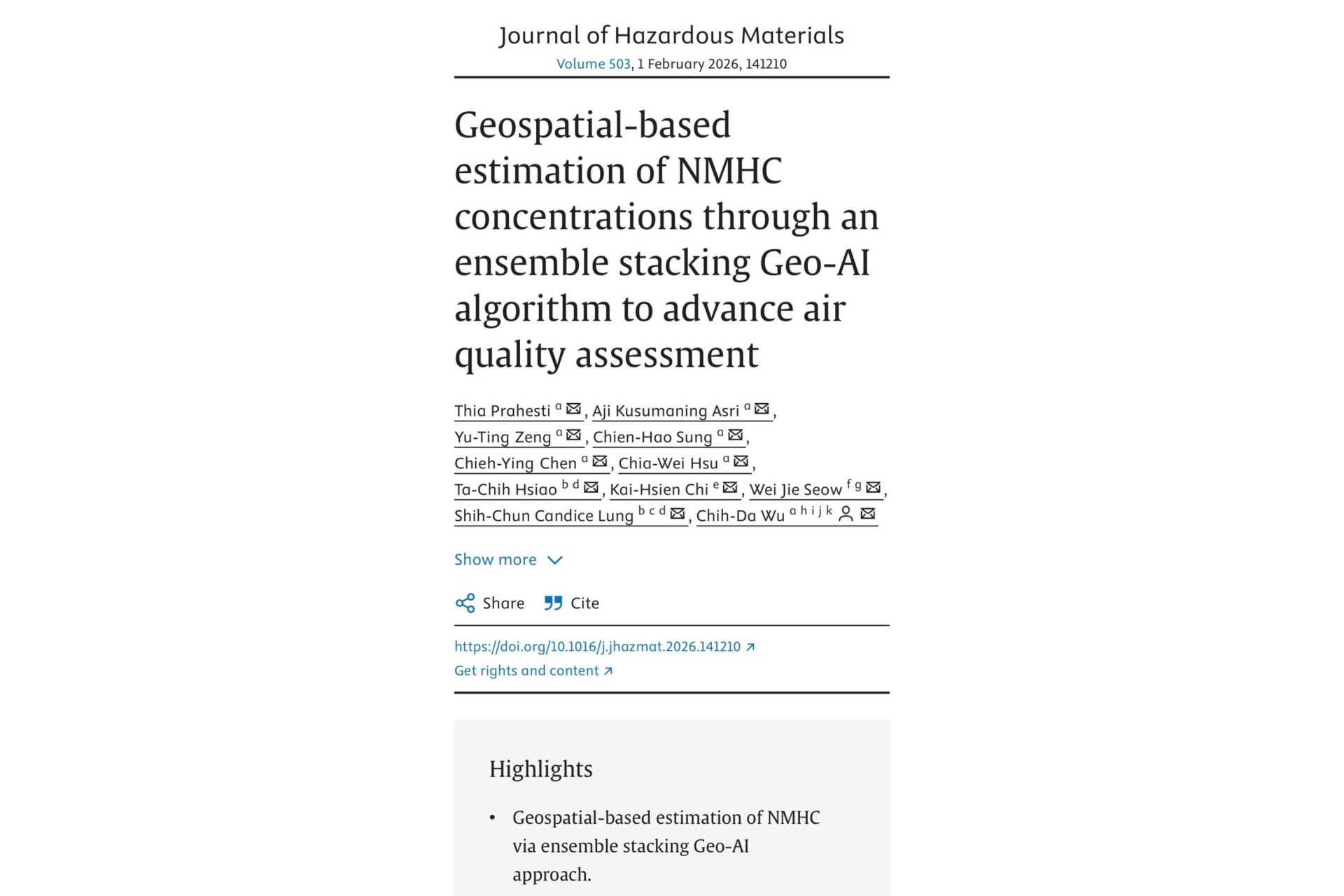
In recent years, the mass concentrations of suspended particulate matter in Taiwan have improved thanks to various control measures. However, ozone—an oxidizing air pollutant that can potentially harm the respiratory and cardiovascular systems—has not declined as expected. A cross-institutional, multidisciplinary team led by Professor Chih-Ta Wu (吳治達教授) from the Department of Geomatics and Geospatial Information at National Cheng Kung University (NCKU) successfully applied and integrated geospatial artificial intelligence (Geo-AI) and machine learning tools to construct spatial distributions of an important ozone precursor, Non-Methane Hydrocarbons (NMHCs). This research provides valuable reference data for government regulatory planning and has been published in the leading environmental journal Journal of Hazardous Materials under the title: Geospatial-based Estimation of NMHC Concentrations through an Ensemble Stacking Geo-AI Algorithm to Advance Air Quality Assessment.
The team explained that the study relied on monitoring data from across Taiwan between 2015 and 2021, provided by the Environmental Protection Administration. Regions with higher NMHC concentrations were primarily concentrated in metropolitan and densely populated areas, including Taipei, Hsinchu, Yilan, Tainan, and Kaohsiung. Notably, vegetation is also a natural source of NMHCs. As a result, areas with dense forests, such as the Central Mountain Range, also exhibited relatively high NMHC concentrations. Although vehicular traffic is lower in mountainous regions, the transport of nitrogen oxides (NOx) combined with NMHC emissions from forests under certain conditions may facilitate ozone formation. Nevertheless, ozone levels are determined by a complex interplay of factors, including the NMHC-to-NOx ratio and sunlight intensity.
Professor Wu noted that NMHCs are a key component of volatile organic compounds in the atmosphere and serve as critical precursors in the formation of ozone and secondary organic aerosols (SOA), which are an important component of fine particulate matter (PM2.5). Compared to a single gaseous pollutant, NMHCs represent a complex mixture of organic compounds with diverse sources and reaction pathways. Their spatial distribution is influenced by multiple factors, including traffic emissions, industrial activities, land use patterns, meteorological conditions, and atmospheric transport. Therefore, NMHCs play a central role not only in ozone formation but also in regional air quality management and the formulation of precursor control strategies.
Currently, the Environmental Protection Administration conducts partial monitoring and regulation of NMHCs. Among Taiwan’s 78 air quality monitoring stations, 34 track NMHC levels, but the coverage is still insufficient. Using the team’s research results, NMHC concentrations across Taiwan can be estimated based on existing monitoring data, achieving a spatial resolution of up to 20 meters in urban areas.
This study employed a high-resolution NMHC spatial estimation framework centered on Geo-AI and, for the first time, systematically applied ensemble stacking in NMHC geospatial modeling. By integrating the complementary strengths of multiple machine learning models, the approach more effectively captures the highly nonlinear behavior of NMHCs in terms of source composition and chemical reactions, while reducing potential bias from individual models.
Professor Wu’s team has long been constructing air pollution modules and participating in multiple research projects commissioned by the Environmental Protection Administration. Their results have been used as a basis for government air quality management, such as generating real-time ozone pollution maps across Taiwan. Using AI, the team has also identified previously undetected instances of open burning of agricultural waste and is currently collaborating with the Environmental Protection Administration to develop a “Walkable Air Quality Map” for the public.
The NCKU cross-institutional and multidisciplinary team includes experts from geospatial information, environmental engineering, environmental health, and public health. Members include Prof. Wu Chih-Ta, Indonesian master’s student Thia Prahesti and postdoctoral researcher Aji Kusumaning Asri from NCKU, Prof. Ta-Chih Hsiao (蕭大智教授) from NTU’s Department of Environmental Engineering, Prof. Kai-Hsien Ji (紀凱獻教授) from NYCU’s Institute of Environmental and Occupational Health, Assistant Prof. Wei Jie Seow from the National University of Singapore’s Saw Swee Hock School of Public Health, and Dr. Shih-Chun Long (龍世俊副主任), Deputy Director of Academia Sinica’s Research Center for Environmental Changes.
A cross-institutional and multidisciplinary team led by Professor Chih-Ta Wu from the Department of Geomatics and Geospatial Information at NCKU used geospatial artificial intelligence (Geo-AI) and machine learning tools to successfully map the detailed spatial distribution of an important ozone precursor, non-methane hydrocarbons (NMHCs). The results can serve as a reference for government regulatory planning and have been published in the leading international environmental journal Journal of Hazardous Materials.
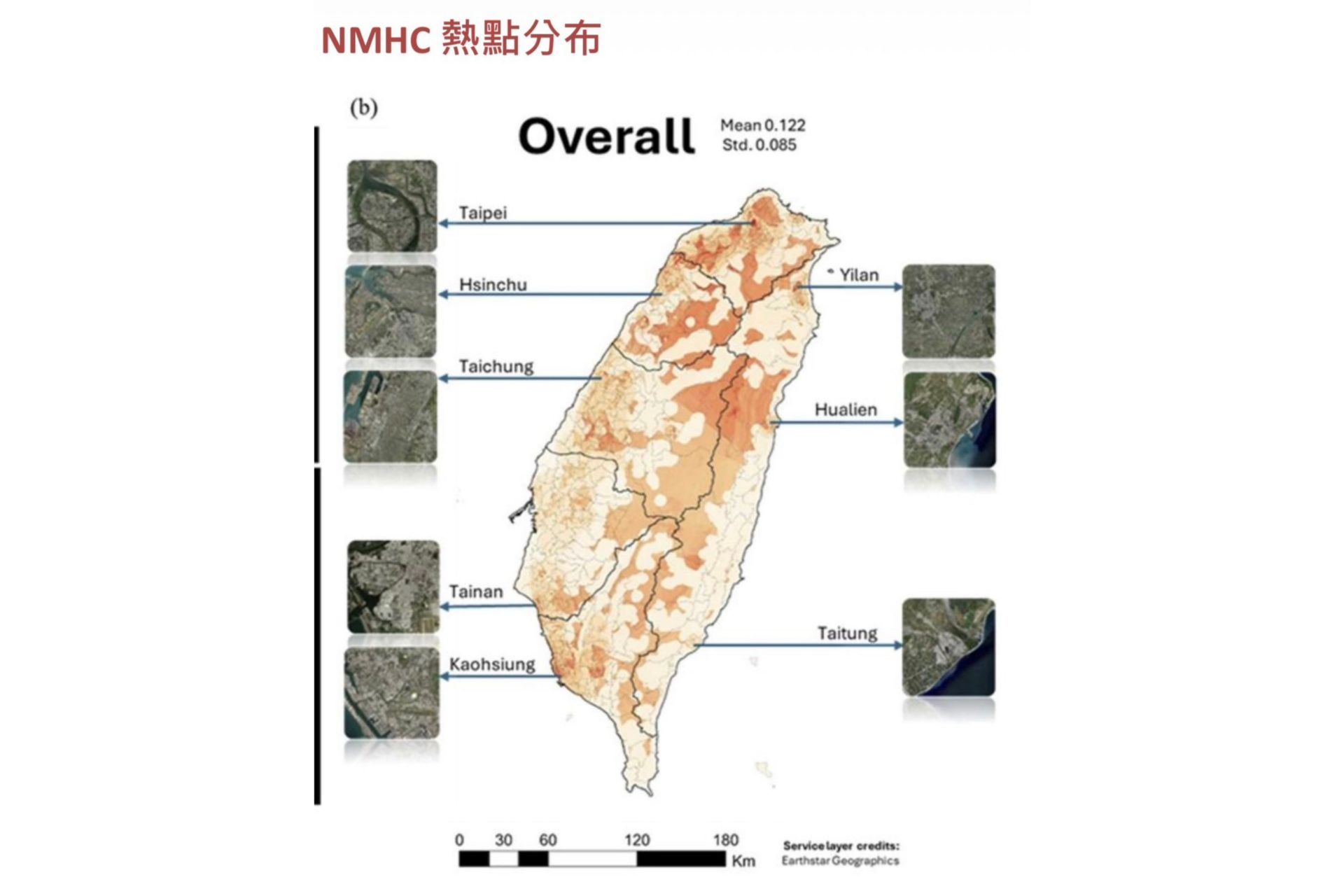
A cross-institutional and multidisciplinary team led by Professor Chih-Ta Wu from the Department of Geomatics and Geospatial Information at NCKU used geospatial artificial intelligence (Geo-AI) and machine learning tools to successfully map the detailed spatial distribution of an important ozone precursor, non-methane hydrocarbons (NMHCs). In the figure, the darker areas indicate regions with higher concentrations.
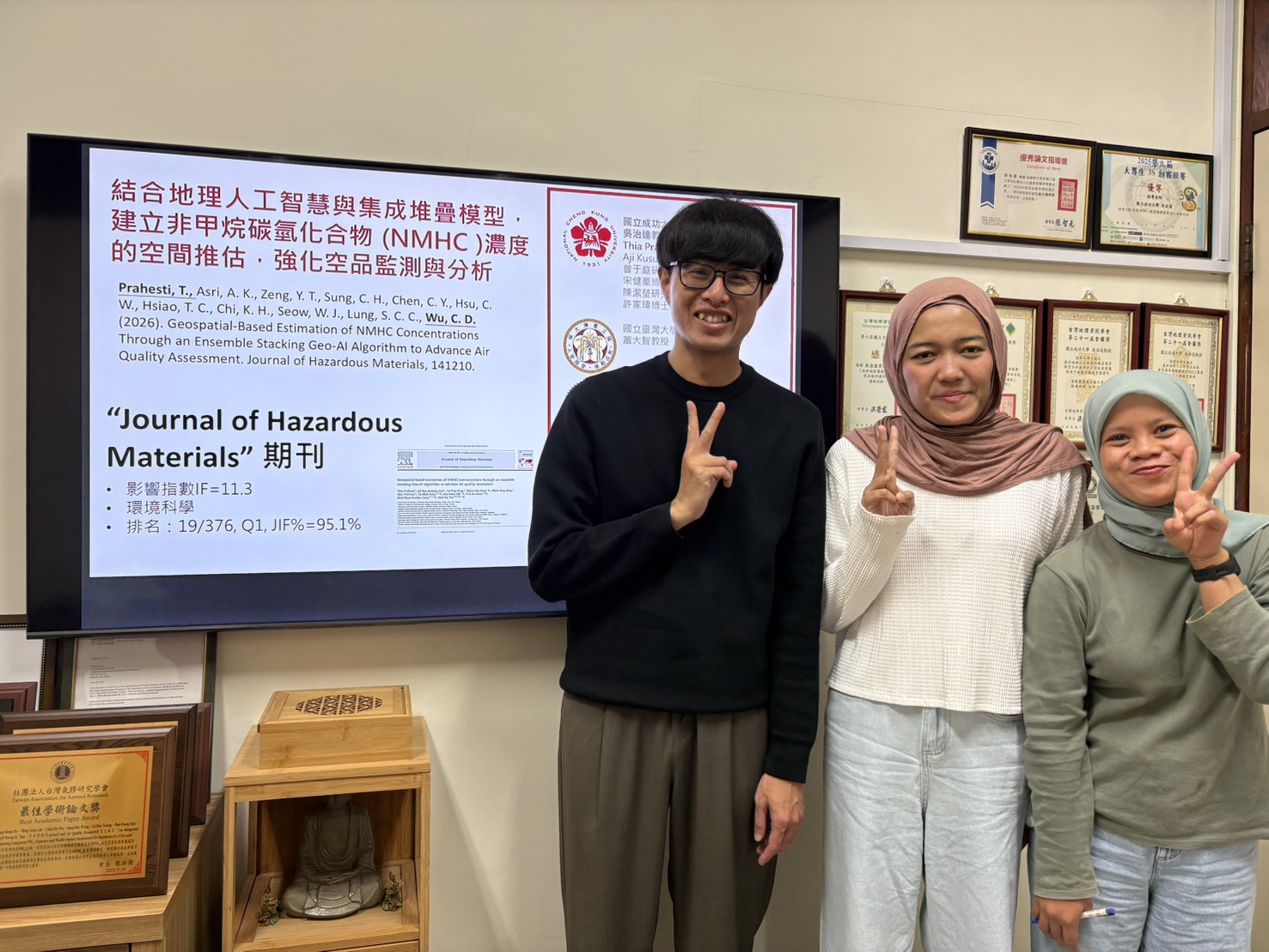
A cross-institutional and multidisciplinary team led by Professor Chih-Ta Wu from the Department of Geomatics and Geospatial Information at NCKU successfully applied and integrated geospatial artificial intelligence (Geo-AI) and machine learning tools to construct detailed spatial distributions of an important ozone precursor, non-methane hydrocarbons (NMHCs). Their findings have been published in a leading international environmental journal. In the photo (from left): Professor Chih-Ta Wu, NCKU Geomatics master’s student and lead author Thia Prahesti, and postdoctoral researcher Aji Kusumaning Asri.
SDG3Silver Sparks Innovation! NCKU × SUSS Launch Cross-Border Co-Creation Course to Inspire a New Generation of Senior Entrepreneurs
View more
SDG3NCKU Soccer Team Claims 5th Place in National Division I — Best Record in Team History with Sports Science Support
View more